

Veolia Environnement’s Profits Shrink as Communities Across the Globe Remunicipalize Water Contracts and Company Fails to Secure Long-Term Leases

Categories

Food

Water Justice Advocates Speak Out on Company’s Long Record of Service Failures 


Washington, D.C.—Despite revenues of $46.5 billion in 2010, Veolia Environnement, the world’s largest water and sewer service provider, suffered an 11 percent drop in its water division’s adjusted operating income from the previous year, finds analysis released today by the national consumer advocacy group Food & Water Watch. Veolia Environnement: A Profile of the World’s Largest Water Service Corporation shows how public backlash against Veolia’s attempts to dominate the water services market has undermined the company’s revenues.

Providing drinking water service to 95 million customers and wastewater service to 68 million in 66 countries, Veolia has struggled over recent years to maintain its profit levels and realize its privatization vision. From 2005 to 2009, the company’s new contracts with public authorities shrank in duration and scope—the major new deals it signed in 2009 were 97 percent less valuable than those it signed in 2005.

The company has directed over half of its growth activities over the next three years to expand its presence in Europe and Asia. Meanwhile, customers across the globe suffer water shortages, skyrocketing rates and irregular billing practices under Veolia Environnement’s service. Some communities, such as Paris, France have ended their relationships with Veolia early, realizing the potential cost savings under public operation.

“In many ways, Paris’s move to reassume public control of its water system from Veolia can be seen as a harbinger of the company’s future problems,” said Food & Water Watch executive director Wenonah Hauter. “A year after taking back its water system, the city is projecting $50 million in annual savings. You know things are bad for Veolia when even its hometown has rejected its services.”

These and other issues were highlighted today at a press conference convened by consumer and water justice advocates. Speakers at the event included Wenonah Hauter, executive director of Food & Water Watch; Danielle Mitterand, president of the Fondation France Libertés; Anne Le Strat, president of the Eaux de Paris and AquaPublicaEuropea; Jean Luc Touly, regional councilor, member of the National Water Committee, trade unionist of Veolia IDF; and William Bourdon, Président de SHERPA. 

“Water management has to separate itself from the commercial sphere, it is a common good and cannot become the oil of the 21st century,” said Jean Luc Touly. “Water as a common good is a source of peace, not profit.”

Veolia Environnement: A Profile of the World’s Largest Water Service Corporation is available here

Contact: Kate Fried, Food & Water Watch, (202) 683-2500, kfried(at)fwwatch(dot)org.
As U.S. Bottled Water Sales Decline 5.2%, Nestlé Waters Taps Into Developing Markets

Categories

Food

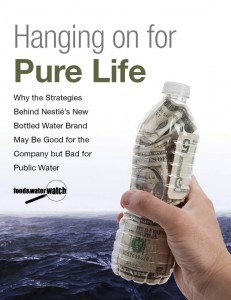
Washington, D.C.—While sales of Nestlé Waters products in the United States, Canada and Europe decreased 17 percent between 2007 and 2010, the company experienced a 44.8 percent increase in sales in other regions of the world in that period, finds new analysis released today by the national consumer advocacy group Food & Water Watch. Hanging on for Pure Life: Why the Strategies Behind Nestlé’s New Bottled Water Brand May be Good for the Company but Bad for Public Water reveals that Nestlé’s expansion into developing markets has curbed its decline among North American and European consumers, leading to an overall sales decline of 12.6 percent world-wide.

“As backlash against bottled water escalates, and many consumers in North America and Europe reject it in favor of the tap, Nestlé is seemingly shifting its strategy to compensate for this revenue loss,” said Food & Water Watch Executive Director Wenonah Hauter. “With Pure Life, Nestlé is targeting a whole new demographic of consumers—those in the developing world.”

With plants in 37 countries, Nestlé hopes to expand its sales in emerging markets by a third within the next decade. Yet over 1.1 billion people around the world lack access to clean drinking water; Nestlé’s new emphasis on developing markets also suggests a strategy of capitalizing on the global water crisis.

“Bottled water is not a viable long-term solution to delivering water to consumers in developing nations. Where are those who cannot afford bottled water supposed to turn to access potable water?” asked Hauter.

Nestlé’s focus on its Pure Life brand reflects the bottled water industry’s shift towards sourcing from municipal water supplies, rather than spring water sources. Between 2005 and 2009 the overall volume of tap water bottled by the industry in the U.S. increased by 66 percent while the volume of spring water increased by only nine percent. Today, nearly half of all bottled water sold in the U.S. comes from municipal supplies.

“Despite years of running roughshod over community concerns about its bottling, Nestlé is still bent on wresting water rights from rural Americans,” said Leslie Samuelrich, chief of staff with corporate watchdog Corporate Accountability International. “But these figures are an indication there is a horizon nearing for Nestlé’s abuses in small town America, though its shifting practices promise ongoing challenges to public water worldwide.”

The report also reveals that in the U.S., Pure Life posted an 18 percent growth in sales between 2008 and 2009 while every other leading bottled water brand saw sales decline, and overall industry sales dropped five percent. Nestlé increased advertising expenditures on Pure Life in recent years—investing $9.7 million on ads for the brand in the U.S. in 2009, a 3000 percent increase since 2004.

Hanging on for Pure Life: Why the Strategies Behind Nestlé’s New Bottled Water Brand May be Good for the Company but Bad for Public Water is available here

Contact: Kate Fried, Food & Water Watch, (202) 683-2500, kfried(at)fwwatch(dot)org.

Hanging on for Pure Life

Categories

Food

Why the Strategies Behind Nestlé’s New Bottled Water Brand May Be Good for the Company but Bad for Public Water

As many consumers in the United States and Europe are dropping bottled water, the industry is beginning to see a decline in sales. In fact, between 2007 and 2010, Nestlé Waters, the biggest water bottler in the world, saw its total sales drop 12.6 percent.

Today, Nestlé appears to have developed new strategies to combat this challenging sales climate, which center around its Pure Life brand. Unfortunately, while the brand has been profitable, these tactics do not bode well for public water in the United States or abroad.

Nestlé has shifted the focus of its advertising dollars in the United States to its new Pure Life brand. Between 2004 and 2009, spending on Pure Life advertising increased by more than 3000 percent; the company’s nearly $9.7 million expenditure on the brand in 2009 was more than any other bottled water company spent on a leading domestic brand, and more than Nestlé’s next five spring water brands combined.

While Nestlé’s global water division’s sales are falling in Europe, the United States and Canada, they are growing rapidly in the “emerging markets” that Nestlé is targeting in the rest of the word. In 2010, Nestlé’s sales of bottled water in these “other regions” increased by 25 percent over its 2009 sales in these areas.

Read the full report.

Pure Life differs from Nestlé’s previous brands in the United States in terms of the source of its water, the messaging used to sell it, and its target audience:

  • Pure Life bottles municipal tap water rather than spring water, which can help the company avoid the costly conflicts over water access and labeling that have plagued its spring water operations in the past, allowing it instead to vie with its main competitors, PepsiCo and Coca-Cola, on price.
  • The company focuses its messaging on the health benefits of bottled water, especially compared to sugary soft drinks, which improves the image of its product and helps it appeal to parents and teachers who are concerned about their children’s health.
  • It also specifically targets Hispanic immigrants in the United States and “emerging markets” in developing nations abroad — consumers who are accustomed to inadequate water infrastructure and therefore less inclined to drink from the tap because of safety concerns.

While these strategies appear to have helped boost Nestlé’s profits, they have not been so beneficial for consumers or the environment. No matter the source, when there is safe tap water available, bottled water comes with unnecessary costs to the consumer as well as environmental damage from the associated energy, water use and plastic waste. In addition, Nestlé’s new Pure Life strategies could be especially worrisome when it comes to their potential impact on public water.

Nestlé’s shift to bottling municipal water in the United States has led an industry trend in shifting from spring water to municipal water. Between 2005 and 2009, the overall volume of tap water bottled by the industry grew by 66 percent while the volume of spring water increased by only 9 percent, which means that tap water bottling expanded at more than seven times the rate of spring water bottling. Today, many public water systems are inadequately funded and facing potential water shortages; allowing a corporation to bottle and sell community water can be a raw deal for the municipality. Bottling municipal water instead of spring water does not do away with the environmental concerns, which is why residents in Sacramento, for one, opposed a new Pure Life facility that would draw on their city tap water.

In addition, selling bottled water as healthy, especially to children, distracts consumers from another option that is also healthy — the tap. Promoting the mindset that bottled water is a good source of healthy water undermines public confidence in tap water, which is especially dangerous today as our disappearing public drinking water sources need political support and funding.

Specifically selling bottled water to populations around the world that do not have access to safe drinking water capitalizes on the world water crisis. While this may be profitable for Nestlé, it does not provide a long-term solution for the billions of people abroad who lack access to adequate water and sanitation. In fact, the company will likely sell bottled water to the customers abroad who can afford it, not those who are in most dire need of better water supplies.

Just as consumers in the United States are better served by properly maintained public water infrastructure than bottled water sales, the water needs of populations abroad cannot be addressed without recognizing that access to water is affected by governance. To address the world water crisis, the global community must treat access to water as a basic human right, not a source of profits.

Consumer Group Calls for Congressional Oversight to Address Nuclear Radiation in U.S. Food Supply

Categories

Food

Washington, D.C. – Radiation from the ongoing nuclear disaster in Japan has reached the shores of the U.S., Europe and other nations far beyond Asia’s borders. In response, a consumer watchdog is asking for Congressional oversight. National consumer organization Food & Water Watch wants regulatory agencies to roll out a plan for radiation monitoring and soil and water testing here as soon as possible to protect U.S. citizens, and children in particular, who are especially susceptible to the impact of foodborne exposure to radioactive materials.

Today Food & Water Watch sent a letter to President Obama, heads of federal agencies, and Congressional leaders noting that the agencies responsible for regulating our food— the Food and Drug Administration (FDA), U.S. Department of Agriculture (USDA) and National Oceanic and Atmospheric Administration (NOAA)—have done very little to detail specific ways in which they are responding to the threat of radiation in food.

“There have been several serious nuclear accidents in the last four decades, but food regulators have not caught up with the threat. Now’s the time to catch up,” said Wenonah Hauter, Executive Director of Food & Water Watch.

Food & Water Watch is asking for a comprehensive and transparent plan to monitor and test for radiation, and expand the monitoring program into agricultural regions of the United States. The Environmental Protection Agency (EPA) should increase its monitoring of air, water, and precipitation, as well as step up monitoring of radiation in milk. The data generated should be used to design sampling programs for soil, water, animals and crops in areas affected by radiation.

The group also believes imports from Japan should be halted. The U.S. imported around 150 million pounds of food from Japan last year, including nearly 600,000 pounds of crab and anchovies and nearly 5 million gallons of bottled water, soft drinks and other non-alcoholic beverages containing water — products that may be potentially higher risk if contamination continues to spread to the ocean and fresh water sources.

The group, which has been asking Congress to not cut food and water protections from the federal budget, is now asking for additional spending on food inspections in light of the disaster.

“We need more food and water protections, not less,” said Hauter. “Disasters like this highlight just how vulnerable our food and water can be. We should no longer take safe food and water for granted.”

ADDITIONAL RESOURCES:

See our letter to President Obama, heads of federal agencies, and Congressional leaders.

See our fact sheet on the impact of Japan’s nuclear accident on food.


Contact: Darcey Rakestraw, 202-683-2467; drakestraw(at)fwwatch(dot)org.

European Commissions’ Intransigence on Consumer Labelling Huge Disappointment

Categories

Food

Statement of Wenonah Hauter, Executive Director, Food & Water Europe

Brussels — “EU talks on the regulation of food products made from cloned animals have failed again with the Council of Ministers, European Commission and European Parliament disagreeing on the way forward. The Parliament has quite rightly stuck to its guns on this. There is no good reason why EU shoppers shouldn’t have a label to show them where cloning has been used.”

“It is particularly disappointing that when the Parliament offered a huge compromise to accept products from clone offspring in the food chain if labels were in place, the Commission insisted labels aren’t possible.

“Denmark clearly thinks a ban on cloning is feasible – are they wrong? Animals already have papers providing a variety of details about their health and movements, and part of the Council’s own proposal was to trace all clones and their offspring. This would be a clear basis for a sound labelling scheme. The irony is the Council’s own proposal shows it is possible to trace clones and label food from their offspring, yet they fight it.”

“European consumers reject cloning as cruel and unnecessary, yet the Commission seems determined to ignore them and bow to pressure from U.S. exporters led by politicians with links to the biotech industry, which spent over half a billion dollars in campaign contributions and lobbying expenditures over the past decade.

“The meat industry needs to realise that if they don’t get behind labels they risk a serious consumer backlash if avoiding conventional meat and milk becomes their only option. The stalemate only serves those who stand to make money from cloning by preventing any controls being put in place.

Food & Water Europe is a program of Food & Water Watch, Inc., a non-profit consumer NGO based in Washington, D.C., working to ensure clean water and safe food in Europe and around the world. We challenge the corporate control and abuse of our food and water resources by empowering people to take action and transforming the public consciousness about what we eat and drink.

Contact:
Eve Mitchell, +44 (0) 7962 437 128, [email protected]
Gabriella Zanzanaini, +32 488 409 662, [email protected]

Vested Interest Influence Over Farm Report “Deplorable”

Categories

Food

On the day of Syngenta’s forum on the future of agriculture, Food & Water Europe today said the influence of the GM lobby in European policy making was clearly out of order, condemning last week’s report on home grown proteins as “deplorable”. [1]

“The report is so bad that the author had to remove his name from it,” said Food & Water Europe Executive Director Wenonah Hauter. “Industry influence turned a badly needed set of recommendations to help European farmers grow the crops European consumers want into a farce. We’ll be watching to see what they cook up at today’s forum.”

The report, drafted by MEP Martin Häusling, originally explained why Europe’s overdependence on imported protein crops, like soy, is harmful and what should be done about it. Recommendations included detailed analysis of the real impacts of trade agreements on EU farming followed by moves to improve Europe’s food sovereignty using home-grown animal feeds to build stable agricultural productivity for the long term. Such moves would benefit consumers and the environment, not to mention European farmers, who would have more control over their businesses, and farmers in the developing world, who could go back to growing food for people rather than industrial export crops for factory farms and biofuels.

By introducing the unrelated issue of low-level presence of GMOs in imports, an issue already addressed by other Parliamentary processes and regulations, the biotech industry ensured that no anti-GM MEP could support the report. The resulting report passed by MEPs was so dramatically altered that Mr. Hausling withdrew his name from it.

“The original intentions of this report were welcome, and action in this area is overdue,” said Hauter. “It is high-time the damaging impacts of trade agreements like the Blair House agreement were dealt with so European farmers can get back to farming without one hand tied behind their backs. [2] It is deplorable that vested interests were able to step in and bully MEPs into undermining the best intentions with half-truths. Hopefully something can be salvaged from all their hard work.”

The Blair House Agreement forced the EU to end support for oilseed crops as part of the launch of the WTO Agreement on Agriculture in order to curb steadily growing EU soy production. Since then, EU soybean production has collapsed (by 50% in 2008 alone), and soy imports are up 57.1% to account for some 80% of the EU’s protein animal feeds. This not only rigs the market in favour of U.S. soy, but presses EU livestock farmers into a dependence that is fuelling factory farms, lowering animal welfare standards and driving down food quality.

As Hauter says, “It’s just not healthy for the livestock industries in 27 countries to be so reliant on imports when there is no need. The change will take time, but few are putting effort into research on alternative breeds and feeds because the EU is shackled by trade agreements at the behest of U.S. biotech industry, so as it stands improvements couldn’t be implemented.”

“The fact that 90% of U.S. soy is GM, and turned into animal feed that goes unlabelled into the market against the wishes of consumers, only makes it worse.”

[1] See report – http://www.europarl.europa.eu/sides/getDoc.do?type=REPORT&reference=A7-2011-0026&language=EN

[2] See our report – http://www.foodandwatereurope.org/reports/the-perils-of-the-global-soy-trade/

Food & Water Europe is a program of Food & Water Watch, Inc., a non-profit consumer NGO based in Washington, D.C., working to ensure clean water and safe food in Europe and around the world. We challenge the corporate control and abuse of our food and water resources by empowering people to take action and transforming the public consciousness about what we eat and drink.

CONTACT:

Eve Mitchell, +44 (0) 7962 437 128, [email protected]

Gabriella Zanzanaini, +32 488 409 662, [email protected]