

Utility Workers Union of America et Food & Water Watch déposent une plainte en vertu d’un traité international contre United Water et Suez Environnement

Categories

Food

Bruxelles, Paris – La Utility Workers Union of America et Food & Water Watch ont déposé aujourd’hui une plainte en vertu d’une convention internationale sur les pratiques de travail et environnementales contre United Water, une compagnie des eaux aux États-Unis et une filiale de la multinationale française Suez Environnement.

La plainte, que les deux organisations ont présenté conformément aux lignes directrices pour les entreprises multinationales adoptée par l’Organisation de coopération et de développement économiques (OCDE), contient à la fois des préoccupations sur la manière dont United Water traite ses employés ainsi que sur l’impact de ses activités sur l’environnement. Les lignes directrices de l’OCDE sont conçues pour promouvoir un comportement responsable des entreprises multinationales dans tous les pays au sein desquels elles opèrent.

«Les travailleurs dans les services d’utilité publique ont été étonnés par la conduite de mauvaise foi de United Water dans les négociations collectives aux Etats-Unis», a déclaré Michael Langford, Président national de UWUA.

Le National Labour Relations Board aux Etats Unis a autorisé plusieurs plaintes déposées contre United Water dans deux localités distinctes pour usage de tactiques de négociation illégales. Des membres de la UWUA travaillent sous des conventions périmées dans quatre États – le Delaware, New Jersey, New York et la Pennsylvanie – en raison des exigences de United Water de faire baisser fortement les pensions de retraite des employés.

« Food & Water Watch croit fermement que l’eau doit être gérée dans l’intérêt public, pas pour des profits privés », a déclaré Wenonah Hauter, directrice exécutive de Food & Water Watch. « Lorsque les services d’eau sont privatisés, l’environnement et les travailleurs en sortent perdants, comme le démontrent plusieurs exemples cités dans la plainte auprès de l’OCDE. Les consommateurs sont également du côté des perdants, étant fréquemment confrontés à un service de moins bonne qualité à un coût plus élevé lorsque la gestion de l’eau est privée. Les communautés, les travailleurs et l’environnement aux États-Unis prennent la banquette arrière par rapport aux actionnaires en Europe et ailleurs lorsque les services de l’eau sont privatisés. »

La plainte déposée auprès de l’OCDE par les deux organisations soulève les préoccupations suivantes:

– Le 31 mai, le National Labour Relations Board (NLRB) a déposé une plainte alléguant que United Water Pennsylvanie avait illégalement refusé de fournir des informations à la UWUA nécessaires à la négociation des demandes de concession formulées par la société dans le domaine des pensions des travailleurs. Le NLRB a autorisé une plainte similaire contre United Water dans le New Jersey.

– En Décembre 2010, un grand jury fédéral a émis une mise en accusation contre United Water pour avoir intentionnellement manipulé les examens de suivi de la bactérie E. coli dans une usine de traitement des eaux usées à Gary, Indiana entre 2003 et 2008. La société a plaidé non-coupable dans l’affaire.

– La mise en accusation contre United Water stipule que la société a manipulé les résultats des analyses dans le cadre d’un programme de réduction de coûts pour l’achat de chlore, qui est utilisé comme désinfectant dans la station d’épuration avant que les eaux usées traitées soient rejetées dans les cours d’eau publics près de Chicago. Le Président de United Water a publiquement rejeté la gravité de ces accusations, affirmant que l’acte d’accusation comporte un « désaccord sur le fonctionnement et les méthodes de monitoring. »

La UWUA et Food & Water Watch ont déposé la plainte aujourd’hui à l’OCDE en compagnie de représentants des gouvernements américain et français. Selon les procédures de l’OCDE, les gouvernements sont tenus de transmettre la soumission aux responsables de la société-mère française et de la filiale américaine pour une réponse officielle.

La Utility Workers Union of America, AFL-CIO, représente les hommes et femmes travailleurs dans les services d’utilité publique et les industries connexes à travers les États-Unis, y compris les employés de l’eau dans le Delaware, le New Jersey, New York et en Pennsylvanie.

Food & Water Europe est un programme de Food & Water Watch, une ONG à but non lucratif représentant les droits des consommateurs basée à Washington, DC, qui vise à garantir une eau propre et une alimentation sûre en Europe et dans le monde. Nous luttons contre le contrôle et l’abus de nos aliments et des ressources en eau par l’industrie en donnant aux citoyens les moyens d’agir et de transformer la conscience collective autour de ce que nous mangeons et buvons.

Contact:

Mark Brooks, +1 615/259-1186, [email protected]

Kate Fried, +1 202/683-4905, [email protected]

Gabriella Zanzanaini, +32 488 409 662, gzanzanaini(at)fweurope.org
“Super Toxic” E. Coli Outbreak Highlights Problems with Labyrinthine Supply Chains

Categories

Food

Statement from Wenonah Hauter, Executive Director, Food & Water Watch and Food & Water Europe

Brussels and Washington—“The E. coli outbreak in Europe, which researchers have called ‘entirely new’ and ‘super toxic’, exposes that much still must be done to understand the risks posed by the industrialized food system. Produce supply chains connecting farmers to consumers have lengthened and now may stretch around the world, mixing a large volume of products of many farms together, shipping them over long distances and using new technologies to extend shelf life.

“Food markets have consolidated into the hands of a few large corporations that deal in tremendous volume. Larger volumes and longer supply chains, in turn, make trace-back more difficult and put a larger number of consumers at risk if there is an incident of microbial contamination somewhere in the system. The E. coli outbreak in Europe shows just how hard it can be to pinpoint where things go wrong in such a labyrinthine system.

“In their investigation, regulators should examine all steps in the supply chain, since the opportunity for contamination is not isolated to where crops are grown. The washing, packing and processing of produce, as well as temperature controls during shipping, should be considered.

“We also encourage the regulators to consider the implications of scale. While small and diversified farms are not risk-free, a growing body of scientific evidence suggests that the management practices common to smaller, biodiverse and conservation-oriented farmers are a net benefit to food safety. As regulators respond to this outbreak and reconsider food safety regulations, food safety concerns must be integrated with organic production and other conservation goals.

“Finally, they must conduct the research needed to understand the risk. Much more research is needed to gain a thorough understanding of the sources of microbial contamination in produce. Scientific evidence finds that cattle, particularly those that are fed grain, are the most significant source of some strains of E. coli and that flies from cattle feedlots may serve as a major vector for E. coli contamination on leafy greens. The practice of feeding livestock antibiotics for growth promotion has increased the prevalence of antibiotic-resistant strains of pathogens like E. coli, and with it, related food safety risks.

“We hope that this food safety crisis helps regulators realize that smaller, regional food systems have many benefits to human health, and that the solution is to create supply chains that make it easier to identify where food production and distribution problems occur. Food technologies like irradiation are no substitute for good information on how and where food production problems go wrong. The struggle to identify the source of the contamination also reinforces the need for adequate funding and resources for public health investigators at all levels of government, as these are the people on the front lines of responding to illness outbreaks.”

###

Food & Water Europe is a program of Food & Water Watch, Inc., a non-profit consumer NGO based in Washington, D.C., working to ensure clean water and safe food in Europe and around the world. We challenge the corporate control and abuse of our food and water resources by empowering people to take action and transforming the public consciousness about what we eat and drink.

Contact:

Eve Mitchell, Food & Water Europe, emitchell(at)fweurope.org, +44 (0)1381 610 740

Darcey Rakestraw, Food & Water Watch, drakestraw(at)fwwatch.org, +1 202-2683-2467

Council of Ministers and European Commission Inappropriately Use Trade Law as Excuse to Refuse Labelling for food from Clones and their Offspring

Categories

Food

Brussels and Washington, D.C. – Today Brussels-based Food & Water Europe and Washington-based Food & Water Watch condemned Council (the EU’s main decision making body) and European Commission attempts to mislead Member States and citizens, as leaked documents reveal their position on cloning is not backed up by the legal opinions they sought.

A recently leaked legal opinion requested by the Council from its official Council Legal Services contradicts Council and Commission claims that banning (or labelling) food from clones and their offspring would risk a trade war between Europe and the U.S. This opinion was available to them at the time conciliation talks broke down in March when the Council rejected the European Parliament’s proposed compromise to relinquish calls for a ban on food from clones and their offspring in exchange for labels showing consumers where clones are used. It was reported on both sides of the Atlantic that the Council and Commission positions maintained such a move would not be compatible with the EU’s international trade obligations and risked a trade war, notably with the US. In Member States like the UK, MPs appear to confirm the spread of misinformation, telling concerned constituents a ban on the import of food from the offspring of clones may well lead to a WTO dispute.

However contrary to this position the leaked legal opinion from Council Legal Services in fact says, “a defendable case may be made on the basis of EC-Asbestos case that food from cloned animals and from their descendents are not ‘like’ product as compared to food from conventionally bred animals,” a key test in trade law.

With regards to labels the legal opinion also says, “The bans of food from cloned animals and of food from offspring of clones could be justified on the basis of the consumers’ ethical considerations,” as could pre-market approvals. “[I]t could reasonably be argued that the general labelling requirement will not sufficiently contribute to the achievement of the public morals objective. In particular, the ethical considerations and the welfare concerns could not be solved by a label.”

Crucially, the legal opinion concludes that even if the argument about the “likeness” of cloned foods was lost, “in relation to food from offspring of cloned animals, a simple labelling requirement for this food would pass the ‘necessity test’ under Article XX GATT” because of the moral and ethical requirements of consumers.

“This document shows that the Council and the Commission inappropriately argued that trade law prevented a ban or labels on food from clones and their offspring, but in reality, the decision appears to be based on a desire to appease the U.S. pro-cloning lobby,” said Wenonah Hauter, Executive Director of Food & Water Watch and Food & Water Europe. “What we now know is that not only is it entirely possible to trace clones and their offspring, but to do so and label the resulting foods is arguably not the violation of WTO rules they said it was according to their own legal advice.

“We think it is highly unlikely that given the global economic and political situations the U.S. would even launch a WTO dispute over something like cloning when everyone admits it is hardly widespread. It would be pretty hard for them to defend when there is an FDA-requested ‘voluntary moratorium’ on cloning still in place to meet U.S. consumer demand and protect both domestic and export markets.

“Given all this, and the legal opinion that even a complete ban could be argued, the Parliament’s compromise position on labels as a ‘bare minimum’ is entirely justified and feasible. We’ve heard enough excuses. Cloning is unnecessary, unwanted and cruel. It’s time consumers were told where it is being used so they can avoid it.”

***

Food & Water Europe is a program of Food & Water Watch, Inc., a non-profit consumer NGO based in Washington, D.C., working to ensure clean water and safe food in Europe and around the world. We challenge the corporate control and abuse of our food and water resources by empowering people to take action and transforming the public consciousness about what we eat and drink.

Contact:

Eve Mitchell, Food & Water Europe, emitchell(at)fweurope.org, +44 (0)1381 610 740

Darcey Rakestraw, Food & Water Watch, drakestraw(at)fwwatch.org, +1 202-2683-2467

###

“Sustainable” Seafood? Maybe not.

Categories

Food

New Consumer Guide to Eco-labels Examines What Certifications Do—and Do Not—Tell You About the Fish You’re Eating

Brussels – A new report and seafood-buying guide released today by Food & Water Europe shows that consumers can’t always rely on labels if they want to buy sustainably. In fact, determining which seafood products are best for you and our planet can be a difficult job. A number of private fish certification programs boast reliable standards and labels to evaluate and market seafood as “environmentally friendly” or “sustainably produced”, but what they don’t tell you is at least as important as what they do, and that’s where things get tricky for conscientious shoppers.

The new report De-Coding Seafood Eco-Labels: Why We Need Public Standards compares and contrasts existing private certifications including those of The Marine Stewardship Council, Global Aquaculture Alliance, and Friends of the Sea. It finds that a lack of meaningful official labelling standards has allowed private eco-labels to capture large portions of the market, but that these are not adequate indicators of sustainable seafood choices for consumers, restaurants or retailers, and in fact can contradict one another.

“People often think that if they buy seafood with an eco-label, it’s automatically a good choice,” said Wenonah Hauter, Executive Director of Food & Water Europe. “Unfortunately, these certifications don’t assure that the product consumers are getting is actually eco-friendly, or that companies are improving their behaviour.”

An analysis of many eco-labels found inadequacies with regard to environmental standards, social responsibility and community relations, labour regulations, international law, and transparency. Some of the findings include:

Flawed fisheries are often certified. Some programs use their eco-label as incentive for a fishery or farm to make improvements. However, consumers have no way of knowing if the fish they are eating comes from a fishery that has merely pledged improvements or one that meets all the criteria for an eco-label. Some critics have claimed that in many cases, few improvements are made after certification.

Conflicts result from labels used for marketing purposes. Eco-labels are often predominantly used as a marketing tool. Certifiers are reliant upon increasing the number of fisheries certified in order to continue building their name and market share—an inherent conflict that can result in objectionable certifications.

Carbon footprints are often not considered. Most eco-labels fail to include “food miles” in their standards. New Zealand hoki, therefore, can be eco-labelled for sale in San Francisco.

They don’t meet FAO guidelines. The Food & Agriculture Organization (FAO) has standards for eco-labelling and certification programs, but an analysis shows them lacking in regard to FAO’s standards on transparency, damage mitigation from pollution, and contribution to rural development and food security.

“Consumers aren’t told that these labels often have a ‘pay to play’ aspect,” said Eve Mitchell of Food & Water Europe. “A well-managed fishery that can’t finance certification may not have an eco-label and still be the best choice, while one that is less sustainable could be certified because someone paid for it. As a result of this, labels can actually encourage consumers to buy less sustainable products, and it can be challenging for consumers to decipher whether labels are very meaningful. To us this is getting very close to actually misleading consumers, which must be dealt with officially.”

The report concludes that the European Commission should 1) expand the information required on seafood labels to close current loopholes, and 2) fulfil their intention to ensure labels adhere to FAO guidelines by developing specific and clear interpretations of those guidelines, requiring all certifiers to adhere to them and enforcing those regulations.

In the meantime, consumers can use the questions in the guide to help them assess the quality and sustainability of seafood they buy.

“While some high-profile areas get attention, reforming the Common Fisheries Policy to end discards or put new labels on tinned tuna is simply not enough to protect our oceans, which are under increasing pressure from the industrial fishing and unchecked corporate harvesting that erroneously leads to products sold as ‘sustainable,’” said Mitchell. “Consumers want to do the right thing, and we think many will be hopping mad to learn the eco-labels they trusted have only told part of the story. We don’t believe you have to ‘work with’ multinational companies because they are there already. It only lets them hide behind pretty labels, and if what they are doing is wrong, we’ll say so.”

Read the new report.

Food & Water Europe is a program of Food & Water Watch, Inc., a non-profit consumer NGO based in Washington, D.C., working to ensure clean water and safe food in Europe and around the world. We challenge the corporate control and abuse of our food and water resources by empowering people to take action and transforming the public consciousness about what we eat and drink.

Contacts:

Eve Mitchell, +44 (0) 7962 437 128, [email protected]

Gabriella Zanzanaini, +32 488 409 662, [email protected]

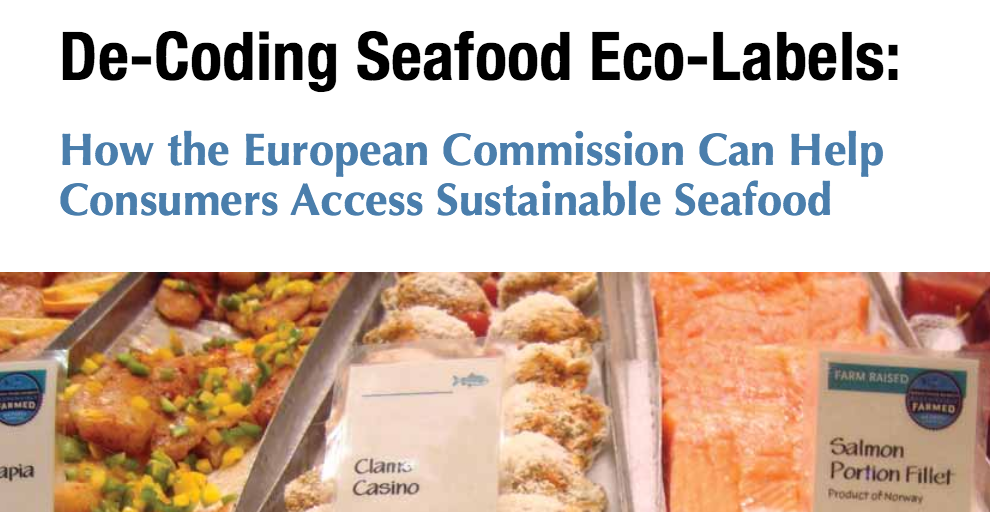
De-Coding Seafood Eco-Labels: How the European Commission Can Help Consumers Access Sustainable Seafood

Categories

Food

DOWNLOAD PDF

In light of these questions, there is a demand for straightforward guidance on seafood. To address the sustainability ques- tions surrounding fish consumption, a number of certification programs have developed sets of standards and labels to evaluate and then market “environmentally friendly” or “sustainably produced” fish.

Choosing the best fish to eat can be complicated. While you’re browsing the seafood counter or restaurant menu you may wonder whether certain fish are safe and sustainable. In many cases, the more a person knows, the more questions arise: Is this wild or farmed? Local or imported? Environmentally responsible and humane? High in mercury? Tainted with anti- biotics and chemicals?

Meanwhile, many retailers have begun sourcing their seafood predominately or exclusively from fisheries or companies that have been certified with eco-labels in an effort to promote their environmental awareness about seafood sustain- ability to consumers. Many of these labels claim to be in line with the United Nations Food and Agriculture Organization (FAO) guidelines for aquaculture or fisheries certification, but are they? The European Commission has indicated it will make an effort to enforce these guidelines.

To determine what eco-labels really mean, Food & Water Europe examined various seafood certification programs and found that, unfortunately, labels do not always represent what consumers expect.

Our research reveals a variety of flaws and inadequacies associated with the eco-labels analyzed and suggests that private labels may not be the most appropriate means to convey neutral, credible information about seafood. While the intent to raise awareness about sustainability among seafood suppliers and fish farms is admirable, it is questionable whether labels are actually increasing sustainability in the marketplace or meeting consumers’ demand for reliable information on seafood. In fact, some labels with industry connections may actually be more successful at convincing consumers that the products found in markets are “sustainable,” than at offering the neutral guidance consumers truly seek.

This report proposes that in order to provide consumers with much-needed, unbiased and well-regulated information, the European Commission must develop and enforce strict criteria for interpreting the FAO guidelines on aquaculture and fisheries certification. Until that time, consumers can use our guidelines and recommendations for safer and more sus- tainable seafood choices at the end of this report.

Findings

  • The eco-label certification programs reviewed in this report demonstrate inadequacies in regard to some or all of the following: environmental standards, social responsibility and community relations, labor regulations, international law, and transparency.
  • Eco-labeling programs may cause increased public acceptance of products from controversial farming operations such as coastal shrimp ponds and open-water aquaculture.
  • Eco-labeling programs fail to promote local seafood options or account for the miles that imported seafood travels.
  • Existing eco-labels have the potential to override the authority of governments, particularly in developing countries.
  • The eco-labels examined fail to meet FAO criteria for eco-labeling and certification programs for wild fisheries and aquaculture.
  • Financial constraints have affected the ability of some otherwise eligible fisheries to attain certification.
  • For some programs, there is a conflict between the intent to promote change within a certain fishery and the labeling program, which can place a seal of approval on a product from a certified fishery before it has made conditional improvements in ecological performance to actually meet the standards for the label.
  • Eco-labels may negatively impact forage fish populations, which could damage marine food webs and harm food security in developing countries.

Les profits de Veolia Environnement s’effondrent alors que des municipalités à travers le monde remunicipalisent leurs contrats d’eau et que l’entreprise ne parvient pas à obtenir de nouvelles concessions de bail

Categories

Food

Les défenseurs de la justice de l’eau dévoilent la longue liste de défaillances de service de l’entreprise

(In English)

Paris, France—Malgré des revenus de €34.8 milliards en 2010, Veolia Environnement, la plus grande entreprise de services d’eau au monde, a subi une diminution de 11% dans le résultat opérationnel ajusté de sa division d’eau par rapport à l’année précédente, révèle une étude publiée aujourd’hui par le groupe de défense des consommateurs Food & Water Europe. Veolia Environnement: Profil de la plus grande entreprise de services d’eau au monde démontre comment la réaction hostile du public aux tentatives de Veolia de dominer le marché des services d’eau a rongé les revenus de l’entreprise.

Fournissant des services d’eau potable à 95 millions de consommateurs et d’assainissement à 68 millions dans 66 pays, Veolia a eu du mal à maintenir ses taux de profitabilité et à concrétiser sa vision de privatisation ces dernières années. De 2005 à 2009, de nouveaux contrats de l’entreprise avec les pouvoirs publics ont diminué dans leur durée et leur portée—les principaux nouveaux contrats signés en 2009 ont diminué en valeur de 97 pour cent par rapport à ceux qu’il a signé en 2005.

La société a orienté plus de la moitié de ses activités de croissance au cours des trois prochaines années pour étendre sa présence en Europe et en Asie. Pendant ce temps, des consommateurs partout dans le monde souffrent de pénuries d’eau, d’une montée en flèche des tarifs et des pratiques de facturation irrégulières au regard des services de Veolia Environnement. Certaines municipalités, telles que Paris, en France et Adelaïde en Australie ont mis fin à leurs relations avec Veolia prématurément, afin de réaliser de potentielles économies grâce à la gestion publique.

“À bien des égards, le fait que Paris ait repris le contrôle public de son système d’eau à Veolia peut être considéré comme un signe des problèmes à venir pour l’entreprise, » a dit la directrice de Food & Water Europe Wenonah Hauter. “Un an après la reprise de son système d’eau, la ville prevoit 35M€ en économies annuelles. On sait que les choses vont mal pour Veolia lorsque même sa ville natale decide de rejeter ses services.”

Ces questions et d’autres ont été soulignés aujourd’hui lors d’une conférence de presse organisée par les défenseurs des consommateurs et de la justice de l’eau. Les intervenants à la conference incluent Wenonah Hauter, Directrice de Food & Water Watch/Europe; Danielle Mitterrand, président de la Fondation France Libertés; Anne Le Strat, président de AquaPublicaEuropea; William Bourdon, Président de SHERPA et Jean Luc Touly, Conseiller régional, membre du Comité National de l’Eau et syndicaliste chez Veolia Eau IdF.

“La gestion de l’eau potable doit être sortie de la sphère marchande, c’est un bien commun et ne doit pas devenir le pétrole du 21ème siècle, » a dit Jean Luc Touly. « L’eau comme bien commun c’est un source de paix et non source de profit.”

Le rapport se peut trouver ici.