

EU Succumbs to U.S. Pressure on GM Contamination

Categories

Food

Industry spent over half a billion lobbying for pro-GMO policies in past decade

BRUSSELS AND WASHINGTON – Today, the head of Brussels-based Food & Water Europe and Washington D.C.-based Food & Water Watch denounced a recent EU Animal Committee vote to permit animal feed contaminated with genetically modified organisms (GMOs) as “spectacularly shortsighted.”

The EU committee responsible for animal health has voted to accept what it calls a “technical solution” to GM contamination of animal feed that will permit up to 0.1% of imports to contain GM traits that have not been assessed as safe under European regulations.

“This spectacularly shortsighted move comes after years of intense pressure from U.S. biotech lobbyists looking to cut the costs segregating out crops the EU has not yet approved,” said Wenonah Hauter, Executive Director of Food & Water Europe. Since 1999, the 50 largest agricultural and food patent holding companies and two of the largest biotechnology and agrochemical trade associations have spent more than $572 million in campaign contributions and lobbying expenditures in the U.S.

The move comes under the guise of easing farmers’ access to cheap feed, with the industry arguing that EU restrictions have made it more difficult to import GM soya. But a mere .2 % of all EU feed imports have ever been turned back because they contained unapproved GMOs, and none have been refused since 2009. All of the shipments ever refused have been from the U.S.

“By exaggerating the situation and inflaming concerns among beleaguered EU livestock farmers, the industry has successfully and dishonestly painted a ‘life or death’ scenario for them,” said Hauter.

The move does not diminish the need for Europe to urgently address its reliance on imported proteins for animal feed, nor does it coincide with the wishes of European consumers, who have consistently rejected GMOs at the checkout counter.

Food & Water Europe and Food & Water Watch called on the U.S. to stop pressuring other countries to accept its choices for food and agriculture. “Every country has the right to plant and eat what they choose without interference from unaccountable multinational agribusinesses,” said Hauter.

The organisation also called for real labels on all meat, milk, eggs and dairy products denoting where GM feed is not used, so consumers can avoid GMOs if they choose.

Food & Water Europe is a program of Food & Water Watch, Inc., a non-profit consumer NGO based in Washington, D.C., working to ensure clean water and safe food in Europe and around the world. We challenge the corporate control and abuse of our food and water resources by empowering people to take action and transforming the public consciousness about what we eat and drink.

Contact:

In Brussels: Gabriella Zanzanaini, +32 488 409 662; gzanzanaini(at)fweurope(dot)org

In Washington: Darcey Rakestraw, 202-683-2467; drakestraw(at)fwwatch(dot)org
Media Statement of the Water Justice Movement

Categories

Food

World Social Forum in Dakar, Senegal

“As water justice advocates from five continents gathered together in Dakar, Senegal for the World Social Forum, we applaud Bolivian President Evo Morales’ proposed United Nations declaration to block the sale of public water service to private companies.

“From Cochabamba, Bolivia to Dar Es Salaam, Tanzania, to Marseille, France, private water companies have deprived people of their human right to water in the name of profit. We oppose the dominant economic model that prescribes privatization, commercialization and corporatization of public water and sanitation services. We will counter this type of destructive and non-participatory public sector reform, having seen the outcomes for poor people as a result of rigid cost-recovery practices and the use of pre-paid meters.

“Looking forward to the next World Water Forum in 2012, we will continue to denounce corporations that attempt to dictate community water service, and we will advocate for community-driven solutions that protect water as a human right, a public good and a part of the global commons.”

Signed,

ACRA – Associazione di Cooperazione Rurale in Africa e America Latina

ATTAC, France

Blue Planet Project, Canada

CEVI – Centre for International Volunteering, Italia

CICMA -Italian Committee for a World Water Contract

Corporate Europe Observatory

Council of Canadians

David Barkin, México

Durban Green Corridor, South Africa

Enginyeria Sense Fronteresc- Catalunya

Food & Water Watch, USA

Foro Italiano de los Movimiento por el Agua

France Libertés

Housing-Water-Sanitation Associates, Cameroon

Jeunes Volontaires pour l’Environnement, Togo

Kenya Local Government Workers Union

Mesas Técnicas de Agua, Venezuela

Municipal Services Project, Global

People’s Coalition for the Right to Water (KRUHA), Indonesia

Public Services International

Solange Chassot  La Liane Saint Louis, Senegal

Transnational Institute, Europe

VAAL Environmental Justice Alliance, South Africa

Water Right Campaign, Turkey

Zanzibar Water Authority, Tanzania

Déclaration Multimédia du Mouvement de Justice d’Eau

10 Février 2011

Forum Social Mondial à Dakar, Senegal

“Comme défenseurs de la justice de l’eau venant des cinq continents et réunis à Dakar, Sénégal pour le Forum Social Mondial, nous applaudissons la declaration proposée aux Nations Unies du président bolivien Evo Morales pour bloquer la vente de service public de l’eau aux entreprises  privées.

“De Cochabamba, Bolivie à Dar Es Salaam, Tanzanie, à Marseille, France, sociétés des eaux privées ont privé les gens de leur droit humain à l’eau au nom du profit. Nous opposons le modèle économique dominant qui prescrit la privatisation, la commercialisation et la ‘corporatisation’ des  services publiques d’eau et d’assainissement. Nous lutterons contre ce type de réforme destructive et non-participative du secteur public, après avoir vu les résultats pour les auvres à la suite des pratiques de redressement des coûts rigides et l’utilisation de compteurs prépayés.

“Attendant avec impatience le prochain Forum mondial de l’eau en 2012, nous continuerons à dénoncer les sociétés qui tentent de dicter service communautaire de l’eau, et nous préconisons les solutions communautaires qui protègent l’eau comme un droit de l’homme, un bien public et une partie du bien commun.“

Signé,

ACRA – Associazione di Cooperazione Rurale in Africa e America Latina

ATTAC, France

Blue Planet Project, Canada

CEVI – Centre for International Volunteering, Italia

CICMA -Italian Committee for a World Water Contract

Corporate Europe Observatory

Council of Canadians

David Barkin, México

Durban Green Corridor, South Africa

Enginyeria Sense Fronteresc- Catalunya

Food & Water Watch, USA

Foro Italiano de los Movimiento por el Agua

France Libertés

Housing-Water-Sanitation Associates, Cameroon

Jeunes Volontaires pour l’Environnement, Togo

Kenya Local Government Workers Union

Mesas Técnicas de Agua, Venezuela

Municipal Services Project, Global

People’s Coalition for the Right to Water (KRUHA), Indonesia

Public Services International

Solange Chassot  La Liane Saint Louis, Senegal

Transnational Institute, Europe

VAAL Environmental Justice Alliance, South Africa

Water Right Campaign, Turkey

Zanzibar Water Authority, Tanzania

Fat Like Us: Europe’s Diet Becoming Americanized Thanks to Soy Feed Imports

Categories

Food

McDonald’s Earned More Revenue From Europe than U.S. in 2009

Washington, D.C. – Decades of trade rules that dismantled or restructured farm safety net programs in the European Union have displaced sustainable, domestic feed grain production and escalated dangerous soy imports from Latin America—and helped turn European farms into polluting factory farms while driving down food quality and expanding waistlines, according to a new report from consumer organization Food & Water Watch.

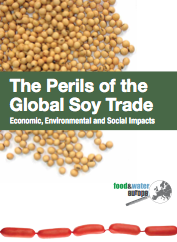
The report, The Perils of the Global Soy Trade, reveals that EU member states’ (EU-15) net soy meal imports grew 57.1 percent since global WTO trade rules entered force, from 12.9 million metric tonnes (28.4 billion pounds) in 1995 to 20.2 million metric tonnes (44.5 billion pounds) in 2007. During the same period, the EU-15 shed 1.7 million farms—nearly a quarter of all farms.

“International trade rules have created a soybean industrial complex that is fattening both livestock and humans in Europe, just like it has in America,” says Food & Water Watch Executive Director Wenonah Hauter.

Trade rules have made soy a cheaper alternative to domestic feed, helping transform pig and poultry holdings in Europe into factory farms like their U.S. counterparts. With this shift to cheaper feed comes more processed, industrialized, fast food. In 2009, McDonald’s actually earned more revenue from Europe (41 percent) than the United States (35 percent.) Now, partially hydrogenated vegetable oil made largely from soybeans is a key shortening in processed desserts and frozen foods as well, adding even more soy to European diets.

In the past several decades, these changes have helped broaden waistlines. The obesity rate in the U.K. more than tripled between 1980 and 2007, and France’s nearly doubled between 1990 and 2006. Almost half of Germany’s population was obese or overweight in 2005.

The glut of soy in Europe’s feed troughs primarily benefits a handful of companies that buy, ship, process and sell the raw agricultural inputs (soybeans and maize):

  • Four international firms dominate the global oilseed trade: U.S-based Archer Daniels Midland (ADM), Bunge, Cargill, and the French company Louis Dreyfus. These firms were four of the top six exporters of soybeans from Argentina in 2009.
  • ADM operates 21 oilseed-crushing plants outside the U.S, and over 100 international oilseed elevators, including port terminals.
  • Bunge operates 56 oilseed-processing plants worldwide, processing more than 13,000 metric tonnes (28.7 million pounds) each day in Argentina alone.
  • Cargill, the largest privately owned firm in America, operates several facilities and terminals in Brazil and Argentina, and operates a fleet of cargo ships that connects their global network of storage facilities.
  • Louis Dreyfus owns two soybean crushing plants and two export terminals in Argentina, and operates a network of oilseed storage and export facilities in Brazil.

American pork and poultry companies also benefit from the soy industrial complex, allowing them to locate their production facilities where labor costs and environmental safeguards are weaker—like Eastern Europe, where Smithfield has begun operating.

Industrial soy has also had a negative effect on farmers, human health and the environment in Latin America. Soy monocultures (often genetically modified) have driven some farmers off their land, use massive amounts of water and generate huge amounts of pesticide use that has poisoned communities:

  • Between 1996 and 2008, applications of herbicide glyphosate (sold by Monsanto as Roundup), which is used to combat weeds on GM soy plantations, surged 14-fold in Argentina due to rampant weed resistance.
  • Brazil cleared 3.1 million hectares of forest annually between 2000 and 2005—an area larger than Belgium each year—deforestation that can be attributed to added land pressures from industrial monocultures, especially soybeans.
  • Soybean production in Latin America has concentrated farmland in the hands of investors and large landowners. Between 1988 and 2002, over 100,000 farms and 230,000 agriculture jobs disappeared in Argentina.
  • In 2007, Argentina’s soybean exports to the EU contained 14.9 trillion liters of “virtual water”—water withdrawals used to cultivate crops for export.

“Through its submission to industrial agriculture interests in trade deals, the EU has imported U.S. worst practices when it comes to factory farming—including an increasing reliance on soy-based feed,” said Hauter. “It’s destroying rural economies, human health, and the environment on two continents.”

CONTACT: Darcey Rakestraw, drakestraw(at)fwwatch(dot)org; 202-683-2467.

The Perils of the Global Soy Trade: Economic, Environmental and Social Impacts

Categories

Food

DOWNLOAD PDF VIEW ON SCRIBD
GET INVOLVED

Globalization has fundamentally changed agriculture across Europe. The idyllic image of small farms with sustainable agriculture has been replaced with agricultural cogs producing food-ingredient inputs for international industrial agri-businesses. The pork chops and chickens on European tables begin their lives far away on soybean plantations in Latin America, where the feed for European livestock is harvested.

The international tentacles of the food chain tie deforestation in Brazil and Argentina to factory-farmed livestock in Europe. International trade agreements like the World Trade Organization facilitated the global corporate agri-business network that delivers soybeans and maize from Latin America to giant pig and chicken holdings in Europe and finally to a handful of supermarket chains.The beneficiaries of deregulated trade in agricultural goods have been the international grain traders, the investors in Latin American plantations, and the largest meatpacking and supermarket chains.

This paper connects the dots between the global agricultural commodity trade and the real-life impacts on consumers, rural communities in Europe and Latin America, and the environment. Findings include:

  • European feed imports surged since the WTO went into effect. Since 1995, soy meal imports from outside the European Union to the 15 member states prior to 2004 (EU-15) grew 57.1 percent to 20.2 million metric tonnes in 2007. Total maize imports nearly doubled to 21.6 million metric tonnes.
  • Soy exports from Latin America fueled deforestation. Four-fifths of EU soymeal imports came from Brazil and Argentina. The demand for more soybeans has been a key catalyst for clearing 44.5 million acres of forests in these two countries.
  • Powerful soy interests drive small farmers off the land. Soybean plantations in Argentina and Brazil average about 1,000 hectares, but can be between 10,000 and 50,000 hectares. These large farms concentrate the land in the hands of a cadre of powerful investors and landowners, hurting indigenous farmers. There have even been reported cases of exploitation and enslavement of soy workers in Brazil.
  • Industrial soy plantations feed European livestock genetically modified (GM) feed. In 2009, Brazil and Argentina were the second- and third-largest cultivators of GM crops (herbicide-tolerant or insect-resistant engineered seeds), growing 42.7 million hectares of GM soybeans, maize and cotton combined.
  • Soybean imports supersized European pig and chicken farms. Low-priced soybean meal has helped reduce the number of European pig and chicken farmers and expand the scale of the remaining farms to gargantuan proportions. In 2007, 74 million pigs were fattened on the largest 1 percent of holdings — half of all pigs in the EU.

None of this is inevitable. Just as we created these changes, we can fix the problems with a few straightforward steps. Agriculture should be removed from the binding strictures of international trade agreements; nations should pursue farm policies that promote sustainable production, food sovereignty and food security for their populations; and food should be labeled to show the full life cycle of its production, including GM feed labeling for meat and dairy products. These are concrete steps we can take immediately to address the problems raised by the international soy and feed industrial complex and move toward improved food sovereignty in the EU and in countries that supply our food.

Soya Dangerous: Industrial Soya Trade Fuels Europe’s Factory Farms, Affects Farmers and Environment on Two Continents

Categories

Food

Net soya meal imports into EU grew 57.1 percent since WTO trade rules entered force

BRUSSELS – Decades of trade rules that dismantled or restructured farm safety net programs in the EU have displaced sustainable, domestic feed grain production and escalated dangerous soya imports from Latin America—a trend that has helped turn European farms into polluting factory farms while driving down food quality, according to a new report from consumer organization Food & Water Europe.

The report, The Perils of the Global Soy Trade, will be released today at an event at the European parliament attended by MEPs and consumer groups. It shows that the 15 European Union member states’ (EU-15) net soy meal imports grew 57.1 percent since global WTO trade rules entered force, from 12.9 million metric tonnes in 1995 to 20.2 metric tonnes in 2007.

“Through its acquiescence to industrial agriculture interests in trade deals, the EU has imported U.S. worst practices when it comes to factory farming—including an increasing reliance on genetically engineered soy-based feed,” says Wenonah Hauter, Executive Director of Food & Water Europe. “The CAP and the trade rules have made it difficult to raise livestock sustainably in Europe, which is now seeing the same trend towards consolidation that has already taken place in America.”

Other findings in the report show how EU factory farm demand for cheap feed exports environmental damage and drives down food quality:

  • Between 1995 and 2007, the EU-15 shed 1.7 million farms—nearly a quarter of all farms.
  • The number of chickens on EU-15 farms rose 10 percent from 923 million in 1995 to 1 billion in 2008; the EU added nearly 3 million pigs between 2004 and 2006;
  • In 2009, Brazil and Argentina were the second- and third-largest cultivators of GM crops, growing 42.7 million hectares of GM soybeans, maize and cotton combined.
  • Soy cultivation in Uruguay has surged over fifteen-fold in less than two decades.
  • Between 1996 and 2008, applications of herbicide glyphosate (sold by Monsanto as Roundup), which is used to combat weeds on GM soy plantations, surged fourteen-fold in Argentina due to rampant weed resistance.
  • Brazil cleared 3.1 million hectares of forest annually between 2000 and 2005—an area larger than Belgium each year—deforestation that can be attributed to added land pressures from industrial monocultures, especially soybeans.
  • The dietary shift towards cheaper meat products have affected Europe’s waistlines: the obesity rate in the UK more than tripled between 1980 and 2007, France’s nearly doubled between 1990 and 2006, and almost half (49.6 percent) of Germany’s population was obese or overweight in 2005.

“Intensive farming in the EU is provoking South America to mass produce soy,” says Kartika Tamara Liotard, Member of European Parliament. “Large food companies in South America are indeed using vast amounts of land to grow corn and soybeans, merely to enable us to feed our livestock. Since the majority of these crops are genetically modified, our livestock end up eating controversial GMO food. Furthermore, mass cultivation is also responsible for the deforestation, not to mention the displacement of local South Americans. It would be much better if the local population could produce and consume its own crops instead of feeding European cattle with it.”

“European farmers can grow the protein plants that Europe needs,” says Gérard Choplin from European Coordination Via Campesina. “Rotating these protein crops and maintaining permanent pastures should be required in all places where it is feasible. This will benefit soil fertility, biodiversity and biodiversity and reduce carbon emissions by storing it in the soil.”

“It is high time Europe found better ways to feed and raise livestock,” says Hauter. “The international grain and oilseeds industry has gone to great lengths to convince European livestock farmers that they cannot survive without cheap imported feed. The truth is, most cannot survive even with it—and those that survive are more vulnerable to price shocks. And as the multinational food conglomerates concentrate their control over our food chain, jobs are lost and private profits soar.”

The Food & Water Europe report recommends policies that will help European farmers wean themselves off of imported soy. These include removal of the soya concessions in the Blair House agreement under WTO rules, and additional support for farmers under the European Common Agricultural Policy so that they can return to producing more sustainable domestic sources of protein for animal feed and the local food from responsible farms that Europeans want.

Read the report.

CONTACT:
Eve Mitchell, +44 (0)7962 437 128, [email protected]
Gabriella Zanzanaini, +32 488 409 662, [email protected]

###

Food & Water Europe is a program of Food & Water Watch, Inc., a non-profit consumer NGO based in Washington, D.C., working to ensure clean water and safe food in Europe and around the world. We challenge the corporate control and abuse of our food and water resources by empowering people to take action and transforming the public consciousness about what we eat and drink.

Proposed Linconshire Mega-Dairy Could Generate As Much Waste as London

Categories

Food


Nocton dairy must not get planning permission, says consumer group

Brussels — Food & Water Europe has formally objected to renewed plans for the EU’s biggest dairy at Nocton, in Lincolnshire in the UK, saying that despite hundreds of pages in dozens of supporting documents, the application fails to adequately account for how the local aquifer can accommodate the massive needs of the dairy, and how to deal with annual waste levels on par with London’s.

The group questioned the economic viability of the plan for a herd of 3,700 cows (“reduced” in this second application after earlier plans were withdrawn), and said this in effect means planning officers have a dilemma: approve plans now that will inevitably lead to the full stocking level of 8,100 cows plus 650 calves in order for the business to have a chance, with all the health risks that brings for humans and animals, or approve a hugely disruptive and unpopular project that is unlikely to survive financially. The only sensible option is to reject the application.

Food & Water Watch Director Wenonah Hauter said, “It looks to us like this application fails in several respects on planning regulations, but the bigger problems revolve around adequate supply of water for the thousands of animals they want to keep and a place to put all the waste they will generate. Water from the local aquifer is already fully committed supplying homes and farms, and local farmers have withdrawn consent to spread waste on their land, so we can’t see how this is going to work. And that’s before we even talk about the impact on the local community.”

The initial number of cows at the proposed dairy will generate more waste annually than the human populations of Manchester and Derby combined, and the full herd annual waste production would exceed that of any city in the UK except London. In the U.S., despite regulation of waste, Washington, D.C.-based Food & Water Watch have found numerous instances where storage lagoons have failed and untreated waste has seeped into groundwater and town water supplies. A 2008 spill forced a town to shut off water supply for two months. With the proposed dairy at Nocton being sited over a fragile natural aquifer, this could cause huge damage to people and protected species, like newts, which are particularly sensitive to manure spills.

Negotiations are “ongoing” to secure changes to water abstraction permits to supply the factory year-round, but were not in place when the application was submitted, calling into question the operational viability of the project.

In addition, health impacts on communities living near mega-dairies include:

  • Nitrate contaminated water – Babies who drink nitrate-contaminated water run a greater risk of developing the potentially fatal “blue baby” syndrome, where their blood cells lose their ability to carry oxygen. Several studies have also linked nitrates in the drinking water to birth defects, disruption of thyroid function, and various types of cancers.
  • Water contamination – Arsenic and other toxic metals, antibiotics, pesticides, and bacterial pathogens where manure is spread on fields increase the risk of E. coli and Camplyobacter infections.
  • Dust particles and toxins from animal feces, hair, and feed can affect white cell blood counts and cause fever and respiratory illness in humans.
  • Ammonia, methane and hydrogen sulphide emissions increase the risk of skin and eye irritation, coughing and wheezing, diarrhoea, asthma, nausea, headaches, depression, and sleep loss.

EU Food Policy Advisor Eve Mitchell said, “We’re very worried about the impact on local people. Noise and smell are only the beginning. Experience in the U.S. shows that communities living near mega-dairies face a host of serious health problems, some many miles away. Given the huge opposition to the project, and the fact that it is simply not needed, we cannot see why anyone would take the risk.”

Mega-dairies have arisen thanks to farmer’s inability to get a fair price for their milk. Supermarkets are selling milk at less than cost price while increasing their profit margins and keeping consumer prices stable. Costs for farmers are going up all the while, so they lose money on every pint. “It is a scandal, and it is driving family farmers out of business,” says Mitchell. “Any outfit that comes along claiming it can succeed in those conditions will do so only by pushing more and more traditional farms to the wall, and may well fall victim to the same game down the road. If supermarkets diverted even 20% of their massive profit on milk back to farmers, we wouldn’t even be having the debate about a mega-dairy in the UK.”

Get the fully referenced copy of the 20 page objection or contact Eve Mitchell.

Food & Water Europe is a program of Food & Water Watch, Inc., a non-profit consumer NGO based in Washington, D.C., working to ensure clean water and safe food in Europe and around the world. We challenge the corporate control and abuse of our food and water resources by empowering people to take action and transforming the public consciousness about what we eat and drink.

Contact: Eve Mitchell, +44 (0)1381 610 740, emitchell(at)fweurope.org or Gabriella Zanzanaini, +32 (0)488 409 662, gzanzanaini(at)fweurope.org