

Climate and health crises driven by factory farms across Europe, says new report

Campaigners urge EU to phase out all factory farms by 2040

Read the report: The Urgent Case to Stop Factory Farms in Europe
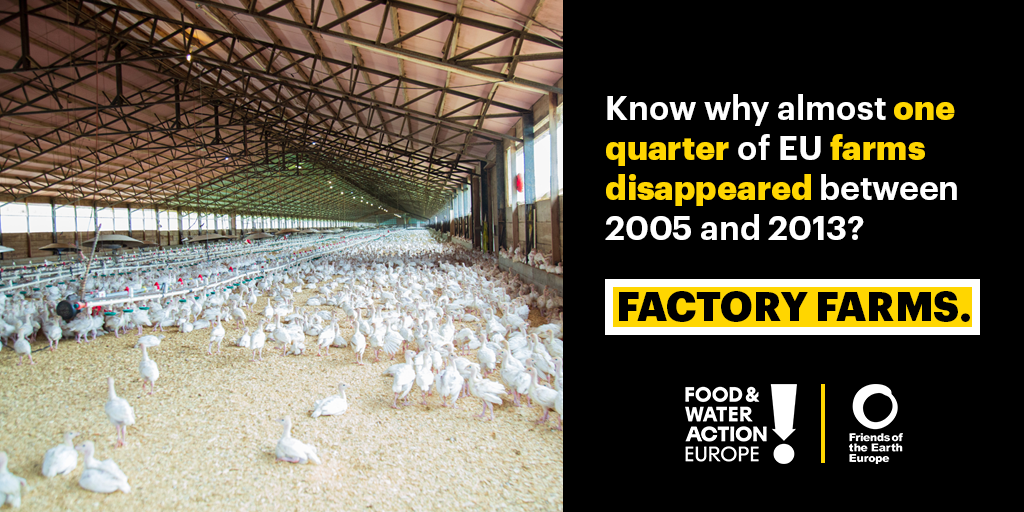
Brussels, October 8 – Factory-farmed meat production in the EU is on the rise, and is putting the climate and human health at risk according to a new report released today from Food & Water Action Europe and Friends of the Earth Europe.

A rise in industrial meat production in the European Union has been accompanied by a rapid decline in the number of small farms. This has led to a dangerous rise of “factory farms”, characterised by large numbers of animals confined in crowded spaces.

The report reveals that:

  • Unsafe working conditions on factory farms and slaughterhouses put workers in danger and increase the spread of diseases including COVID-19;
  • Global production of soybeans for animal feed, and the resulting deforestation, are exacerbating the climate crisis, constituting around 7% of all greenhouse gas emissions originating from human activity;
  • The European meat sector is dominated by a few large corporations who are increasing in size through mergers and acquisitions. Vertical integration threatens the existence of small-scale farmers, drops the prices for producers and leaves all the profits with agribusiness;
  • The routine dosing of antibiotics to factory farmed animals is increasing the risk of antibiotic resistant bacteria ending up in meat;
  • Manure from livestock farming severely contributes to air pollution (namely via ammonia emissions) and water pollution (via nitrate outputs) – a serious health risk for people living near factory farms.

Stanka Becheva, food and farming campaigner at Friends of the Earth Europe said: “Intensive animal farming is on the rise in Europe and it has already had devastating impacts on nature, peasant farming, our health and rural areas. The COVID-19 crisis has proved the fragility and inhumanity of the system which makes cheap meat possible, and how much it depends on unethical and unfair conditions for workers. We need urgent action from EU and national policy makers to change this.

David Sánchez Carpio, director of EU affairs at Food & Water Action Europe said: “The rise of factory farming in Europe is the result of misguided political choices. The European Commission should use the Farm to Fork strategy to shift this trend, ban factory farms in Europe and to support a just transition into a socially and environmentally friendly livestock sector.”

The European Commission’s Farm to Fork strategy pledges to reduce the environmental and climate impact of animal production. However, no concrete actions are suggested to tackle the root causes of the problem.

Friends of the Earth Europe and Food & Water Action Europe are calling on the European Commission use its upcoming ‘legislative framework for sustainable food systems’ to:

  • Propose concrete action to stop the construction of new factory farms and phase out existing ones by 2040.
  • Develop a transition fund for workers in factory farms and the meat industry to shift into more sustainable jobs
  • Support sustainable small-scale livestock producers and decentralised meat processing facilities that contribute to rural development

ENDS

***

Open letter: Commission turning blind eye to new GMOs

17 September 2020

88 civil society and farmers organisations from across Europe are today warning the EU Commission is turning a blind eye to new GMOs and demanding EU health and food safety Commissioner Stella Kyriakides keeps new GMOs regulated, in an open letter.

The controversial new generation of food genetic engineering techniques should be subject to EU safety checks and consumer labelling, according to an EU Court of Justice ruling, but the organisations complain the European Commission is not implementing this ruling.

Public letter to EU Health and Food Safety Commissioner

New Irish Government Vows to Ban Imports of Fracked Gas and Cease Support for Shannon LNG Terminal

Dublin, 29 June 2020

Members of Fine Gael and Fianna Fáil, the major political parties in Ireland, voted by a substantial majority to enter into a historic three-party coalition with the Green Party, endorsing a new programme for government that would end support for the controversial Shannon LNG project, removing it from the EU Projects of Common Interest list, and developing a policy statement to stop the imports for fracked gas altogether.

The EU Projects of Common Interest list covers priority energy infrastructure projects to be built in Europe, drawn up by the European Commission, member states and the European Network of Transmission System Operators for Gas (ENTSOG). Approved projects become eligible for EU funding under the Connecting Europe Facility (CEF).

The development in Ireland represents a major milestone for climate activists on both sides of the Atlantic, and is also a major blow for New Fortress Energy, the US investor of the Shannon LNG project that is behind the strongly criticized Gibbstown LNG export terminal proposed in New Jersey, USA.

“The Emerald Isle is lighting the way into a global frack-free future”, says Andy Gheorghiu, policy advisor for Food & Water Action Europe and co-initiator of the Irish campaign. “This Irish Government is set to become a true climate champion and will hopefully become an example to be followed by all European Member States.”

Food & Water Action executive director Wenonah Hauter said, “The Shannon LNG project would fuel more fracking in communities across the US who have suffered for over a decade from air and water pollution inextricably linked to this destructive industry. Fracking and gas infrastructure have no place in a sustainable future on either side of the Atlantic. By committing to removing Shannon LNG from the PCI list and stopping LNG imports, Ireland’s new government is showing the leadership we need to move the world rapidly off fossil fuels.”

One step away from full victory: Draft programme for next Irish government rejects fracked gas import terminals

Dublin, 15 June 2020

After weeks of behind the scenes negotiations, a leaked draft programme for the next Irish Government seeks to stop all proposed fracked gas imports, including the controversial Shannon LNG terminal.

If approved by party members, these commitments would represent a substantial victory for climate activists and anti-fracking campaigners around the world.

Ireland’s former ruling parties Fianna Fáil and Fine Gael agreed with the Green Party on the following wording for the Government programme of the next five years:

As Ireland moves towards carbon neutrality, we do not believe that it makes sense to develop LNG gas import terminals importing fracked gas, accordingly we shall withdraw the Shannon LNG terminal from the EU Projects of Common Interest list in 2021.

 We do not support the importation of fracked gas and shall develop a policy statement to establish that approach.“

All three parties have to get permission from their membership now to form a government and implement the programme.

This development is a major blow for New Fortress Energy, the US investor of the Shannon LNG project that is behind the strongly criticized Gibbstown LNG export terminal in New Jersey, USA.

“After the co-initiating this campaign and constant support for the cause, I’m more than happy with this major step forward”, says Andy Gheorghiu, anti-fracking policy advisor and campaigner for Food & Water Action Europe. “With an import ban of climate hostile and environmentally destructive fracked gas, the Irish Government shows true global climate leadership by creating a decisive legal precedent that could truly shake up markets and pave the way for the much needed clean energy transition.”

Food & Water Action executive director Wenonah Hauter said, “The consensus is growing across the Atlantic that fracking and gas infrastructure have no place in a sustainable future. Ireland’s next coalition government needs a strong policy that formally rejects climate hostile gas infrastructure like LNG, in the same way the country has already rejected fracking. Anything less would simply lock us into more climate chaos, while exporting the dangers of fracking on communities across the world.”

Broad Opposition to Bailout Request of #Fracking4Plastics Company Ineos

Prominent activists, scientists, and groups urge COP26 hosts to side with the climate and environment – while prioritising long term stability for workers through green jobs

London – A request for £500m in state support by petrochemical and fracking company Ineos – partly owned by billionaire and tax exile Jim Ratcliffe, is drawing international opposition.

In an open letter, signed by over 100 groups, prominent activists and scientists urge Scottish First Minister Nicola Sturgeon and UK’s Prime Minister Boris Johnson not to bailout or grant any government loans to Petroineos, the joint venture of PetroChina and Ineos.

Signatories include Talk Fracking, Food & Water Action Europe, Friends of the Earth Scotland, Greenpeace UK, #BreakFreeFromPlastic, Frack Free United, UK Youth Climate Coalition, Plastic Free Scotland, Physicians for Social Responsibility Pennsylvania, Centre for International Environmental Law, Oil Change International as well as fashion icon Dame Vivienne Westwood and climate scientist Prof. Robert Howarth, Cornell University, NY.

“Ineos is the main driving force behind the establishment of an already existing supply chain of fracked US gas for virgin plastic production in Europe,” says Andy Gheorghiu, Policy Advisor for Food & Water Action Europe. “The COP26 hosts shouldn’t support a climate hostile business model that fuels the proliferation of fracking in Pennsylvania, a state that was already struggling with the impacts of oil, gas and petrochemicals industry pollution.”

“Any support packages for companies must set conditions to protect workers’ rights and high environmental standards, prevent public money from being diverted into the pockets of shareholders, and re-orientate the industry towards meeting the Paris climate agreement,” says Louise Edge, Head of Oceans Plastic Campaign, Greenpeace UK.

“This must be planned for and managed in deep partnership with trade unions, workers and communities to ensure a Just Transition into clean industry that guarantees decent work for those impacted and secure local economies,” says Sarah Moyes, Plastic and Circular Economy Campaigner for Friends of the Earth Scotland.

“Ineos is well known for publicly opposing green policies and taxes – while at the same time the company owned by one of the richest men in the UK sees no contradiction in making use of a state loan guarantee to maintain its otherwise unprofitable fracking for plastics business model”, says Delphine Levi European coordinator of Break Free From Plastic. “This cannot be tolerated – in particular in times when we desperately need massive investment in a green stimulus.”

“Every investment in or support for Ineos would directly fuel the climate and plastics crisis, locking in future instability at a time when investment should be prioritised towards creating a secure and sustainable industry”, say fashion icon Vivienne Westwood and her son Joe Corré, Founder of Talk Fracking. “The Prime Minister of the UK and the First Minister of Scotland must prove true climate leadership by not granting any government support to Jim Ratcliffe and Ineos.”

Open Letter (PDF)

Contacts

Andy Gheorghiu, Policy Advisor, Food & Water Action Europe,
Email: [email protected] / Phone: +49 (0) 160 20 30 974

Louise Edge, Head of Oceans Plastic Campaign, Greenpeace UK
Email: [email protected]

Sarah Moyes, Plastic and Circular Economy Campaigner, Friends of the Earth Scotland,
Email: [email protected]

Claire Stephenson, Campaign Media Manager, Talk Fracking
Email: [email protected]

Global Environmental Activists Ask UN to Support Worldwide Fracking Ban

Group represents frontline communities from Europe, Mexico and Pennsylvania, along with researchers and international climate campaigners

New York, NY — A group of environmental activists, public health professionals and campaigners who are fighting fracking, climate change, petrochemicals and plastic pollution met with the United Nations to discuss the harms and threats of gas drilling and petrochemical expansion in their communities, and the necessity of stopping further extraction to combat the global climate crisis.

Activists from Mexico, Ireland and Germany were joined by frontline residents and campaigners from Pennsylvania and New York in the meeting with Satya Tripathi, UN Assistant Secretary-General and Head of New York Office at UN Environment.

The meeting was the result of an open letter sent to the United Nations Secretary-General António Guterres last September. That letter — organized by Food & Water Action, its European arm Food & Water Europe and the Breathe Project in Pittsburgh — was signed by nearly 460 grassroots groups, faith communities, celebrities, activists and organizations, including actors Mark Ruffalo, Emma Thompson and Amber Heard, authors and activists Naomi Klein, Bill McKibben, fashion icon Vivienne Westwood and her son Joe Corré as well as iconic children’s singer Raffi.

As the groups wrote to Secretary General Guterres, the “continued production, trade and use of fracked hydrocarbons for energy, petrochemicals and plastics torpedoes our global efforts to tackle climate change and violates basic human rights.”

The groups appealed to the United Nations to consider the critical findings it has issued over the years. The Committee on Economic, Social and Cultural Rights (CESR) and the Committee on the Elimination of Discrimination Against Women (CEDAW) have expressed concern that fracking will make it all but impossible to achieve emissions reductions targets outlined by the Paris Agreement, as well as the impacts of fossil fuel drilling on human rights. As early as 2012, the U.N. Environment Programme (UNEP) issued a “Global Alert” on fracking, concluding that it may have adverse environmental impacts under any circumstances.

All speakers will appear at an evening event, “Global Impacts of Fracking: From Pennsylvania to Europe and Back,” at the CUNY School of Law in Long Island City on the evening following the UN meeting. They will be joined by Rolling Stone journalist Justin Nobel, who will discuss his bombshell article on fracking and radioactivity.

Quotes:

“Fracking has been linked to radioactive brine, higher rates of cancer and nervous, immune, and cardiovascular system problems,” highlights Dr. Sandra Steingraber, Concerned Health Professionals of New York together with Dr. Ned Ketyer, Physicians for Social Responsibility Pennsylvania. “The gathered scientific evidence shows that women, industry workers, communities of color, and the poor are especially vulnerable to environmental injustices and harm to health and safety from fracking.”

“The petrochemical industry has teamed up with the fracking industry to benefit from cheap fracked ethane to produce more unneeded and environmentally destructive plastic,” says Michele Fetting, Breathe Project together with impacted local activist Lois Bjornson. “Families are suffering from the effects of contaminated air and water and there is increasing fear as fracking activities and the petrochemical build-out show no sign of slowing down.”

The promise of our current president to stop fracking in Mexico has not been met. All legislation favors the industry in disregard of the rights of communities in extraction areas, underlines Claudia Campero, Alianza Mexicana contra el Fracking, Mexico.

Eddie Mitchell, Love Letirim, Ireland, adds: “Now that we stopped fracking in Ireland, we’re also forced to fight the fracking industry from infiltrating our energy markets through import pipelines and LNG terminals – undermining all our efforts to move forward towards a clean energy future.”

“After over four years of evidence gathering, the Permanent Peoples Tribunal judges on Human Rights, Fracking and Climate Change recommended in 2019 that fracking be banned and that the Special Rapporteur on Human Rights and the Environment be asked to investigate the violations of the rights of humans and nature by the Unconventional Oil and Gas Extraction industry,” said Scott Edwards and Andy Gheorghiu, Food & Water Action US and EU. “It’s time for the UN take action and finally recommend a global ban on fracking to tackle one of the worst crises in human history.”

Talk Fracking founder Joe Corré says: “Countries like Britain are employing smoke and mirrors strategies to continue fracking while pretending they’re not. The United Nations must impose a global fracking ban for the sake of humanity. Fracking simply puts another log on the fire of the Climate emergency. It’s no bridging fuel. It’s fossil fuel’s last stand.”

Fashion icon Dame Vivienne Westwood adds: “If we’re serious about saving the planet from Climate devastation, then Fracking – or any other form of extreme energy extraction under a different name – like Acidisation – must be totally outlawed”.