

New Report: Fracking Could Cause a New Global Water Crisis

Categories

Food

Risky Technology to Extract Shale Gas Should Be Banned, Says Consumer Group

Washington, D.C.—New technology enabling the extraction of large quantities of oil and natural gas from shale and other rock formations could drive the world’s next great global water crisis unless it is banned, according to a new report released today by national consumer group Food & Water Watch. Hydraulic fracturing, or fracking, combined with horizontal drilling, is poised to become a global environmental and public health threat as the oil and gas industry seeks more access to oil and gas trapped in rock formations far beneath the ground.

“Fracking is a dangerous American export that should be viewed critically by countries just starting to engage in the practice,” says Wenonah Hauter, Executive Director of Food & Water Watch. “Modern drilling and fracking have caused widespread environmental and public health problems, as well as posed serious, long-term risks to vital water resources.”

According to the report, Fracking: The New Global Water Crisis, countries around the world are grappling with how to address the push to drill and frack. In Europe, while France and Bulgaria have banned fracking in the face of strong public opposition, Poland has welcomed the industry. In China and Argentina, shale gas extraction is being developed with government support. In South Africa, pending an environmental review, a subsidiary of Royal Dutch Shell may be granted permission to extract shale gas.

The oil and gas industry touts the economic benefits of fracking, but the report counters that any economic benefit to local communities is short lived and can be outweighed by the risks and costs of the industry. Employment, construction, housing demand and royalty payments may increase significantly during an initial boom, but these effects diminish quickly as well productivities decline and operations move elsewhere, leaving behind a costly legacy of environmental pollution and scarred landscapes.

“While the oil and gas industry is profiting off of this technology, it has been a disaster for Americans exposed to its pollution. They have dealt with everything from mysterious ailments likely caused by hazardous air pollution to well water contamination that has left rural communities unable to use their water for washing, brushing their teeth or cooking—much less drinking,” said Hauter. “Does the rest of the world want to live this nightmare?”

The report also notes that while natural gas has been touted as a low-carbon fuel, recent scientific studies have shown that the growing dependence on shale gas is likely to accelerate global climate change in the coming decades.

“Shale gas drilling’s benefits can be summed up quickly: good for the oil and gas industry, and bad for rural communities,” says Hauter. “Legislators around the world need to learn what’s happened to these communities in the U.S. as a cautionary tale and implement fracking bans in their countries before it’s too late.”

Fracking: The New Global Water Crisis is available here.

Contact: Kate Fried, Food and Water Watch, (202) 683-4905, kfried(at)fwwatch(dot)org.
Poland’s Lack of Transposition of the Water Framework Directive Especially Worrying Given Plans for Shale Gas Expansion

Categories

Food

Statement by Wenonah Hauter, Executive Director Food & Water Europe 

Brussels – “Food & Water Europe is disappointed that Poland has failed for eight years to implement the European Union’s Water Framework Directive. Poland was recently reprimanded by EU Commissioner for the Environment Janez Potocnik on its inability to establish a national monitoring programme on the health of its surface waters and groundwater. This is particularly worrying given Poland’s plans to encourage shale gas extraction on a large scale.”

“As the Polish government embraces widespread drilling and fracking for shale gas, the absence of a meaningful water monitoring programme is highly problematic. Fracking has led to thousands of cases in the United States of water contamination by leaks, spills, blowouts, and improper treatment of wastewater. The absence of a programme to monitor water quality will leave the Polish government without any baseline studies to properly assess the environmental and health impacts of fracking. Poland will essentially be flying blind, unable to assess environmental damage, let alone take remedial action.” 

Contact: Geert De Cock tel. +32 (0) 2 893 10 45, mobile +32 (0)484 629 491, gdecock(at)fweurope.org

Public-Public Partnerships Provide Affordable, Efficient Drinking Water and Sanitation to Cash- and Resource-Strapped Communities 


Categories

Food


New Food & Water Europe Report Shows that Municipalities Can Collaborate, Avoid Privatizing Assets

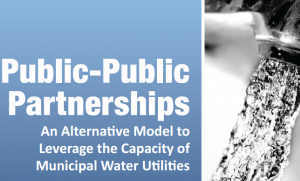
FoodandWaterEuropePublicPublicPartnershipsBrussels – Solving the tragedy of almost 900 million people around the globe lacking access to safe water, and 2.6 billion lacking access to sanitation requires innovative solutions to fixing inadequate and underfunded infrastructure. But a new report released today by the consumer advocacy group Food & Water Europe highlights how public-public partnerships have successfully and inexpensively provided these critical resources to communities around the globe. Public-Public Partnerships: An Alternative Model to Leverage the Capacity of Municipal Water Utilities, shows that municipalities can forge partnerships with one another to efficiently deliver drinking water and wastewater service while ensuring that these resources are kept under public control.

“All too often, communities that cannot afford to maintain their own drinking and wastewater systems are forced to sell or lease them to private entities, which often provide subpar service at higher rates,” said Food & Water Europe Executive Director Wenonah Hauter. “Public-public partnerships allow communities to avoid the woes associated with privatized service and ensure that essential drinking water supplies and sewer systems stay in the public’s hands.”

Under a public-public partnership, two or more water utilities or non-governmental organizations pool resources, buying power and technical expertise. Such partnerships provide the same advantage that a private utility could deliver without the workforce reductions, poor customer service, rate increases and service interruptions that private utilities are notorious for. Because such partnerships do not involve investors who expect a cut of the savings, efficiencies generated are reinvested into the system, not shareholder bank accounts.

Public-public partnerships can be successfully implemented on a variety of scales—within nations, across national boundaries and between industrialized nations and developing ones. Some examples include:

  • The Baltimore Regional Cooperative Purchasing Committee, a group of communities in Maryland saved $1.5 million in 2010 by partnering with one another.
  • In Puerto Cortés, Honduras, a partnership among five civil society groups created a new water utility that was eventually able to provide water to 98 percent of the city’s residents 24 hours a day whereas the city’s old water utility only delivered water to 79 percent of residents, 14 hours a day.

For communities in the developing world, these partnerships can serve as the foundation for sustainable economic development. Partnerships between water systems in industrialized nations and those in developing countries can improve water quality and allow parties to share best practices. Industrialized countries can provide management and technical expertise in these cases while ensuring that costs are kept low for consumers. This model has been particularly successful in Africa, where over half a dozen cross-border utility partnerships have been forged since 1987.

The European Commission recognized the advantage of such cross border partnerships by designating €40 million in 2010 for establishment of non-profit water and sanitation sector PUPs in African, Caribbean and Pacific countries. Importantly, the EU Water Facility guidelines specifically bar profit-making endeavors, thus precluding public-private partnerships from receiving grant funding.

“Tight economic times often mean that communities have a hard time maintaining their drinking water and sanitation systems, and through austerity measures are being forced into leasing or selling these assets to private entities in order to receive bail outs. But privatization has already proven to be a failure. Public-public partnerships are a cheap, efficient method of providing essential drinking water and wastewater services. Governments around the globe should implement policies to facilitate them,” concluded Hauter.

See the report.

For more information, please contact:

Gabriella Zanzanaini, gzanzanaini(at)fweurope(dot)org, +32 488 409 662

World Water Forum Attendance Reportedly Down as Activists Ramp Up Preparations for Alternative Forum

Categories

Food

Brussels – Critics of the triennial World Water Forum are encouraged by the failure on the part of forum organizers to attract large numbers to this year’s event taking place March 12-17 in Marseille.

Forum organizers announced at a press conference last week that only 2,000 people had fully registered, while another 2,000 were yet to be confirmed. This falls dismally short of the 20,000 participants that had been anticipated.

The small number of registrations also comes despite the fact that various national, regional and municipal authorities have poured millions of euros of public funds into sponsorship of the event.

“It isn’t just the World Water Forum that is failing,” says Maude Barlow, senior advisor to the 63rd President of the UN General Assembly. “Water privatization has failed communities around the world and a growing number are now reclaiming control of their water. In this context, it is no surprise that this illegitimate Forum is no longer able to attract attention.”

Notably, the Norwegian Ministry of Foreign Affairs has already stated that it will not be attending this year.

At the 2009 World Water Forum in Istanbul, 24 governments signed a counter-declaration recognizing water as a human right in opposition to the forum’s official ministerial declaration. And in a scathing criticism of the World Water Forum, then-president of the United Nations General Assembly Father Miguel d’Escoto Brockmann called for the UN to hold its own event to address the global water crisis.

“It is significant for the World Water Forum to show signs of crisis in Marseille, which is where the World Water Council was founded,” says French MEP Michèle Rivasi. “Re-municipalization is gaining speed in France, regardless of the strong support for privatization from the French government.”

Groups from around the world—who view the forum as a corporate trade show disguised as a multi-stakeholder conference—are organizing the Alternative World Water Forum (in French, Forum Alternatif Mondial de l’Eau, or FAME). They have invited governments to a consultation with civil society outside the forum on the implementation of the human right to water.

Contact: Darcey Rakestraw, drakestraw(at)fwwatch(dot)org, 202-683-2467; Gabriella Zanzanaini, gzanzanaini(at)fweurope.org, +32 488 409 662; Meera Karunananthan, mkarunananthan(at)canadians.org, +1 613 355 2100

Pour diffusion immédiate

Mardi 14 février 2012

Baisse apparente de participation au Forum Mondial de l’Eau alors que des militants accélèrent les préparations du Forum Alternatif

Bruxelles–Les critiques du rendez vous triennal que constitue le Forum mondial de l’eau sont encouragés par l’incapacité des organisateurs du Forum à attirer beaucoup de monde à l’événement de cette année qui aura lieu du 12 au 17 mars à Marseille.

Les organisateurs du Forum ont annoncé à l’occasion d’une conférence de presse la semaine dernière que seulement 2 000 personnes s’étaient inscrites en bonne et due forme, tandis que l’inscription de 2 000 autres personnes était encore en attente de confirmation. C’est une diminution extrême par rapport au nombre de 20 000 participants qui étaient attendus.

Le petit nombre d’inscriptions reçues se produit également malgré le fait que diverses autorités nationales, régionales et municipales ont versé des millions d’euros de fonds publics dans le parrainage de l’événement.

« Ce n’est pas seulement le Forum mondial de l’eau qui échoue, » a dit Maude Barlow, conseillère principale auprès du 63e président de l’Assemblée générale des Nations unies. « La privatisation de l’eau a berné les collectivités du monde et le nombre de ceux qui réclament maintenant le contrôle de leurs eaux augmente. Il n’est pas surprenant dans ce contexte que ce Forum illégitime n’arrive plus à attirer l’attention, » a t elle ajouté.

Entre autres, le Ministère norvégien des affaires étrangères a déjà déclaré qu’il ne participerait pas au Forum de cette année.

Lors du Forum Mondial de l’eau 2009 à Istanbul, 24 gouvernements qui s’opposaient à la déclaration ministérielle officielle du Forum avaient signé une contre déclaration reconnaissant que l’eau est un droit humain. Et dans une critique accablante du Forum Mondial de l’Eau, le président de l’Assemblée générale des Nations Unies à l’époque, le père Miguel d’Escoto Brockmann, avait demandé à l’Organisation des Nations unies d’organiser son propre événement pour se pencher sur la crise mondiale de l’eau.

« Il est révélateur que le Forum mondial de l’eau affiche des signes de crise à Marseille, qui est l’endroit où le Conseil mondial de l’eau a été fondé, », a déclaré la députée européenne Michèle Rivasi. « La remunicipalisation gagne de la vitesse en France, malgré le soutien ferme du gouvernement français pour la privatisation. »

Des groupes du monde entier, qui considèrent le Forum comme une foire commerciale déguisée en conférence de multiples intervenants, organisent le Forum Alternatif Mondial de l’Eau, le FAME (Alternative World Water Forum en anglais). Ils ont invité les gouvernements à participer à une consultation avec la société civile, à l’extérieur du Forum, sur la mise en œuvre du droit humain à l’eau.

Over 25,000 People Tell Ahold: Stop Misleading Consumers, Genetically Modified Toxic Soy is Not Responsible!

Categories

Food

Photo opportunity: Public demonstration and petition handover

When: Thursday 9 Feb 2012, 12.30-13.30

Where: Amsterdam, Ahold CSR office, Piet Heinkade 167-173

On Thursday, 9 February multinational food retailer Ahold will receive the signatures of 26.000 people across Europe demanding an end to greenwash projects like the Round Table for Responsible Soy (RTRS). Hugo Byrnes, director of product integrity at Ahold and the company’s representative in the soy roundtable, is invited to accept the signatures at 13.00 in front of his office.

The petition was kicked off in six countries in 2011 and targeted supermarket chains and food companies around Europe like Ahold, Aldi, Arla, Carrefour, Colruyt, Coop, Delhaize, Marks & Spencer and Unilever. International environmental groups including Friends of the Earth International, Action Aid, Global Forest Coalition and Food & Water Europe supported the action.[1]

Tjerk Dalhuisen of campaign group Toxicsoy.org says: “Europe imports 34 million tons of genetically modified (GM) soy every year, mainly to feed factory farmed animals. This system can never be called responsible and does not deserve a green label.”

“The criteria proposed by the Round Table on Responsible Soy (RTRS) do not guarantee any level of ‘responsibility’. Soy plantations can still expand at the expense of forests and small farms; large scale pesticide spraying on soy farms will continue to poison people and the environment.”[2]

Eve Mitchell of Food & Water Europe added, “Food & Water Europe is concerned that the EU continues to rely far too heavily on imported soya from highly GM damaging monocultures, including to fuel factory farming. We cannot continue to export our environmental and social damage in this way, and consumers have a right to see on food labels where this imported GM soya is being used as animal feed.”

The RTRS is an initiative of the World Wildlife Fund and the soy industry and companies with a vested interest in soy expansion such as the agribusiness and oil giants Monsanto, Syngenta, Cargill, BP and Shell. The Dutch food and animal feed industry are actively supporting the RTRS, and the Dutch government is providing financial support to the scheme in particular via the Sustainable Trade Initiative (IDH).

The soy roundtable has faced strong opposition from civil society for years. Hundreds of organisations from Europe and South America have signed declarations against the RTRS.[3] WWF and the Dutch NGOs involved in the RTRS have been criticised by nine Belgian NGOs.[4] In April 2011 the German platform of environmental organisations DNR (Deutsche Naturschutzring) sent a letter to WWF and asked them to withdraw from the RTRS stating, “DNR cannot accept that WWF protects a failed system of agriculture and secures the profits of companies like Monsanto and BP.”[5] 

The soy that is being certified by the RTRS is mostly Monsanto’s RoundupReady GM soy, made resistant to Monsanto’s own herbicide Roundup based on glyphosate, which has been increasingly linked to serious health impacts on humans and wildlife.[6] Mixtures of pesticides are sprayed over large surfaces by airplane or large machines, causing severe health problems for the local population, pollution of water and damage to crops.

Hugo Byrnes on behalf of Ahold wrote in response to the petition that there are at present too few alternatives to soy imports. However, retailers like Ahold drive the use of soy by promoting cheap meat products. Instead, soy animal feed should be replaced by locally grown animal feed, and factory farming should be banned.

He also claimed that Ahold “does not intend to communicate the use of certified soy to consumers via packaging”, which shows once more that certified “responsible” soy has already failed as a brand.

Meike Vierstra (ASEED Europe) says: “Supermarkets that participate in this greenwash are making a big mistake. Consumers will understand that this label is misleading. We say to these companies: Don’t sell the lie.” 

For more information:

Eve Mitchell, Food & Water Europe

Phone: +44 (0)1381 610 740 email: [email protected]

Tjerk Dalhuisen, Toxicsoy.org,

Mobile: +31 6 14699126, email: [email protected]

Nina Holland, Corporate Europe Observatory

Mobile: +31-6 30285042, email: [email protected]

Meike Vierstra, ASEED Europe, Mobile: +31-6-5248 1471, e-mail: [email protected]

Notes to the editor:

[1] Petition text: http://www.toxicsoy.org/toxicsoy/Action/action.html.
Support letter: http://www.toxicsoy.org/toxicsoy/news/Artikelen/2011/3/8_Letter_to_supermarkets__responsible_soy_is_misleading_consumers_files/Please%20reject%20RTRS-certified%20soy%20letter-1.pdf

[2]More critical analysis on the RTRS criteria: Certified Responsible? GM Watch, CEO and Friends of the Earth, March 2011. http://www.gmwatch.eu/images/pdf/rtrsbackgrounderfinal.pdf

[3] Open Letter: Growing Opposition to Round Table on Responsible Soy. June 2010.

[4] Letter from Belgian NGOs: http://www.gifsoja.nl/Gifsoja/nieuws/Artikelen/2011/2/4_Artikel_1_files/11%2002%2004%20%20brief%20NL%20organisaties%20RTRS.pdf 

[5] Letter Deutsche Naturschutzring to WWF:

[6] Antoniou, M., Brack, P., Carrasco, A., Fagan, J., Habib, M., Kageyama, P., Leifert, C., Nodari, R., Pengue, W. 2010. GM Soy: Sustainable? Responsible? http://www.gmwatch.org/files/GMsoy_SustainableResponsible_Sept2010_Summary.pdf

Food & Water Europe is a program of Food & Water Watch, Inc., a non-profit consumer NGO based in Washington, D.C., working to ensure clean water and safe food in Europe and around the world. We challenge the corporate control and abuse of our food and water resources by empowering people to take action and transforming the public consciousness about what we eat and drink.

Food & Water Europe Director Warns European Policymakers About Major Risks of Fracking

Categories

Food

Brussels – This week, Food & Water Europe executive director Wenonah Hauter led a delegation from Poland, the UK and Belgium meeting with MEPs about the major risks involved in using hydraulic fracturing – or fracking – to extract shale gas. The aim of the visit to Brussels was to inform the political debate within the EU about the negative American experiences with fracking, both in terms of the disastrous environmental record of the shale gas industry as well as the exaggerated claims about its economic benefits. Food & Water Europe hopes these conversations will contribute to the two own-initiative reports on shale gas that are currently being prepared in the European Parliament.

“The dubious benefits and poor environmental record of shale gas development in the U.S. serve as a cautionary tale for Europe,” said Wenonah Hauter. “It is worrying that European policymakers perpetuate the myth of shale gas as a viable bridge to a low carbon future.” Recent studies reveal that widespread shale gas development may actually worsen global climate change. Apart from the problematic impact of shale gas on climate change, fracking has caused widespread environmental and public health problems and created serious, long-term risks to underground water resources. Since the shale gas boom has really taken off in the U.S., the evidence of these major risks involved in fracking has piled up.

Based on these American experiences, a growing number of European countries and regions have imposed a moratorium on fracking. In May 2011, France banned fracking, and this month Bulgaria also imposed a fracking ban. A number of German states, Swiss cantons, Irish counties, and regional and local governments have taken a similar approach. “Opposition to shale gas is building in communities where fracking activities have started and where the impacts will be felt,” said Hauter. “The wait-and-see approach of the European institutions will become increasingly untenable as fracking for shale gas starts to endanger our precious water resources”.

In addition, the economic benefits that were promised by the energy corporations involved in shale gas drilling have been grossly exaggerated, according to a recent analysis by Washington, D.C. based Food & Water Watch, which showed one job claim had been exaggerated by 900 percent.

Contact: Geert De Cock tel. +32 (0)2 893 10 45, mobile +32 (0)484 629.491, gdecock(at)fweurope(dot)org