UK Supermarkets Challenged Over “Effective Support” for Megadairies

Categories

Food

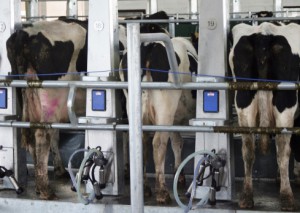
dairy cowsBrussels— Today, consumer organization Food & Water Europe wrote to Asda, Morrison’s and The Co-op asking them to clarify their corporate policies on megadairies, asking if they sell milk as a loss leader and, if so, how they justified selling milk below cost — a trend that is crippling the ability of small- and medium-sized farmers in the EU to make a living and stay in business. The letters also suggest they are supportive of massive megadaries, which consolidate milk production into the small number of giant massive operations that can scale up to meet the challenges of providing cheap milk to retailers—but at a great cost to communities where these megadairies operate and consumers who want sustainable dairy choices that support farmer livelihoods.

“Consumers need to know if their favourite retailer is helping, behind the scenes, to create polluting megadairies and harm farmer livelihoods,” said Wenonah Hauter, Executive Director of Food & Water Europe. “We expect these retailers to clarify their policies about megadairies and justify selling milk as a loss leader.”

“The financial situation for dairy farmers across the EU is perilous, and many continue to go out of business. The reason they can’t stay in business is due to the way they are treated by processors and supermarkets,” continued Hauter.

The practice of selling milk as a loss leader piles additional pressure on farmers as supermarkets drive the farmgate price lower and lower while farmers’ costs of production are on the rise. “We have not noticed a commensurate drop in the retail price families pay for milk at the supermarket, so presumably the supermarkets are pocketing the difference. It’s time milk was valued properly and farmers paid a decent price for the hard work they do producing something we all have in our fridges,” said Hauter.

“As you may be aware, UK consumers are very hostile to megadairies, for very good reason. The continued practice of selling milk as a loss leader, coupled with repeated cuts in the price paid for milk in the first place, is undisputedly driving increasing numbers of UK small and family dairies out of business,” says Food & Water Europe in its letters to the retailers.

“All supermarkets need to change course urgently before the UK loses traditional dairy farming altogether. If that means supermarkets have to give up a tiny fraction of their profits, so be it. Anything else is artificial distortion of the market and comes at far too great a cost.”

Contact: Eve Mitchell – emitchell(at)fweurope.org, tel + 44 (0)1381 610 740)

Ocean-Farmed Fish, Brought to You by Monsanto and Cargill

Categories

Food

 Soy Industry Stands to Gain Hundreds of Millions Annually from Open Ocean Aquaculture

Washington, D.C. and Brussels— If proponents of soy in aquaculture alliance have it their way, soy will be used to feed fish in open ocean pens in federal waters, a move that would negatively impact the marine environment as well as the diets of both fish and consumers.

Food & Water Watch and Food & Water Europe’s new report, “Factory-Fed Fish: How the Soy Industry is Expanding Into the Sea,” shows how a collaboration between two of the most environmentally damaging industries on land and sea —the soy and open ocean aquaculture industries, respectively—could be devastating to ocean life and consumer health. And since much of the soy produced in the United States is genetically engineered (GM), consuming farmed fish would likely mean eating fish that are fed GM soy.

“Our seas are not Roundup ready,” said Wenonah Hauter, Executive Director of Food & Water Watch. “Soy is being promoted as a better alternative to feed made from wild fish, but this model will not help the environment, and it will transfer massive industrial farming models into our oceans and further exacerbate the havoc wreaked by the soy industry on land—including massive amounts of dangerous herbicide use and massive deforestation.”

The powerful soy industry, which is well represented in Washington, D.C. and Brussels, stands to gain over $200 million (€160 million) each year by aggressively promoting the use of soy to feed farmed fish at a time when more and more consumers are eating seafood sourced from aquaculture or fish farms. Close to half of the seafood we consume globally comes from these factory fish farms.

Unfortunately, increased use of soy in fish feed could do greater harm to the health of fisheries by increasing the amount of soybeans grown. Like other monoculture crops, soybeans require large amounts of fertilizer for their production. Much of this fertilizer gets washed off the fields and into waterways that eventually lead to important fisheries such as the Gulf of Mexico or the Chesapeake Bay. The nitrogen and phosphorus from this fertilizer contributes to the dead zones in these fisheries, reducing the number of fish that live there and the ability of fishermen to catch them.

Relying on soy to feed farmed fish could also have devastating affects on consumer choice. In 2007, there were total of 279,110 soybean farms. A 2008 report indicated that only 1,336 soybean farms were certified organic, which do not allow the use of GM crops. This leaves a lot of room for non-organic soybean farms to produce crops from GM seeds. GM soy-fed fish would probably not need to be labeled, so consumers wouldn’t know that they were eating fish fed with GM soy. Considering that Monsanto and Cargill would be big players—two agribusinesses that use GM seeds—this scenario seems likely.

While the soy industry is busy promoting soy as an environmentally friendly alternative to fish feed from wild fish, it is clear that soy is not a natural food for fish to eat, and that its use can be destructive to ocean ecosystems. Fish have a difficult time digesting it, and it causes nutrient deficiency. As a result, fish tend to produce excessive amounts of waste, which attracts disease and bacteria, and disrupts the normal ecology of the immediate marine environment.

To access the report, go to: http://www.foodandwaterwatch.org/reports/factory-fed-fish-europe/

For any questions regarding the report, please contact Rich Bindell at +1 202-683-2457 or [email protected].

The UN Conference on Sustainable Development in Rio Takes 20 Steps Back

Categories

Food

Statement by Wenonah Hauter, Executive Director of Food & Water Watch and Food & Water Europe

Washington, D.C. and Brussels—“For the UN Conference on Sustainable Development (CSD) wrapping up today in Rio de Janeiro, 20 years has sadly not meant progress on critical environmental issues that affect our food and water and our communities that depend on vital common resources. In fact, the only sector that progressed at Rio+20 was the private sector. Corporations are more entrenched than ever before in the UN process.

“By our rough count in the final document that heads of state will consider today, the concept of the ‘public sector’ was mentioned 11 times in comparison to the ‘private sector,’ which was mentioned 20 times. Clearly, this is an indication of priorities. The conference was stamped with corporate marketing by Coca-Cola, Petrobras and others, while key panelist positions were given to Nestlé, Aquafed, Unilever, Dow Chemical and other major corporations at UN-hosted events.

Despite the highest turnout of heads of state for a global forum, both President Barack Obama and Prime Minister David Cameron were conspicuously absent at the CSD, preferring instead to offer their political heft at smaller, more elite events, such as the G20, which took place just a few days prior. The most powerful nations are not setting forth a global vision on the most critical issues affecting the globe and have squandered a key opportunity to advance concrete action.

“The final outcome document is in support of everything, but doesn’t commit to anything. It was continuously stated by the U.S., Canada, and other powerful countries that the CSD was ‘not a pledging conference,’ thus setting the tone for negotiations throughout the week and lowering expectations. There will be no legally-binding outcomes from this conference. It was effectively an exercise in public relations by the industrialized nations.

“Numerous promising ideas were proposed in the draft text only to be cut during the negotiating process due to lack of consensus and pressure from vested interests, including regulation that would curb food speculation, a tax on financial transactions that could contribute to poverty eradication and climate change adaptation and mitigation, and clear deadlines for ending fossil fuel subsidies.

“Rio+20 represents 20 steps back for both the multilateral UN process and global sustainability.”

Contact: (Gabriella Zanzanaini +32 488 409 662)


During Green Economy Negotiations Leading Up To Rio +20, Prestigious Water Institute Aids Pepsi Bluewashing

Categories

Food

Joint statement of Maude Barlow, Chairperson of the Council of Canadians and Wenonah Hauter, Executive Director of Food & Water Europe

Ottawa and Brussels – “As activists from around the globe are convening at the Rio +20 conference to protect our common resources from private interests, the Stockholm International Water Institute’s decision to award PepsiCo for water efficiency is a cruel irony. PepsiCo has inflicted massive harm on vital community water resources around the globe. This award validates and aids that activity, further justifying PepsiCo’s PR efforts to spin itself as “green.”

“This award legitimizes PepsiCo’s dubious business practices in an age of increasing water scarcity. PepsiCo has routinely depleted our groundwater resources, undertaken unsustainable intra-basin water transfers and polluted community water resources. Praising the corporation for reported water efficiency does little to reverse its damaging legacy. 

“PepsiCo recently touted its commitment to the human right to water. But privatizing and destroying a vital and irreplaceable resource directly undermines human rights. The company’s hollow promise won’t stop communities from fighting its control of their water.

“There are some resources that simply shouldn’t be bottled, traded or sacrificed to the market, and that is especially true of water. While multinational corporations lobby for an unfair share of our natural resources, no respectable institution should award them for their greedy, destructive behavior.

“Furthermore, the promotion of Pepsi through Stockholm Water Week highlights the influence of corporations within global policy spaces. Over the last decade, multinational corporations have gained tremendous access to decision-makers within UN agencies and summits, as well as through corporate-run multi-stakeholder meetings frequented by high-level government and UN officials—including Stockholm Water Week and the World Water Forum. This award to Pepsi underscores the need for international public institutions and policy spaces that defend the rights of people and nature, not ones that promote corporate interests.  

“We must not allow corporations to influence and benefit from the vital negotiations in Rio. Rio+20 must adopt principles for a true green economy, not a greenwashed economy that further privatizes nature for profit.”


###


Since 1985, the Council of Canadians has brought people together to act for social, economic and environmental justice in Canada and around the world. With chapters and members across the country, the Council of Canadians is Canada’s largest public advocacy organization.

Contact: Kate Fried, +1 202-683-4905; [email protected] 

Viewpoint: Why We Are Opposed to Shale Gas for Europe

Categories

Food

Shale gas a dangerous experiment on environment and human health

Shale gas, shale oil and coal bed methane have arrived in Europe under the banner of energy security, and more worryingly, environmental protection. However, the reality is that shale gas and the process of hydraulic fracturing (or ‘fracking’) represent a dangerous experiment on both the health of European citizens and the environment, while the economic viability is debateable.

Last month, following the presentation of MEP Boguslaw Sonik’s draft report on shale gas for the parliamentary committee working on Environment, Public Health and Food Safety, our coalition of environmental and health NGOs released a joint position statement warning the European Parliament of the dangers of fracking. Sonik’s report either omitted or minimised the risks and negative impacts of fracking, and replaced them with overly optimistic industry assessments interests. This characterises how shale gas is being promoted at the European level: obvious loopholes in current regulatory frameworks are glossed over, and the true environmental and economic costs of shale gas, and the financial viability of the industry, are misrepresented.

The European debate however, is out of touch with citizens’ concerns about clean water, air quality, etc. This unconventional fossil fuel has not gone unnoticed across Europe. Citizens’ groups have sprung up around Europe that question the lack of consent or involvement in decision-making granted to local communities affected by shale gas exploration, and question outright the safety of the process. These grassroots groups have recognised that shale gas poses a serious threat to both local communities and the environment and are intent on opposing it. Bans on fracking are already in place in France and Bulgaria, moratoria in regions of Germany and Switzerland, and in the Netherlands, with Romania and the Czech Republic considering the same.

It’s time for decision makers to start listening. The rush for shale gas began without proper political debate on the costs and benefits of this energy source. To date, there has been no independent, comprehensive or detailed analysis of the EU regulatory framework that applies to both exploration and exploitation. We know little about how Europe’s Water Framework Directive might cover the specifics of fracking and its impact on water resources. Vast amounts of water are required to extract shale gas, creating significant social and environmental pressures at local and regional levels.

Water is definitely a key issue and there has been no assessment of the capacity of water treatment plants in affected regions to handle flow back waste water, nor has there been any assessment of monitoring and enforcement capacities of Member State authorities across all the different impact areas.

There has been no scientific study of the risks of fracking-related air or soil pollution or water contamination, and the long-term health impacts of large-scale shale gas extraction remains unknown. Loopholes in the European chemicals legislation (REACH) allow companies to remain secretive about chemicals used during fracking, making it impossible to assess the environmental and health risks. These toxic chemicals used whilst fracking, along with the hazardous and radioactive materials naturally present underground, smog particulates and other pollutants released during the process can contaminate surface and groundwater, and pollute the air and soil – seriously threatening human health.

There is still no consistent process in Europe that guarantees the free and fully-informed consent of local communities in decision-making – most communities only find out about shale gas developments when the drilling rigs arrive.

All these problems and unknowns amount to a serious question mark that hangs over shale gas and its position within Europe’s energy future. When European legislation catches up with the reality of shale gas exploitation and extraction, and industry covers all the costs involved, there is no way that shale will be a financially attractive option. The financial viability of shale gas is questioned even by those within the industry: Peter Voser, CEO for Royal Dutch Shell, concludes that the development of shale gas in Europe and worldwide “will be limited as a result of regulation, legislation, high population density and the challenge of obtaining permits” and could face major cost overrun in order to comply with environmental regulations.

The European Union has made a clear commitment to move to a low-carbon economy, agreeing to almost full decarbonisation of its power sector by 2050. Unconventional fossil fuels like shale gas sideline Europe’s vision for a more sustainable, low-carbon energy system. There is no scientific agreement that the lifecycle greenhouse gas emissions of shale gas will be significantly lower compared to other conventional fossil fuels, even the most carbon-intensive ones like coal. The combustion stage of natural gas may be cleaner than that of coal, but a life-cycle analysis of shale gas processes tells a different story and does not warrant the “transition fuel” label.  Such fuel could instead lock the EU into a continued dependency on fossil fuels at the expense of renewable energy, energy savings and significant reductions in emissions – the only genuine path towards an environmentally sustainable and healthy future.

We want European member states to suspend ongoing activities, to abrogate permits, and to place bans on any new projects, whether exploration or exploitation. Europe faces some serious challenges in the next decade, and this shouldn’t be one of them. Europe must embrace a low-carbon future, based on renewable energy and improved energy savings.

Contact:

Antoine Simon, Friends of the Earth Europe

Geert de Cock, Food and Water Europe

Lisette Van Vliet, Health and Environment Alliance 

Position statement on shale gas, shale oil, coal bed methane and ‘fracking’

Categories

Food

We, a coalition of environment and health NGOs, have grave concerns about hydraulic fracturing (fracking) of shale gas, shale oil, and coal bed methane (CBM) in Europe. In particular, because of its impacts in the following areas:

Climate: there is no scientific agreement that unconventional gas (such as shale and CBM) will have significantly lower total greenhouse gas emissions compared to other conventional fossil fuels (e.g. coal);

Energy: development of shale gas and CBM will be at the expense of cheaper and safer policies to save energy and speed up the transition to renewable energy and the reduction of greenhouse gas emissions;

Water pollution: fracking could cause the contamination of surface and groundwater (including drinking water) with toxic chemicals used in fracking fluids,* and increasing the concentration in such water of methane and hazardous and radioactive materials that naturally occur in shale and coal;

Water use: fracking involves pumping vast amounts of freshwater underground, much of which becomes irretrievable and / or contaminated; because vast quantities of fresh water are required in fracking operations, this will create significant social and environmental pressures at least at a local and regional level, and particularly in regions suffering from water scarcity;

Air pollution: Unconventional gas drilling/operations produces soot and smog precursors, particulate matter, methane and natural gas;

Soil pollution: fracking carries the risk of leakages from polluted tailing ponds, wastewater and well blowouts;

Land use: fracking disrupts the landscape and impacts upon rural and conservation areas;

Noise: shale gas development generates noise pollution from equipment and transport that affects local residents, agricultural livestock and wildlife;

Seismic activity: fracking increases the risks of earthquakes, which in turn increases the risk of damage to, and leakages from, gas wells;

Cumulative and combined health and environmental impacts on communities and workers in the unconventional gas industry: for example, fracking causes additional exposure to toxic chemicals;

Socio-economic impacts on communities: fracking can drive “boom and bust” cycles in local economies, undermining more sustainable agricultural and tourism economies.

All of these effects have direct and indirect impacts on individual and public health. Many of these impacts are not only local, but can be felt regionally and even globally. Without a comprehensive scientific assessment of the impacts of fracking, an unconventional gas boom would be an enormous experiment on the environment and human health.

We further note the following:

1. In order to limit global warming below 1,5 degrees Celsius, and thereby prevent dangerous climate change, fossil fuels must be phased out as quickly as possible. We believe renewable energy, energy savings and a significant reduction of CO2 emissions provide the only viable path to an environmentally sustainable and healthy future. Exploiting unconventional fossil fuels such as shale gas, shale oil and coal bed methane will increase total greenhouse gas emissions since further development of these fuels will increase the world’s dependency on fossil fuels and consequently slow down the large-scale deployment of clean energy renewables and energy savings.

2. Fracking is a high-risk activity that impacts human health and the wider environment. Fracking for unconventional fuels runs counter to the EU’s commitment to achieving a high level of environmental protection, as enshrined in Article 37 of the Charter on Fundamental Rights. Also article 35 of the Treaty commits the EU to ensuring a high level of human health protection in all of the Union’s policies and activities. The EU is tasked with developing environmental policies based on “the precautionary principle and on the principles that preventive action should be taken, that environmental damage should as a priority be rectified at source and that the polluter should pay” (Article 191, Treaty on the Functioning of the European Union). We therefore believe that the development of unconventional gas within the EU runs counter to EU Treaty obligations.

3. We believe the above mentioned principles are violated due to the absence of:

– A comprehensive and detailed analysis by an independent entity of the EU regulatory framework, as it applies to both exploration and exploitation phases;

– Sections in the Water Framework Directive or any relevant subsidiary laws (e.g. groundwater, EQS) covering fracking specificities;

– A scientific study of fracking-related air pollution and the long term health impacts;

– A scientific study of fracking-related water contamination and the long term health impacts (both from contamination by the naturally occurring hazardous and radioactive materials released in the fracking process, and from methane and other fracking fluid contaminants interacting with water disinfectant products, etc.);

– A full assessment of the capacity of all relevant water treatment plants, in all affected countries, to handle flow back waste water, and of water treatment costs, based on the polluter pays principle;

– A full assessment of the monitoring and enforcement capacities of Member State authorities across all the different impact areas;

– A scientific assessment of cross-border risks of water contamination and air pollution, with public input;

– A European Commission Green paper with full public participation of all relevant stakeholders, on the areas pertaining to the impacts of fracking activities that are not covered by existing EU regulations;

– A clear and binding set of European Best Available Technology Reference Standards (Brefs) for fracking operators.

4. To date, there is no consistent process in Europe that properly includes citizens and communities in decision-making related to shale gas, shale oil or coal bed methane. Free and fully-informed consent of local communities is not applied for most fracking projects prior to both exploration and exploitation phases, while they should be placed at the heart of the discussions.

5. Companies involved in fracking are not disclosing an exhaustive and detailed list of the chemicals used for each project, thus making it impossible to assess the environmental and health risks from exploitation and exploration (including full life cycle impacts). Currently the different deadlines and requirements in the REACH legislation mean that the information about chemicals is not automatically available to the public, and REACH controls on fracking may not come into force for a long time.

Until all these problems are adequately addressed, we believe that no further shale gas, shale oil and coal bed methane activities should proceed. We call on all Member States to suspend all ongoing activities, to abrogate permits, and to place a ban on any new projects, whether exploration or exploitation.

The Commission, as guardian of the treaties, should ensure timely and full legal compliance of Member States with all EU laws that pertain to shale gas, shale oil and coal bed methane, and bring forward legal proposals to cover those aspects not yet effectively addressed in EU law.

We also call on the EU, its Member States and European Financial Institutions to cease providing financial or political support to shale gas, oil and coal bed methane development projects. Any financial and political assistance provided to shale gas projects in countries of the Global South should be redirected towards the production and promotion of renewable energy sources and energy savings, in line with the Millennium Development Goals.

For more information please contact:

Antoine Simon, Friends of the Earth Europe

Tel: +32 (0) 2 893 10 18, Mob: +32 (0) 486 685 664, email: antoine.simon(at)foeeurope.(dot)org

Geert De Cock, Food and Water Europe

Tel: +32 (0) 2 893 10 45, Mob: +32 (0) 484 629 491, email: gdecock(at)fweurope(dot)org

Lisette van Vliet, Health and Environment Alliance

Tel: +32 (0) 2 234 36 45, Mob: +32 (0) 484 614 528, email: lisette(at)env-health(dot)org

Tara Connolly, Greenpeace

Tel: +32 (0) 2 274 19 21, Mob: +32 (0) 477 790 416, email: tara.connolly(at)greenpeace(dot)org