Last Saturday, thousands of people across the world gathered to participate in the Global Frackdown: an international day of action to demand a ban on fracking and other dangerous forms of oil extraction. By almost any measure, this year’s collection of rallies, performances, public speaking events and educational opportunities was the biggest and most powerful day of action yet — a reflection of the growing movement against fracking, fueled by mounting scientific evidence that this dangerous practice not only poses a significant threat to water, air, health and our communities, but also threatens the climate on which we all depend.
The first Global Frackdown in 2012 featured 200 international events. Last year, we noted over 250 and in 2014 we saw many more — well over 300 — and actually many more including all of the actions in Europe that were also connected with a day of action against three trade agreements. These agreements could make it much more difficult for European communities to prevent fracking. Last year, the Global Frackdown had events in 30 different countries; this year our day of action spread out to 34. Last year, in the U.S. there were actions in 30 states; this year there were actions in 33 states and the District of Columbia. And, this comes on the heals of the People’s Climate March, which was attended by 400,000 and was noted, in part, for the strength of the anti-fracking contingent.
Fracking is full of risks; It threatens water, air, the climate, public health, livelihoods and more.
That much we know.
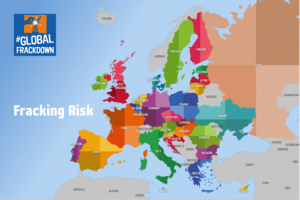
But what if fracking were RISK? As in RISK, the board game, where the goal is to occupy as many territories as possible (keep in mind that the oil and gas industry’s goal is to frack as many territories as possible). The metaphor is not as farfetched as you may think.
This past Tuesday, ahead of the Global Frackdown, Food & Water Watch’s international day of action to ban fracking, we gathered outside the European Parliament in Brussels to play our own version of RISK — “Fracking RISK” — to bring lawmakers and community members up to speed on the many dangers of fracking.
Right now in the UK, European states are offering large swaths of territory to the oil and gas industry for shale gas exploration. Fearful of the many known risks of fracking, local communities are pushing back against this looming threat. Some states have even enacted local, regional and national bans on fracking. Much like the game RISK, the oil and gas industry is trying to control as much territory as it can.
Because of the crisis in Ukraine and the growing dependency of European Union member states, especially in Eastern Europe, on natural gas imports from Russia, the issue of drilling for shale gas has really shot to the top of the EU’s political agenda. Energy security and shale gas are now an integral part of geopolitical discussions in the European Union and in neighboring nations.
So, how does “Fracking RISK” work?
First, you will need to create or find a “board” with all the countries of Europe.
The rules:
Players split into two camps: On one side is Big Oil and Gas; its goal is to spread as many drilling rigs around Europe. On the other side is Local Communities; this team’s goal is to defend its lands against Big Oil and Gas by spreading fracking bans. The teams take turns throwing two dice.
If, for example, Big Oil & Gas throws a total of two or 12, they get to put in five new rigs. Throwing a total of three or 11 earns you four rigs, and so on. The rules of the dice are based on basic probabilities. The same rules apply for how many fracking bans Local Communities gets to put on the map.
There are also cards that each player receives after their turn, which they can cash in on the next turn. For Big Oil & Gas, one card might read: “NATO Secretary General claims anti-fracking groups are KGB spies: Big Oil & Gas gets to put up five extra rigs.” Another could read: “Thanks to a ruling of a corporate tribunal (the Investor-State Dispute Settlement Mechanism currently being negotiated in the EU-US free trade agreement), Big Oil & Gas can overturn four fracking bans”.
Of course, the Local Communities team can earn these cards as well: “Public opinion demands a health impact study: Big Oil & Gas must skip a turn.” Or: “Another train with volatile shale oil blows up: Take three rigs away from Big Oil & Gas”. This one has particular relevance to a densely populated continent like Europe: “Government decides no fracking in densely populated areas: Take five rigs away from Big Oil & Gas”.
So, who won the test-round outside the Parliament on Tuesday? Unsurprisingly, Local Communities overwhelmed Big Oil & Gas by their numbers and quickly spread fracking bans all around Europe.
Check out some pictures and a video of our game. Feel free to suggest some extra rules and cards in the comments section below! On Saturday, October 11, communities all over the world will participate in the Global Frackdown to challenge lawmakers to ban fracking.
Join an event near you! www.globalfrackdown.org/events
You can’t end up right if you start out wrong. At least it’s awful hard (and takes a big helping of blind luck).
The EU is showing every indication of making a very bad turn indeed on biodiversity offsetting, and you can help us put on the brakes. Biodiversity offsetting is all the rage lately because it offers a seemingly easy way for governments to allow habitats to be destroyed by companies that can afford to pretend to make up for the damage somewhere else. It doesn’t work.
Offsetting is getting a lot of attention, including from esteemed organisations like the London Zoological Society. The zoo hosted a conference on offsetting in April attended by a host of representatives of companies that make money from this kind of thing. They were addressed by no less than the (now former) UK Minister for the Department for Environment, Food and Rural Affairs Owen Patterson offering official support.
An extreme version of the erroneous biodiversity offsetting is the No Net Loss concept. No Net Loss (or NNL in the jargon) says you can somehow recreate the nature you destroy without really causing any “damage” at all, even if you don’t “replace” like-for-like (so destroying a salt water marsh and replacing it with forest of the same “value” equates to no overall damage done – it’s mind boggling).
We’re not buying it and neither should you. Here’s how you can help:
The European Commission is holding a consultation on adopting NNL as a key principle in Europe. The consultation is part of implementing the EU Biodiversity Strategy 2020 (which “aims to halt biodiversity loss and to conserve ecosystem services”). The Strategy’s Action 7 is “to ensure no net loss of biodiversity and ecosystem services”. The Commission proposes to use NNL and biodiversity offsetting to do it.
The Commission says the purpose of its consultation is “to gather views” about that proposal. We need to tell them we don’t like it one bit.
Nature Not For Sale has written a letter to the Commission we can all sign. Please do.
The letter explains our reasons for rejecting offsetting.
It tells the Commission, “Nature is a common good that all share rights to and have responsibilities over.” You get the idea. Please help us tell the Commission to get the EU headed in the right direction. I did.
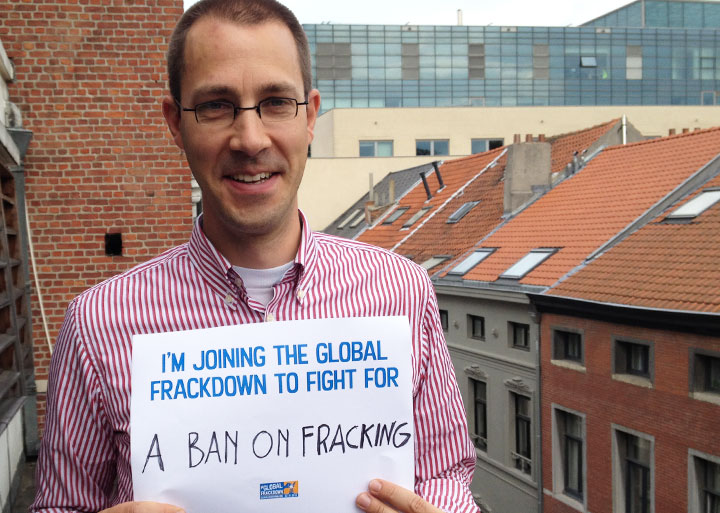
Geert deCock, Food & Water Europe Policy Officer, is joining this year’s Global Frackdown to fight for a ban on fracking.
With just two weeks until the Global Frackdown, we called up our colleague Geert deCock in Brussels to get the low-down on Europe’s fight against fracking — the progress that’s been made and the work that still needs to be done. Prepare to be inspired.
Geert, to start us off, can you tell us a little bit about yourself? Why did you become involved in the fight against fracking?
My name is Geert deCock. I’m Belgian, and I work for Food & Water Watch in Brussels for the European program. My main focus is to campaign for a ban on fracking in Europe and to generally support the groups that oppose fracking in Europe, providing knowledge about fracking, its many harmful impacts and that ways in which we can organize to stop it.
I became involved in the fight against fracking when living in Alberta, Canada (Edmonton), quite close to the tar sands, where I was exposed to a lot of the rhetoric around oil and gas extraction and its “supposed” benefits. That’s when I became politicized about energy and climate and fossil fuels. I saw that there was such a huge gap between what the government was saying about “minimal” risks of tar sands extraction and the real experiences of nations and communities — the very real health impacts tar sands extraction has on people living in those areas and the environment. There’s such a close parallel to fracking where, again, the industry claims the benefits are huge and the risks are minimal, when really, if you talk to the people on the ground, it’s the other way around.
Food & Water Watch is calling for a ban on fracking and an aggressive transition towards renewable energy, all across the globe. Why is it important that communities around the world become involved in this fight, not just those in the U.S.?
Right now in Europe, we don’t have particularly large-scale fracking operations yet. So, it’s important to ban fracking now, before it is too late — before fracking begins and contaminates local water supplies, pollutes the air, industrializes once agrarian communities and really exacerbates global climate change.
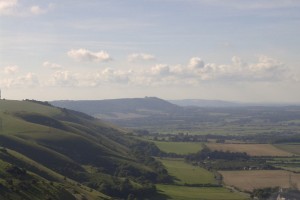
A view of the South Downs in from Devil’s Dyke in southern England. CC by SA(c) IngerAlHaosului/commons.wikipedia.org.
OK, I admit: I had never before heard about the South Downs National Park in England. However, last week, I learned that the planning committee of the park had voted unanimously to turn down an application by shale gas explorer, Celtique Energie, to start drilling and maybe fracking at Fernhurst, a two hour drive south of London. A couple of hours later, I can call myself a South Downs fan. Yes, I want to go on holiday there. Except maybe for blue sky and warm temperatures, the South Downs has lots to offer. Wikipedia informs me that the South Downs has “a rich heritage of historical features and archaeological remains, including defensive sites, burial mounds and field boundaries”. Within the park, there are 37 “Sites of Special Scientific Interest”, protecting the very little that remains of the old chalk grassland. Needless to say, South Downs is a “popular recreational destination, particularly for walkers, horse riders and mountain bikers”. And by drilling and fracking in such an area of outstanding beauty, UK shale gas explorers hope to win the hearts and minds of locals and public opinion more generally? How out of touch can you be? A recent report of the federal environment agency of Germany (covered in our previous blog post) details what is required to extract shale gas from an area of 260 square kilometers (about 16 by 16 kilometers) over a period of 10 years.
144 well pads (one per every 2 square kilometers!)
Despite these facts, the CEO of Celtique has the temerity to state that his application “has been refused on subjective and unjustified grounds”. What is more likely to be the case, is that the planning committee analysed the existing pressures on their national park from agriculture, traffic and housing development and drew the common sense conclusion that adding fracking to the mix simply was not going to work. Despite all this, the UK government’s energy strategy continues to be “going all out for shale”, stressed Prime Minister Cameron. The efforts of shale enthusiasts like David Cameron (but also other mainstream political parties) will continue to fight a losing battle, as people get better informed about shale gas and fracking. In the latest licencing round, almost 60 percent of the UK territory was offered to shale gas explorers to start drilling for shale gas. It should not come as a surprise that new groups are popping up like mushrooms in areas singled out for shale gas drilling. Some of the most vocal groups are Residents Action on Fylde Fracking in the Blackpool area or the Frack Free Balcombe Residents Association, where exploratory drilling was halted last summer due to protests. They are not only determined to stop this terrible development, but they are well organized. Just take a look at all the resources available on the website of a grassroots campaign like Frack Off. This summer, the No Dash for Gas campaign hosted a “Reclaim the power” anti-fracking action camp. And they have the support from larger groups like Friends of the Earth and Greenpeace. The combination of a vibrant and growing anti-fracking movement with the non-stop PR disasters committed by shale gas explorers and the UK government will mean that their shale gas strategy will slowly but surely grind to a halt. With more than half of the UK territory now licensed for shale gas and oil exploration, anti-fracking groups in England, Wales, Northern Ireland and Scotland will be at the forefront of the campaign to ban fracking. On October 11, the Global Frackdown – an international day of action against fracking – will offer a great opportunity to express our solidarity with those communities in the UK under siege from the shale gas industry and its political supporters. Join us on October 11 for the Global Frackdown: http://www.globalfrackdown.org/.
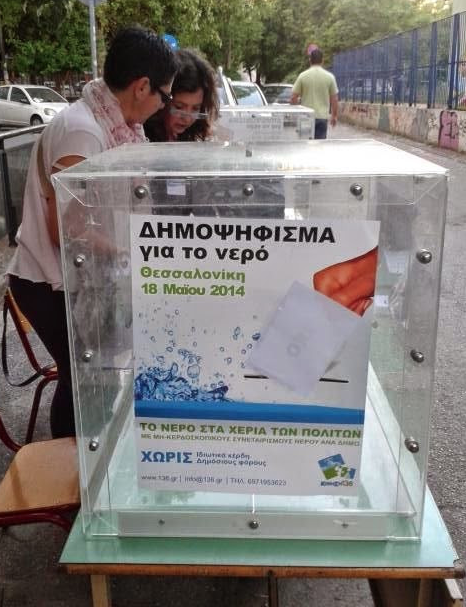
Referendum about water privatisation in Thessaloniki, Greece.
Credit: Save Greek Water
There is an ongoing struggle in southern Europe, where water privatisation is promoted as a way out of the economic crisis. But this summer, a turnaround victory was achieved in Greece: the Council of State ruled against the privatisation of Greek public water companies. Citizens have shown, again, that privatisation can be defeated through a combination of grassroots mobilisation, legal actions and international solidarity.
The story goes back some years ago. Under conditions imposed by the Troika (which includes the International Monetary Fund, the European Commission and the European Central Bank) to reduce Greece’s debt, public water companies in Athens and Thessaloniki were about to be privatised by the government, among other painful and socially unfair measures.
The mobilisation against this measure was massive, and great campaigns were launched in Athens, with a great success in media, and Thessaloniki, where a popular referendum showed an overwhelming opposition to water privatisation. A solidarity effort was coordinated by the European Water Movement (Food & Water Europe is an active member). Over 130 civil society organisations and trade unions teamed up with 50 members of the European Parliament to send a letter to the bidders of the public water company in Thessaloniki urging them to drop their bid. Those companies included French multinational Suez Environnement and Israeli group Mekorot. The situation in Greece was central in the campaign for the European Citizen’s Initiative that collected nearly 1.9 million signatures to support the human right to water and to stop liberalisation in the water sector.
This victory in Greece sends a clear signal to the European Commission and to the transnational water companies that were trying to make profit out of Greek crisis. The myth that people cannot resist against the Troika’s demands has collapsed. And as our colleagues from Save Greek Water say: “we can all, without exceptions, feel proud of this major victory.”
While we definitely celebrate this new major step to stop water privatisation in Europe, we are aware that we cannot be naïve. Public water management is still under threat in Greece and the rest of Europe as long as the European Union and the U.S. negotiate a new free trade agreement (known as TTIP or TAFTA), as long as the Troika pushes for water privatisation in many other countries, and as long as the European Commission goes on with their liberalisation agenda. These threats will require renewed mobilisation for the recognition of water as a human right and a common good.
Get the latest on your food and water with news, research and urgent actions.
By submitting my email, I agree to receive emails about urgent food, water and climate issues from Food & Water Action. I may unsubscribe at any time.
We use cookies on this site to enhance your user experience.
By clicking any link on this page you are giving your consent for us to set cookies.
This website uses cookies to improve your experience while you navigate through the website. Out of these, the cookies that are categorized as necessary are stored on your browser as they are essential for the working of basic functionalities of the website. We also use third-party cookies that help us analyze and understand how you use this website. These cookies will be stored in your browser only with your consent. You also have the option to opt-out of these cookies. But opting out of some of these cookies may affect your browsing experience.
Necessary cookies are absolutely essential for the website to function properly. These cookies ensure basic functionalities and security features of the website, anonymously.
Cookie
Duration
Description
cookielawinfo-checkbox-analytics
11 months
This cookie is set by GDPR Cookie Consent plugin. The cookie is used to store the user consent for the cookies in the category "Analytics".
cookielawinfo-checkbox-functional
11 months
The cookie is set by GDPR cookie consent to record the user consent for the cookies in the category "Functional".
cookielawinfo-checkbox-necessary
11 months
This cookie is set by GDPR Cookie Consent plugin. The cookies is used to store the user consent for the cookies in the category "Necessary".
cookielawinfo-checkbox-others
11 months
This cookie is set by GDPR Cookie Consent plugin. The cookie is used to store the user consent for the cookies in the category "Other.
cookielawinfo-checkbox-performance
11 months
This cookie is set by GDPR Cookie Consent plugin. The cookie is used to store the user consent for the cookies in the category "Performance".
viewed_cookie_policy
11 months
The cookie is set by the GDPR Cookie Consent plugin and is used to store whether or not user has consented to the use of cookies. It does not store any personal data.
Functional cookies help to perform certain functionalities like sharing the content of the website on social media platforms, collect feedbacks, and other third-party features.
Performance cookies are used to understand and analyze the key performance indexes of the website which helps in delivering a better user experience for the visitors.
Analytical cookies are used to understand how visitors interact with the website. These cookies help provide information on metrics the number of visitors, bounce rate, traffic source, etc.
Advertisement cookies are used to provide visitors with relevant ads and marketing campaigns. These cookies track visitors across websites and collect information to provide customized ads.


 Last Saturday, thousands of people across the world gathered to participate in the Global Frackdown: an international day of action to demand a ban on fracking and other dangerous forms of oil extraction. By almost any measure, this year’s collection of rallies, performances, public speaking events and educational opportunities was the biggest and most powerful day of action yet — a reflection of the growing movement against fracking, fueled by mounting scientific evidence that this dangerous practice not only poses a significant threat to water, air, health and our communities, but also threatens the climate on which we all depend.