

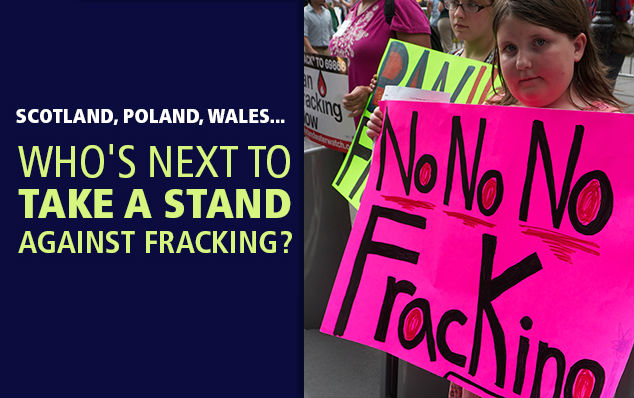
Fracking Scorecard: Shale Gas In Retreat In The European Union

By Geert Decock 

Which country will stand against fracking next?
France. Belgium. Scotland. Wales. We’ve got a slew of wins against fracking to acknowledge and celebrate. But we cannot rest on our laurels. The profiteers are working to keep their dirty and dangerous fracking operations active and they will continue to do so until we work together to make sure there is a complete ban in Europe and beyond!

Those of us following the debate on fracking in Europe are probably aware that France and Bulgaria already banned fracking, in 2011 and 2012 respectively. Big Oil & Gas has challenged these bans, even all the way up to the Constitutional Court in France. But these bans on fracking are still standing. This is a testament to how strong public opinion rejects fracking for shale gas. So far, no other Member State has moved to also ban fracking in their national law.

However, that does not necessarily mean that shale gas is advancing elsewhere. Quite the contrary: Over the few months, a slew of new moratoriums on fracking has come in effect. It started in the summer of 2014, when the regional Flemish government decided that – in the absence of some minimal rules and administrative capacity on fracking – there would be a moratorium for the exploration and production of fossil fuels that require fracking. In December 2014, the Dutch Parliament also voted in favour of another extension of an earlier moratorium, at least until the end of the current government of Prime Minister Rutte. This means that there may be no fracking in the Netherlands until mid-2017.
Why Are We Still Talking About Cloning? Because We Have To.

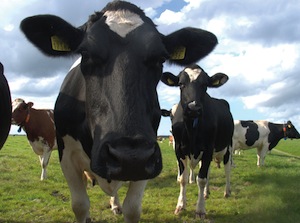
Cows
Cloning for food is on the move again in the EU. This is not good news. It is an intolerable and unnecessary practice that has no place in a civilised food system.

By Eve Mitchell

The facts show that Europeans roundly reject clones for food:

  • 61% think all cloning is morally wrong,
  • 58% say it can never be justified for food production,
  • and a whopping 83% say that any clone use in the food chain MUST be labelled.

What’s more, under considerable pressure for years, the EU Parliament admirably demands a full ban on all clones — and, critically, their offspring — in our food.

So what’s the point of this February 23 public meeting of Parliament’s Environment and Agriculture Committee, titled “Cloning of animals for farming purposes”?

Sadly, the Parliament’s wishes for a ban on clones are still being fought by two of the three branches of the EU system.

Water Activists, Beware of Free Trade Agreements!

WHAT CAN YOU DO?
  • Read our new fact sheet: Trading Away Public Water: Trade Negotiations and Water Services
  • Join more than 1 million Europeans and sign the self-organised European Citizens’ Initiative to Stop TTIP and CETA

STOP TTIP

By David Sánchez 

Citizens in Europe are still resisting the last wave to privatize water, as a consequence of austerity measures imposed in several countries affected by the crisis. Attempts were blocked in Greece and are still being resisted in countries like Ireland. On the other hand, we have a new wave of cities taking back public control over water management, like Paris and Berlin. But those victories, and the huge effort to keep water public and enforce the human right to water in the European Union (EU), are facing now another major threat.

Oil, Gas and Water Just Do Not Mix

By Geert Decock

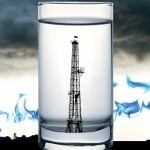
Oil, Gas and Water Don't MixKids learn in a basic science experiment that when you try to mix oil and water, oil will float to the top, because the two substances don’t mix. I had to think back to such experiments when reading a report on Water Innovation in Oil and Gas 2014, published by the London Environmental Investment Forum and sponsored by Veolia.

The water sector sees a major new growth opportunity in the development of unconventional fossil fuels, such as shale gas, tight gas and coal-bed methane. These oil and gas resources can only be extracted by the use of fracking, which involves injecting millions of litres of water at high pressure underground, mixed with sand and (at times toxic) chemicals.

The Last Straw for Irish Citizens: The Struggle Against Water Charges

Categories

Food

By David Sánchez 

Supporting the Irish Right2WaterA European country in crisis. Men in black come to the rescue. With the complicity of the national government, they impose painful measures on the population. Men in black never forget to be nice to their friends, so the measures include a provision to privatise public water services. As a reaction, massive citizen’s mobilisations take place. The story sounds familiar, doesn’t it?

We have already experienced this situation in Greece, and just a few months ago, Greek citizens won the battle, and water will remain in public hands. Now history repeats itself, and the struggle against water privatisation and commodification is at boiling point in Ireland.

Can 1 Million People Stop a Bad Trade Deal for Europe?

Categories

Food

By Eve Mitchell

This Is One Doozey of a Trade Deal
This trade deal is such a doozey, it made more than 721,000 EU citizens hopping mad in a couple of weeks. Nothing makes citizens angry faster than being ignored. The executive director of War on Want and one of the citizens named in the official Stop TTIP ECI proposal summed it up nicely: “These trade deals are already facing unprecedented opposition for their secrecy and unaccountability, but now we are denied even the right to petition our own EU leaders. An unelected executive [the Commission], facing growing vocal opposition, has put its hands over its ears.”We don’t want the TTIP.We have to stop the TTIP.

Act now.

Take Action to stop the TTIP.

In July, a group of people set off to do a hard thing, but an important thing.

They wanted to collect 1 million signatures.

Once attained, those 1 million signatures would force the European Commission to discuss an immediate halt to the ongoing trade talks between the EU and U.S. These talks are known as the Transatlantic Trade and Investment Partnership. For short, they are called the TTIP.

Having already achieved nearly three-quarters of the signatures through the European Commission’s official process — the European Citizen’s Initiative (ECI) — we should be celebrating.

We aren’t celebrating. Here’s why: