

The Two Faces of the EU Commission’s Gas Narrative: Arguments Against Nord Stream 2 Completely Ignored in Discussions Around EU Priority Gas Projects

By Frida Kieninger

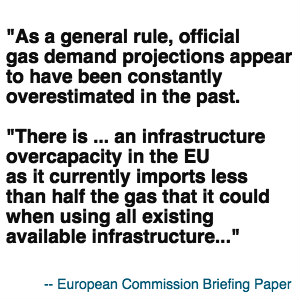
A while ago, the European Commission published another briefing paper about Nord Stream 2. A steadfast opponent of the planned big underwater pipeline aiming at expanding the gas transport capacity between Germany and Russia through the Baltic Sea, the Commission brings a set of arguments pointing to several reservations in connection with the project.

Interestingly, they use the same line of argument they completely ignore when it comes to other pipeline projects, particularly the Commission’s list of priority infrastructure projects, the PCI (Projects of Common Interest) list.

Nord Stream 2 Vs. the Commission’s Priority Projects: Stick and Carrot?

Having a closer look at some of the arguments, it is striking how contradictory the Commission’s narrative is on the project in question. The briefing paper laments that the Nord Stream 2 pipeline “would cost billions of euros that could be spent in other priority segments of the economy and the energy sector” and that the pipeline’s economic rationale ignores EU objectives on energy efficiency, renewables and research and innovation.

This is a warning that NGOs and grassroots groups have sounded several times in connection with the large amounts of money the EU Commission granted and will continue granting to several projects of common interest. In order to have a chance to stay well below 2 degrees of global warming, direct and indirect subsidies for fossil fuels have to cease; in particular, public money must not be invested in backward-looking technologies locking us into further decades of fossil gas use.

The Fracking & LNG Ghosts of Gas Addicted Germany (Part II of II)

by Andy Gheorghiu

Read Part I

Alleged “Frack-Free” Germany

Many people think that Germany has banned fracking but this is not completely true. And even the existing partial ban is at risk at the moment.
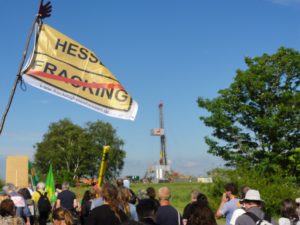
Let’s have a look at the legal framework: In Germany, fracking is officially banned outright in shale and coal bed methane layers until 2021. However, with the approval of an expert panel established in June 2018, up to four fracking research projects in these layers might be allowed and conducted.

In addition, fracking and fracking waste disposal is also prohibited in designated water protection areas, areas with water bodies linking to natural lakes or dams that serve as public water supplies, areas with wells for the production of beverages or drinks, or areas that fall under the water security law.

However, the details of Germany’s current fracking legal framework reveal a number of cracks. Just as in the UK, nature protection zones and national parks appear to be protected. However, this protection only applies to the construction of facilities related to fracking projects directly in the park. It does not prohibit drilling projects from being authorised just outside the protected areas. This allows operators to drill horizontally under them, thereby putting these restricted areas at risk.

The legislation also includes a ban on fracking within the European nature protection zones, the so-called Natura-2000 areas, but this only covers the construction of facilities related to shale gas and coal bed methane projects. In other words, other kinds of tight gas or oil development involving the use of fracking would be allowed. Tight gas is usually extracted from sandstone or limestone layers. The ongoing lobbying of the oil and gas industry has been so sucessfull that the German government has even re-branded sandstone and limestone layers as “conventional layers’ in order to creat the artificial term of “conventional fracking” – which helps tight gas fracking bypass the otherwise applicable ban.

Furthermore, an official request to the German government revealed that Germany provides public funding of €4.75 million towards the above-mentioned fracking research projects.

With this policy, the German government undermines its own goal of being a climate protection leader.

The Fracking & LNG Ghosts of Gas Addicted Germany (Part I of II)

by Andy Gheorghiu

Part I

Many folks around the world see Germany as a progressive “green energy“ country and think it has banned fracking. Unfortunately, both statements are untrue.
In October 2017, federal environment ministry calculations showed that – without further action – Germany would miss its 2020 climate target by a wider margin than previously anticipated (a drop in emissions of only 31 – 33 percent instead of 40 percent).

But instead of increasing desperately needed further actions, the current (and former) government watered down the 2020 emission reduction goal. Conservatives (CDU) and Socialdemocrats (SPD) now want to close the current gap “as much as possible” and reach the target “as soon as possible”.

However, it is simply beyond belief that this is anythiing but a spineless promise particularly if we take a closer look at Germany’s gas consumption.

“Gassy” Germany Beats “Green” Germany

 Despite its “green” image, Germany remains the biggest gas consumer in Europe. With almost 92 billion cubic metres (bcm) of consumption in 2017, fossil gas accounted for 24 percent in Germany’s primary energy consumption.

Fracked US LNG Torpedoes Ireland‘s Dreams of A Fossil-free Future

by Andy Gheorghiu

The Green Island is on a positive path towards a fossil-free future. However, things are far from perfect and the country might even miss the 2020 climate targets, which could force Ireland to pay fines of up to €600m.

But despite the hard economic struggles that the small and proud nation had to navigate through, Ireland made some real progress towards a sustainable, clean energy future.

Green Island banned onshore fracking and wants to divest from fossil fuels

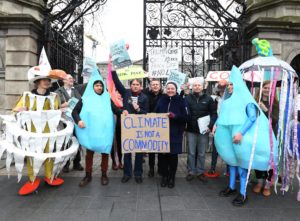
In the Summer of 2017, the Ireland banned onshore fracking, enacting the best formulated fracking ban legislation in Europe. It doesn’t include “offshore” fracking, but Irish activists won’t stop until offshore fracking is also banned.

Previously, in January 2017, the Irish Parliament (Dàil) had voted in favour of divesting coal, oil and gas holdings from the €8 billion Ireland Strategic Investment Fund. The Fossil Fuel Divestment Bill is set to go to report stage ahead of the Dáil’s 2018 summer recess.

In April 2018, on Earth Day, a group of several Catholic institutions (including the Sisters of St. Joseph of Chambery and Sisters of Mercy, from the Northern Province in Ireland) announced a partial divestment from the fossil fuel industry – as did the Church of Ireland in May 2018. These developments should also encourage the Catholic Church of Ireland to do something against the expansion of fossil fuel infrastructure in the country.

Your Petition To ExxonMobil – the European Parliament MUST Act

ExxonMobil has lied about the facts of climate change for decades.

Ask the European Parliament to hold the oil and gas giant accountable for its disinformation campaign!

Send an email or tweet to the coordinators of the petition campaign:

Send an email to: [email protected]

Send an email to: [email protected]

Sample email: Subject: Support petition 0900/2016 – hold ExxonMobil accountable for its climate-change denial campaign

For half a century, ExxonMobil knows that its fossil fuel activities aggravate climate change. Nevertheless, the company decided to hide these facts and started a disinformation campaign. Today, oil and gas giant ExxonMobil is active in several EU Member States and among the biggest greenhouse gas emitters globally. While in the US an initially promising vigorous push to hold the corporation accountable was recently stalled, it is crucial that the issue is discussed at EU level. The EU has to protect its citizens and companies such as ExxonMobil have to be required to provide honest and transparent information – a request which is certainly not conflicting with freedom of speech.

I am asking you, a representative of the European Parliament, to take appropriate measures and do everything possible to convince ExxonMobil to act in line with the Paris Agreement and communicate the evidence of climate change appropriately.

Kind regards, ________

Tweet: Peter Jahr

Tweet: Beatriz Becerra

Sample tweet: #ExxonKnew about climate change since the 70s-yet they lied about it. @peter_jahr @beatrizbecerrab please support petition 0900/2016 on ExxonMobil during the upcoming Coordinators meeting and protect EU citizens from the #oil& #gas giant’s denial campaigns! #beyondgas #beyondoil

Do you want to know more about this issue?

Read about the ExxonMobil climate change denial campaign in our blog.

We Prevented a Bad Change to Environmental Law – For Now

Change to ASEA law would have enabled conflicts of interest in environmental monitoring of fossil fuel industry in Mexico

This is the translation of a blog written by the Mexican Alliance Against Fracking (Alianza Mexicana contra el Fracking), a coalition of 40 local, state and national organizations in Mexico advocating for a ban on fracking. Food & Water Watch is part of this coalition.

Thanks to the work of organizations supported by citizens and some lawmakers, we managed to prevent a legislative proposal that would have possibly enabled dangerous conflicts of interest in the environmental monitoring authority of the fossil fuels sector in Mexico.

Two weeks before the end of the last legislative session, the Committee on Environment and Human Resources of the Chamber of Deputies passed an amendment to change the Law of the National Agency of Industrial Security and Environmental Protection in the fossil fuel sector (ASEA). The Mexican Alliance Against Fracking (Alianza Mexicana contra el Fracking) set out to assess this proposal, then reported on the significant risks it posed.

With the passage of energy reform in Mexico in 2013, ASEA was created to follow environmental issues specific to fossil fuel development. This has meant that instead of Mexico’s federal environmental agency (Semarnat) plus the environmental attorney’s office (Profepa) that have traditionally been in charge of all environmental issues, Mexico now has ASEA that oversees drafting regulations and permitting, monitoring, and sanctioning oil and gas companies. This agency has been bad news for communities and great news for the industry, because all permits have been fast tracked. This agency has shown significant deficiencies, including a clear distance to communities affected by contamination through fossil fuel operations.