Laboratory Error: Majority of Seafood Imports Not Tested for Food Safety

Categories

Food

CONTACT:
Patrick Woodall or Erin Greenfield
(202) 683-2500

Laboratory Error: Majority of Seafood Imports Not Tested for Food Safety, According to New Food & Water Watch Report

Washington, DC - As food safety problems continue to make headlines, American consumers are in for more disturbing news:  that less than one in a million pounds of seafood imported into the United States are tested in laboratories for Salmonella, Listeria, chemical and drug residues, metals, and pesticides.  Laboratory Error, a report released today by Food & Water Watch, a national consumer advocacy organization, reveals that as the volume of imported seafood steadily increased between 2003 and 2006, the number of samples taken for laboratory testing by the Food and Drug Administration decreased by 25 percent.

“FDA is failing to adequately inspect seafood imports not just at ports, but also in laboratories used for detecting foodborne hazards invisible to the naked eye,” said Wenonah Hauter, executive director of Food & Water Watch. ”The agency‚ appalling record on inspecting seafood imports poses a real threat to the health of American consumers.”

Laboratory Error is a follow-up to Food & Water Watch‚ 2007 report Import Alert, and delves deeper into the FDA inspection system.  In the new report, Food & Water Watch examined FDA‚ laboratory testing of imported seafood for seven food safety laboratory tests (such as microbial contamination and botulism risk), the number of tests FDA performed and whether the imported fish failed these tests. The group‚ analysis revealed some troubling trends:

* Imported seafood shipments grew by 15 percent between 2003 and 2006, and the volume grew by 11 percent to 5.4 billion pounds. During this same period, the number of imported fish samples taken for laboratory analysis fell by 25 percent.

* The number of laboratory tests the FDA performed declined by 27 percent from 9,552 laboratory tests in 2003 to 6,995 tests in 2006.

* Between 2003 and 2006, about one in 11 (8.7 percent) of FDA laboratory tests on imported seafood turned up unacceptably high levels of disease, decomposition or adulteration.

* The FDA waited several years to issue a ban on fish from China in 2007 after finding very high failure rates for illegal veterinary drugs and chemicals on the imports for several years - including violations much higher than the FDA admitted in 2007.

FDA‚ limited field laboratory resources and staffing, coupled with increasing fish imports and an already inadequate inspection system at portside, have all contributed to decreased testing on potentially dangerous seafood. Unfortunately, one of the solutions proposed by FDA to monitor imports is using private laboratories hired by exporters to certify which exporters and products are safe.

“FDA‘s plan for third-party certification would essentially privatize food inspection, allowing corporate interests to trump the interests of American consumers,” said Hauter. “We need FDA to increase inspections and laboratory testing to ensure imported products are safe for consumers.”

Food & Water Watch also recommends that FDA allow seafood imports only from countries with food safety regulations that are at least as strong as U.S. standards, increase its laboratory testing rates for imported seafood to the levels conducted in the European Union and Japan, and conduct at least annual inspections of domestic food establishments and annual visits to countries that export seafood to the United States.

Read all recommendations and key findings from Laboratory Error.

###

Dairy Product with Unsafe Melamine Levels Found on U.S. Shelves, FDA Has Yet to Issue Recall

Categories

Food

CONTACT:
Tony Corbo or Erin Greenfield
(202) 683-2500

Dairy Product with Unsafe Melamine Levels Found on U.S. Shelves, FDA Has Yet to Issue Recall

Food & Water Watch Enraged Over Agency‚ Negligence That Endangers Consumers

Washington, DC , Just two weeks after the Food and Drug Administration set ‚acceptable” levels for melamine in food instead of issuing a complete ban on Chinese milk-containing products, the Alabama Department of Agriculture announced that Koala‚ March brand cookies have tested positive for melamine with levels that exceed FDA‚ safe levels of exposure. FDA has not issued a recall for the product, and despite assurances from the agency that the parent company, Lotte USA, was removing the product from the marketplace, Koala‚ March cookies are still present on U.S. shelves. Food & Water Watch, a national consumer advocacy group, has called on the government to follow suit with many foreign countries that have closed their borders to Chinese dairy products and immediately issue a recall for the Koala‚ March cookies.

‚It is completely unacceptable that FDA has not issued a recall for a contaminated product that is on U.S. shelves and ending up in the homes of American consumers and their families,” stated Food & Water Watch Executive Director, Wenonah Hauter. ‚What‚ alarming is that not only had a product been found in stores where it shouldnt have been in the first place, but it also had exceeded FDA‚ safe levels for human consumption. This just makes it more apparent that without a complete ban on all Chinese dairy products, FDA is incapable of protecting American consumers.”

This is not the first time the Alabama Department of Agriculture took action before FDA. Last year the department found contaminated seafood from China that eventually led to FDA issuing an Import Alert two months later.  FDA is now considering lifting that import alert.

‚Perhaps the Alabama Department of Agriculture should do all of FDA’s testing because they seem to be more interested in protecting American consumers than protecting a corrupt food safety system in China,” stated Hauter.

During a conference call on October 8th with FDA officials and consumer groups, Food & Water Watch lobbyist Tony Corbo asked FDA officials if they were recalling the Koala’s March cookies and if the cookies had been tested. They responded that FDA was working with the parent company and its U.S. subsidiary to remove the product from store shelves, and that the Koala‚ March cookies the agency had tested were safe.

To date, Hong Kong, Macau, Canada and France have all banned the Koala product. The European Commission is also tightening their rules on Chinese imports, recently announcing that it will ban milk-containing products from China, and will test all other Chinese milk-containing products that are already in the EU.

‚We cannot take FDA at their word that dairy products from China are safe, since at this point it seems that FDA is more concerned with promoting imports than protecting consumers,” concluded Hauter. ‚It is time for FDA to follow the lead of countries around the world that have taken precautionary steps to protect their citizens by banning imports of Chinese dairy products and processed foods that contain Chinese milk ingredients.”

The Alabama Department of Agriculture press release can be viewed at .

###

The Rush to Ethanol: Not All Biofuels Are Created Equal

Categories

Food

Introduction

Rising oil prices, energy security, and global warming concerns have all contributed to the current hype over biofuels. With both prices and demand for oil likely to continue to increase, biofuels are being presented as the way to curb greenhouse gas emissions and to develop homegrown energy that reduces our dependence on foreign oil.

In this context, corn-based ethanol has emerged as a leading contender to reduce dependence on fossil fuel-based gasoline. At first glance, corn-based ethanol seems simple, even patriotic: take the sugar from corn that U.S. farmers grow and ferment it with yeast to distill basically the same stuff found in alcoholic beverages. Byproducts, such as distiller‚ grain and corn gluten, serve as livestock feed and help offset refining costs. The industry claims that ethanol blends will lower tailpipe emissions, promote energy independence, and revitalize rural America.

Farmers and investors envision a new gold rush. Ethanol production is registering record growth rates, and reached nearly five billion gallons in 2006. Dozens of new ethanol refineries are being constructed, with production capacity forecast to double as early as 2008. President Bush intensified this momentum in his 2007 State of the Union address with a call to produce 35 billion gallons of alternative fuels by 2017– fivefold increase from the currently established goals.

Read the complete report online.

Consumer Organization Pans NOAA Propaganda Report about Ocean Fish Farming

Categories

Food

CONTACT:
Erin Greenfield or Marianne Cufone
(202) 683-2500

Consumer Organization Pans NOAA Propaganda Report about Ocean Fish Farming

Washington, D.C. , Today, Food & Water Watch, a national consumer advocacy organization, panned a new report by the National Oceanic and Atmospheric Administration on offshore aquaculture – the industrial production of fish using cages located in open ocean waters. Legislation to create a national program for offshore aquaculture has been discussed in both the U.S. House of Representatives and the Senate, but not approved.

‚This report is nothing more than a desperate effort by NOAA to pressure Congress into authorizing a bill for a national offshore aquaculture program in our oceans, ” said Wenonah Hauter, executive director of Food & Water Watch. ‚We believe real facts clearly show that ocean fish farming could cause serious economic and environmental problems for our country.”

NOAA‚ report contends that the practice of cramming thousands of fish in cages between about three and 200 miles from shore would, among other things, bring fiscal benefits and dramatically reduce U.S. reliance on foreign seafood products.

However, a report released just last month by the independent U.S. Government Accountability Office on the very same topic, indicated otherwise. It showed that ‚significant barriers still exist in the development of an environmentally safe offshore aquaculture industry,” according to a statement from the U.S. House of Representatives Natural Resources Committee. Representative Nick Rahall, Chair of that Committee, requested the GAO report in 2007.

The evidence that ocean fish farming is problematic goes beyond the GAO findings. The Gulf of Mexico Fishery Management Council, one of eight regional councils Congress established to help manage U.S. fisheries, is drafting regulations to allow ocean fish farming in their region, with support from NOAA. Their very own plan concedes that the increased supply of farmed fish could decrease the prices that fishermen get for their catch. That in turn could harm the economies of coastal communities that depend on fishing and related activities.

In a mad rush to get any big legislative victory, the Bush Administration and NOAA are promoting development of the offshore aquaculture industry, while ignoring trends in the global seafood trade. The United States exports more than 70 percent of its wild-caught and farmed seafood. At the same time, we import cheaper, often lower quality seafood from countries such as China and Thailand for U.S. consumers to eat. These places recently have had have questionable food safety records. Meanwhile, Japan and Europe, known for high seafood safety standards, receive nearly half of U.S. exports. This means that if offshore aquaculture were allowed in the U.S. commercially, likely trends would remain the same ,producers will export the majority of ocean farmed fish for higher dollar returns, and U.S. consumers will continue to eat imported , and potentially unsafe , farmed fish.

Offshore aquaculture also could cause problems for our marine environment. For example, fish waste, uneaten fish feed, antibiotics used to maintain the health of fish crowded into the farm pens and chemicals that prevent organisms from growing on the nets and cages can pollute the seafloor and surrounding ocean ecosystem.

‚Little is known about the assimilative capacity of the marine environment for these pollutants,” concluded a report commissioned by the Woods Hole Oceanographic Institution. ‚Pollution from a greatly expanded [aquaculture] industry could have significant effects locally and regionally.”

Parasites and disease can spread from fish farms to wild species. In British Columbia, the Pacific Fisheries Resource Conservation Council found that fish farms increased the number of parasitic sea lice and likely caused the collapse of pink salmon in the Broughton Archipelago in 2002.

Farmed fish, which can be behaviorally, physically and even genetically different from similar wild fish, escape their pens. Once out in the wild, they could mate with native species, spawning inferior wild fish that could be more susceptible to disease or unable to survive well in the wild. In the alternative, some escaped farmed fish may be super fish , bred to grow bigger, faster and may out-compete wild fish for increasingly scarce food resources, mates and habitat. Either of these scenarios could lead to fewer , and possibly less desirable , wild fish for fishermen to catch and people to eat.

‚NOAA is the agency tasked with conserving and managing our living marine resources.   Rather than wasting time and taxpayer dollars to crafting reports trying to justify a national program for offshore aquaculture, our government needs to spend time ensuring strong U.S. fisheries and clean, green and safe methods of seafood production for U.S. consumers,” Hauter said.

To learn more about the problems with offshore aquaculture and viable alternatives, visit us at  .

# # #

What’s Behind the Global Food Crisis?

Categories

Food

How Trade Policy Undermined Africa’s Food Self-Sufficiency

Introductio

The 2008 global food crisis is compromising the survival of 860 million undernourished people and threatens to push a hundred million people into extreme poverty, erasing all of the gains made in eradicating poverty in the last decade. Record high prices have put food out of reach for the poorest people in the developing world, many of whom already spend more than half their income on food. Growing food insecurity is undermining tenuous civil stability in at least 33 countries, about one sixth of United Nations member countries.

Read the full report.

Real food prices are at near-record highs — and are approaching the levels of the food crisis of the early 1970s. The UN’s Food and Agriculture Organization reports that grain prices jumped 88 percent between March 2007 and March 2008. Currently, high agricultural production costs, tight commodity supplies and increased demand have all contributed to food price escalation. All-time high oil prices increase fuel costs for freighters and farm equipment. Unusually poor weather conditions have undercut rice and grain production in Australia, Northern Europe, Central Asia and America’s wheat belt. The growing diversion of food crops to produce biofuel and increased demand in booming economies have helped drive up commodity prices.

But rising production costs are not the only culprits in the food crisis. The globalization model that prioritizes cash crop exports over food self-sufficiency has helped make Africa and other developing regions vulnerable to volatile global food prices.

In the last dozen years, the World Bank and the World Trade Organization encouraged developing countries to switch from growing food for domestic markets to growing cash crops for export to industrial countries. Traditional African food crops like sorghum, cassava, yams and millet are not traded internationally, so they typically were ignored by international agribusinesses and globalization proponents. Instead, farmers were encouraged to grow crops like coffee, sugar, cocoa beans, tea and cotton and then use the export earnings to purchase food, often low-priced imports from industrial countries. Globalization cheerleaders viewed food self-sufficiency as obsolete. Although imported food benefited consumers in the developing world when prices were low, local farmers were often displaced by low-priced imports. Now that imported food prices are rising, consumers cannot afford sustenance and there is too little local production to provide food for local markets in many countries.

While the WTO ostensibly offered “carrots” to entice countries to transition to export-oriented agriculture, the World Bank used its power as a stick. The WTO promised increased access to markets in rich countries, encouraging farmers in the developing world to shift to tradeable agricultural commodities instead of local food staples. At the same time, the World Bank invested in cash-crop enterprises in the developing world while it pressed developing countries to eliminate government programs supporting domestic agriculture, ultimately reducing the productivity of the food staple sector.

The shift to export-oriented agriculture has contributed to developing country dependence on imports of staple crops like corn, wheat and rice. Africa is at ground zero in the global food crisis in no small part because resources were diverted from food crop production to cash crop investments. About half (40 of 82) of the countries designated low-income food deficit countries by the FAO are in Africa. Africa is now more reliant on food imports than before the WTO went into effect, and food imports are more expensive than ever.

rBGH: Anything but Green

Categories

Food

The dairy industry has followed the same path as much of agriculture: Produce as much as possible and do it cheaply, all in the name of increasing profitability. Like those who are, for example, growing grain or raising chickens, dairy farmers are responding to the increasing power of agribusiness and farmer-unfriendly federal policies by getting bigger or getting out.

One of the many factors contributing to factory-scale dairy operations is recombinant Bovine Growth Hormone (rBGH or also sometimes called rBST), an artificial growth hormone developed by Monsanto to increase dairy cows’ milk output.

Industrial agriculture proponents proclaim that farming on a large scale, and using technology such as rBGH, brings many benefits to farmers. Lately, a healthier environment has been their prime example of these supposed benefits. One outspoken advocate of industrial dairy production recently wrote that the genetically engineered hormone is good for the environment because dairy cows injected with it “eat less feed for each gallon of milk they produce” and this means that less land is used for cows given the artificial hormone. “Less land plowed, less fertilizer, less of all of the inputs that go into producing the dairy products consumers enjoy.” Going even further, he says, those cows on rBGH help cut down on greenhouse gases.

Are rBGH Cows More Efficient?

Is it true? Do cows injected with rBGH really eat less feed while producing more milk? The Food & Drug Administration says no.
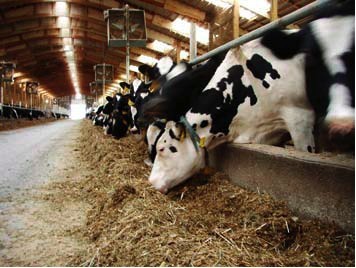
Years ago, when rBGH was being approved for use, Monsanto wanted to make a label claim that it increased both feed efficiency and milk production. This is exactly what proponents of rBGH are saying now, that cows treated with the artificial hormone eat the same amount of feed while producing more milk. But when agency approval came in 1993, the label claim for increased feed efficiency was not allowed because Monsanto could not produce enough data to convince FDA of their claims.
So FDA approved the use of rBGH for increasing the amount of milk per cow, but didnt buy the claim that those cows are necessarily more efficient users of feed. But there’s still another question to ask: Is the amount of milk per cow all that matters? To answer that one, we need to look at which cows are getting treated with rBGH.

An Environmental Reality Check

So who‚ using these artificial hormones? While rBGH is used in only about 17 percent of all U.S. dairy cows, factory farm operators inject it into 42 percent of large herds (500 animals or more). Indeed, big dairy farms are the primary users of the artificial hormone. Nationally, fewer than 10 percent of small dairy farms (those with fewer than 100 cows) used rBGH in 2007.

To understand what this distribution of rBGH use means, perhaps we should step back and look at the overall bleak picture of modern dairy production. Instead of wandering around eating grass in pastures, as cows are built to do, the majority of them are now concentrated in factory farms where they eat grain that takes lots of land and energy to grow and transport. The process of planting and harvesting and transporting all that corn pollutes our soil and water with agro-chemical waste – about 10 billion pounds a year of nitrogen fertilizer alone is dumped onto fields – and releases carbon dioxide emissions into our atmosphere, where it assists with climate change.

So does it really decrease land use and help address climate change to cram together all those cows – many of them on rBGH – and feed them shipped in grains?

How – and where – cows are raised matters. While the United States lost 94,000 dairy cows over the last decade, their number increased dramatically – by half a million – in the biggest dairy states. Meanwhile, smaller, sustainable family dairy farms are going away, their numbers having fallen by 39 percent over the last decade. Larger, unsustainable factory dairies have replaced them. Between 1987 and 2002, the average size dairy herd more than tripled, going from 80 to 275 cows.

In California from 1997 to 2007, the number of dairy cows increased by 30 percent, from 1.39 million to 1.81 million. Those 422,000 additional cows consumed 44 million more bushels of corn in 2007 than the state’s dairy herd ate a decade earlier. An additional 293,000 acres of corn were required to feed those new dairy cows in 2007.

And in Idaho, which is considered new to the production of milk on a large scale, the number of dairy cows in the state skyrocketed from 272,000 in 1997 to 513,000 in 2007, an increase of 88.6 percent. Those 241,000 additional cows ate about 25 million more bushels of corn. Growing that corn required 167,000 acres of land.

California and Idaho dont produce enough corn to supply the rising demand from factory farms, so much of that extra corn has to be shipped from thousands of miles away, using energy and contributing to climate change.

More cows eat more feed that is grown on more land. That strikes us as neither efficient, nor environmentally friendly. And what about all the manure?

Storing millions of gallons of factory farm generated manure and other waste in one place emits dust particles and hundreds of different volatile gases, including ammonia, carbon dioxide and methane. In fact, one 2,500-cow dairy produces as much waste as a city with 400,000 residents. So perhaps it was no surprise to hear California‚ San Joaquin Valley Air Pollution District‚ 2005 announcement that the region‚ more than two million dairy cows bore more responsibility for air emission of volatile organic compounds than cars, trucks or pesticides.

And for one more opinion on whether rBGH is better for the environment, we can turn once again to the FDA. In a 1993 environmental impact statement, the agency noted that analysis of the impact of rBGH use on greenhouse gas emissions found that emissions would either increase slightly or decrease slightly, but that “the magnitude of the changes will be extremely small and insignificant compared to total worldwide emissions of carbon dioxide and methane.”

Bad for Business

Ironically, given the aims of industrial agriculture, the profitability of using the drug is questionable. It has produced a very mixed bag – some farmers seem to make money with rBGH, but others don’t. Plus, the variability is high, depending on the price of milk, feed and other factors. While farmers who put their cows on rBGH may see a 10 percent increase in milk production, they also have increased expenses, including corn feed that has become more expensive, the $6.50 per injection cost of the hormone (not including the labor charge to administer it) and the possibility of more bills from the veterinarian to deal with bovine health ills stemming from rBGH. Additionally, some dairy farmers report that cows treated with rBGH burn out faster and have to be sent to slaughter and replaced.

In all this talk about increasing milk production, perhaps we should pay heed to a very basic financial reality: Increasing the supply of milk reduces the price that dairy farmers receive for it. That financial reality drives many out of business and forces the remaining producers to adopt the bigger-is-better model, fraught with the questionable technology that comes along for the ride.

All that said, recombinant Bovine Growth Hormone affects more than the environment and dairy economics.

Lingering Health Questions

This artificial hormone’s history is just a bit shady. While the U.S. Food and Drug Administration approved rBGH in 1993, based solely on an unpublished study submitted by Monsanto, the governments of Canada, Australia, New Zealand, Japan and the European Union have never allowed it to be used.

The possible health implications of rBGH for humans and cows are significant. The milk from cows injected with rBGH has higher levels of another hormone called insulin growth factor-1 (IGF-1). Elevated levels of IGF-1 in humans have been linked to colon and breast cancer. Some researchers believe there may be an association between the increase in twin births over the past 30 years and elevated levels of IGF-1 in humans.

And rBGH use has increased bacterial udder infections in cows by 25 percent, adding to the need for antibiotics to treat the infections, a worrisome trend in light of the growing problem of antibiotic resistance.

The Bottom Line

Pumping rBGH into cows to increase milk production has not led to fewer cows producing more milk. Instead, it has become a tool for keeping more cows in fewer places where they gobble up more grain grown unsustainably on more acreage. In short, rBGH has contributed to the growth of mega-dairy operations that cram together thousands of cows generating mountains of waste that are toxic to us and to our environment. In addition, rBGH causes numerous human and bovine health issues, including bacterial resistance to antibiotics and more frequent bovine udder infections.

What You Can Do About It:

Consumers should purchase dairy products that are labeled “rBGH-free,” “rBST-free,” or “organic.” Problem is, some states are trying to prevent dairies from labeling their products with this information.

  • Download the fact sheet: How to Go rBGH-Free

Learn More