

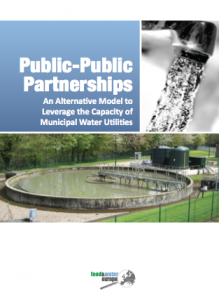
Public-Public Partnerships: An Alternative Model to Leverage the Capacity of Municipal Water Utilities

Read the full report.

DOWNLOAD PDF

Clean drinking water and wastewater treatment are basic services that societies and governments provide. Water is a necessity for life, and safe water and sanitation are crucial for public health. In July 2010, the United Nations declared access to clean water and sanitation to be a human right. But recognizing the human right to water does not explain how to deliver this right to households. Even with this commitment to enhance water delivery and safety, an estimated 884 million people worldwide lack access to safe water, and 2.6 billion lack access to improved sanitation. Meeting this need requires significant investments in infrastructure and expertise. In the last 20 years, major multinational efforts have relied on private sector strategies in both developed and developing countries to provide water. These approaches have included encouraging public- private partnerships (PPPs) between public water utilities and private water companies.

Proponents of privatization promised increased investment and efficiency, but privatization has failed to meet these expectations. Instead, it often has led to deteriorating infrastructure, service disruptions and higher prices for poorer service.

A different model, called public-public partner- ships (PUPs), can be a more effective method for providing services. In contrast to privatization, which puts public needs into the hands of profit- seeking corporations, PUPs bring together public officials, workers and communities to provide better service for all users more efficiently.PUPs allow two or more public water utilities or non-governmental organizations to join forces and leverage their shared capacities. PUPs allow multiple public utilities to pool resources, buying power and technical expertise. The benefits of scale and shared resources can deliver higher public efficiencies and lower costs.

These public partnerships, whether domestic or international, improve and promote public delivery of water through sharing best practices. The partnerships can take many forms and may include networks of public water operators in different areas or non-governmental organiza- tions. As a public collaboration, no PUP partner can generate a profit through the partnership. In short, PUPs provide the collaborative advantages of private partnerships without the profit-extracting focus of private operators, and they promote the public interest mission of equitably delivering water services.

Although PUPs can be used for many public func- tions, including roads and electricity, they have particular applicability to water. Access to safe drinking water varies widely across the globe. The United Nations Millennium Declaration aimed to “halve the proportion of people who are unable to reach or to afford safe drinking water.” To meet that ambitious goal, more than a billion people will need to gain access to safe water and sanita- tion by 2015.

This tremendous undertaking will require both international cooperation and atten- tion to local needs. Public-public partnerships are uniquely suited to this task. The reason that PUPs work so well is that they retain local, public control of existing water systems. Public utilities are responsible for most water and wastewater services worldwide. In 2010, only about 12 percent of the world’s population had water or sewer service that was priva- tized in some way. The nature of water service as a public good and natural monopoly favors the public administration of water systems.

World Water Forum Attendance Reportedly Down as Activists Ramp Up Preparations for Alternative Forum

Categories

Food

Brussels – Critics of the triennial World Water Forum are encouraged by the failure on the part of forum organizers to attract large numbers to this year’s event taking place March 12-17 in Marseille.

Forum organizers announced at a press conference last week that only 2,000 people had fully registered, while another 2,000 were yet to be confirmed. This falls dismally short of the 20,000 participants that had been anticipated.

The small number of registrations also comes despite the fact that various national, regional and municipal authorities have poured millions of euros of public funds into sponsorship of the event.

“It isn’t just the World Water Forum that is failing,” says Maude Barlow, senior advisor to the 63rd President of the UN General Assembly. “Water privatization has failed communities around the world and a growing number are now reclaiming control of their water. In this context, it is no surprise that this illegitimate Forum is no longer able to attract attention.”

Notably, the Norwegian Ministry of Foreign Affairs has already stated that it will not be attending this year.

At the 2009 World Water Forum in Istanbul, 24 governments signed a counter-declaration recognizing water as a human right in opposition to the forum’s official ministerial declaration. And in a scathing criticism of the World Water Forum, then-president of the United Nations General Assembly Father Miguel d’Escoto Brockmann called for the UN to hold its own event to address the global water crisis.

“It is significant for the World Water Forum to show signs of crisis in Marseille, which is where the World Water Council was founded,” says French MEP Michèle Rivasi. “Re-municipalization is gaining speed in France, regardless of the strong support for privatization from the French government.”

Groups from around the world—who view the forum as a corporate trade show disguised as a multi-stakeholder conference—are organizing the Alternative World Water Forum (in French, Forum Alternatif Mondial de l’Eau, or FAME). They have invited governments to a consultation with civil society outside the forum on the implementation of the human right to water.

Contact: Darcey Rakestraw, drakestraw(at)fwwatch(dot)org, 202-683-2467; Gabriella Zanzanaini, gzanzanaini(at)fweurope.org, +32 488 409 662; Meera Karunananthan, mkarunananthan(at)canadians.org, +1 613 355 2100

Pour diffusion immédiate

Mardi 14 février 2012

Baisse apparente de participation au Forum Mondial de l’Eau alors que des militants accélèrent les préparations du Forum Alternatif

Bruxelles–Les critiques du rendez vous triennal que constitue le Forum mondial de l’eau sont encouragés par l’incapacité des organisateurs du Forum à attirer beaucoup de monde à l’événement de cette année qui aura lieu du 12 au 17 mars à Marseille.

Les organisateurs du Forum ont annoncé à l’occasion d’une conférence de presse la semaine dernière que seulement 2 000 personnes s’étaient inscrites en bonne et due forme, tandis que l’inscription de 2 000 autres personnes était encore en attente de confirmation. C’est une diminution extrême par rapport au nombre de 20 000 participants qui étaient attendus.

Le petit nombre d’inscriptions reçues se produit également malgré le fait que diverses autorités nationales, régionales et municipales ont versé des millions d’euros de fonds publics dans le parrainage de l’événement.

« Ce n’est pas seulement le Forum mondial de l’eau qui échoue, » a dit Maude Barlow, conseillère principale auprès du 63e président de l’Assemblée générale des Nations unies. « La privatisation de l’eau a berné les collectivités du monde et le nombre de ceux qui réclament maintenant le contrôle de leurs eaux augmente. Il n’est pas surprenant dans ce contexte que ce Forum illégitime n’arrive plus à attirer l’attention, » a t elle ajouté.

Entre autres, le Ministère norvégien des affaires étrangères a déjà déclaré qu’il ne participerait pas au Forum de cette année.

Lors du Forum Mondial de l’eau 2009 à Istanbul, 24 gouvernements qui s’opposaient à la déclaration ministérielle officielle du Forum avaient signé une contre déclaration reconnaissant que l’eau est un droit humain. Et dans une critique accablante du Forum Mondial de l’Eau, le président de l’Assemblée générale des Nations Unies à l’époque, le père Miguel d’Escoto Brockmann, avait demandé à l’Organisation des Nations unies d’organiser son propre événement pour se pencher sur la crise mondiale de l’eau.

« Il est révélateur que le Forum mondial de l’eau affiche des signes de crise à Marseille, qui est l’endroit où le Conseil mondial de l’eau a été fondé, », a déclaré la députée européenne Michèle Rivasi. « La remunicipalisation gagne de la vitesse en France, malgré le soutien ferme du gouvernement français pour la privatisation. »

Des groupes du monde entier, qui considèrent le Forum comme une foire commerciale déguisée en conférence de multiples intervenants, organisent le Forum Alternatif Mondial de l’Eau, le FAME (Alternative World Water Forum en anglais). Ils ont invité les gouvernements à participer à une consultation avec la société civile, à l’extérieur du Forum, sur la mise en œuvre du droit humain à l’eau.

Over 25,000 People Tell Ahold: Stop Misleading Consumers, Genetically Modified Toxic Soy is Not Responsible!

Categories

Food

Photo opportunity: Public demonstration and petition handover

When: Thursday 9 Feb 2012, 12.30-13.30

Where: Amsterdam, Ahold CSR office, Piet Heinkade 167-173

On Thursday, 9 February multinational food retailer Ahold will receive the signatures of 26.000 people across Europe demanding an end to greenwash projects like the Round Table for Responsible Soy (RTRS). Hugo Byrnes, director of product integrity at Ahold and the company’s representative in the soy roundtable, is invited to accept the signatures at 13.00 in front of his office.

The petition was kicked off in six countries in 2011 and targeted supermarket chains and food companies around Europe like Ahold, Aldi, Arla, Carrefour, Colruyt, Coop, Delhaize, Marks & Spencer and Unilever. International environmental groups including Friends of the Earth International, Action Aid, Global Forest Coalition and Food & Water Europe supported the action.[1]

Tjerk Dalhuisen of campaign group Toxicsoy.org says: “Europe imports 34 million tons of genetically modified (GM) soy every year, mainly to feed factory farmed animals. This system can never be called responsible and does not deserve a green label.”

“The criteria proposed by the Round Table on Responsible Soy (RTRS) do not guarantee any level of ‘responsibility’. Soy plantations can still expand at the expense of forests and small farms; large scale pesticide spraying on soy farms will continue to poison people and the environment.”[2]

Eve Mitchell of Food & Water Europe added, “Food & Water Europe is concerned that the EU continues to rely far too heavily on imported soya from highly GM damaging monocultures, including to fuel factory farming. We cannot continue to export our environmental and social damage in this way, and consumers have a right to see on food labels where this imported GM soya is being used as animal feed.”

The RTRS is an initiative of the World Wildlife Fund and the soy industry and companies with a vested interest in soy expansion such as the agribusiness and oil giants Monsanto, Syngenta, Cargill, BP and Shell. The Dutch food and animal feed industry are actively supporting the RTRS, and the Dutch government is providing financial support to the scheme in particular via the Sustainable Trade Initiative (IDH).

The soy roundtable has faced strong opposition from civil society for years. Hundreds of organisations from Europe and South America have signed declarations against the RTRS.[3] WWF and the Dutch NGOs involved in the RTRS have been criticised by nine Belgian NGOs.[4] In April 2011 the German platform of environmental organisations DNR (Deutsche Naturschutzring) sent a letter to WWF and asked them to withdraw from the RTRS stating, “DNR cannot accept that WWF protects a failed system of agriculture and secures the profits of companies like Monsanto and BP.”[5] 

The soy that is being certified by the RTRS is mostly Monsanto’s RoundupReady GM soy, made resistant to Monsanto’s own herbicide Roundup based on glyphosate, which has been increasingly linked to serious health impacts on humans and wildlife.[6] Mixtures of pesticides are sprayed over large surfaces by airplane or large machines, causing severe health problems for the local population, pollution of water and damage to crops.

Hugo Byrnes on behalf of Ahold wrote in response to the petition that there are at present too few alternatives to soy imports. However, retailers like Ahold drive the use of soy by promoting cheap meat products. Instead, soy animal feed should be replaced by locally grown animal feed, and factory farming should be banned.

He also claimed that Ahold “does not intend to communicate the use of certified soy to consumers via packaging”, which shows once more that certified “responsible” soy has already failed as a brand.

Meike Vierstra (ASEED Europe) says: “Supermarkets that participate in this greenwash are making a big mistake. Consumers will understand that this label is misleading. We say to these companies: Don’t sell the lie.” 

For more information:

Eve Mitchell, Food & Water Europe

Phone: +44 (0)1381 610 740 email: [email protected]

Tjerk Dalhuisen, Toxicsoy.org,

Mobile: +31 6 14699126, email: [email protected]

Nina Holland, Corporate Europe Observatory

Mobile: +31-6 30285042, email: [email protected]

Meike Vierstra, ASEED Europe, Mobile: +31-6-5248 1471, e-mail: [email protected]

Notes to the editor:

[1] Petition text: http://www.toxicsoy.org/toxicsoy/Action/action.html.
Support letter: http://www.toxicsoy.org/toxicsoy/news/Artikelen/2011/3/8_Letter_to_supermarkets__responsible_soy_is_misleading_consumers_files/Please%20reject%20RTRS-certified%20soy%20letter-1.pdf

[2]More critical analysis on the RTRS criteria: Certified Responsible? GM Watch, CEO and Friends of the Earth, March 2011. http://www.gmwatch.eu/images/pdf/rtrsbackgrounderfinal.pdf

[3] Open Letter: Growing Opposition to Round Table on Responsible Soy. June 2010.

[4] Letter from Belgian NGOs: http://www.gifsoja.nl/Gifsoja/nieuws/Artikelen/2011/2/4_Artikel_1_files/11%2002%2004%20%20brief%20NL%20organisaties%20RTRS.pdf 

[5] Letter Deutsche Naturschutzring to WWF:

[6] Antoniou, M., Brack, P., Carrasco, A., Fagan, J., Habib, M., Kageyama, P., Leifert, C., Nodari, R., Pengue, W. 2010. GM Soy: Sustainable? Responsible? http://www.gmwatch.org/files/GMsoy_SustainableResponsible_Sept2010_Summary.pdf

Food & Water Europe is a program of Food & Water Watch, Inc., a non-profit consumer NGO based in Washington, D.C., working to ensure clean water and safe food in Europe and around the world. We challenge the corporate control and abuse of our food and water resources by empowering people to take action and transforming the public consciousness about what we eat and drink.

Food & Water Europe Director Warns European Policymakers About Major Risks of Fracking

Categories

Food

Brussels – This week, Food & Water Europe executive director Wenonah Hauter led a delegation from Poland, the UK and Belgium meeting with MEPs about the major risks involved in using hydraulic fracturing – or fracking – to extract shale gas. The aim of the visit to Brussels was to inform the political debate within the EU about the negative American experiences with fracking, both in terms of the disastrous environmental record of the shale gas industry as well as the exaggerated claims about its economic benefits. Food & Water Europe hopes these conversations will contribute to the two own-initiative reports on shale gas that are currently being prepared in the European Parliament.

“The dubious benefits and poor environmental record of shale gas development in the U.S. serve as a cautionary tale for Europe,” said Wenonah Hauter. “It is worrying that European policymakers perpetuate the myth of shale gas as a viable bridge to a low carbon future.” Recent studies reveal that widespread shale gas development may actually worsen global climate change. Apart from the problematic impact of shale gas on climate change, fracking has caused widespread environmental and public health problems and created serious, long-term risks to underground water resources. Since the shale gas boom has really taken off in the U.S., the evidence of these major risks involved in fracking has piled up.

Based on these American experiences, a growing number of European countries and regions have imposed a moratorium on fracking. In May 2011, France banned fracking, and this month Bulgaria also imposed a fracking ban. A number of German states, Swiss cantons, Irish counties, and regional and local governments have taken a similar approach. “Opposition to shale gas is building in communities where fracking activities have started and where the impacts will be felt,” said Hauter. “The wait-and-see approach of the European institutions will become increasingly untenable as fracking for shale gas starts to endanger our precious water resources”.

In addition, the economic benefits that were promised by the energy corporations involved in shale gas drilling have been grossly exaggerated, according to a recent analysis by Washington, D.C. based Food & Water Watch, which showed one job claim had been exaggerated by 900 percent.

Contact: Geert De Cock tel. +32 (0)2 893 10 45, mobile +32 (0)484 629.491, gdecock(at)fweurope(dot)org

Food & Water Europe Applauds European Commission’s Investigation of Price Fixing by French Water Companies

Brussels–Just 50 days before the World Water Forum and the Alternative World Water Forum take place in Marseille, France, the European Commission has announced formal anti-trust proceedings against French water companies Veolia, Suez and subsidiaries Lyonnaise des Eaux and SAUR.

The Commission will examine whether companies have coordinated their behaviour in markets for water and wastewater services in France, in particular, with respect to elements of the price invoiced to final consumers. This follows several unannounced inspections at the companies in April 2010, where Suez was then fined €8 million for breaking a seal placed by the Commission during the inspection.

“Food & Water Europe applauds the European Commission for its actions,” said Food & Water Europe Executive Director Wenonah Hauter. “This investigation shows why our water services should be publicly owned. The first priority of private water companies is shareholders, not communities. Private operators are known for trimming costs in operation, as well as cutting jobs and raising rates in communities they enter with no consideration for transparency.

“Even though there is strong public resistance to privatization, the public sector is helping the private water companies by providing finance, developing strategies, and even investing in these companies. At the same time, the ownership of private water companies in Europe has become all the more concentrated, overwhelmingly dominated by Veolia and Suez.

“In times of austerity measures and financial crisis, it is all the more important that there is transparency on the pricing of water services, especially when the business of these companies deal with a common good such as water.

“This comes at a bad time for the French water companies who are preparing the World Water Forum in the name of the World Water Council and have already seen their shares drop by around 5 percent following the Commission’s announcement,” concluded Hauter.

Food & Water Europe is a program of Food & Water Watch, Inc., a non-profit consumer NGO based in Washington, D.C., working to ensure clean water and safe food in Europe and around the world. We challenge the corporate control and abuse of our food and water resources by empowering people to take action and transforming the public consciousness about what we eat and drink.

Contact: Gabriella Zanzanaini, +32488409662, gzanzanaini(at)fweurope.org

UK’s Dairy Industry Becomes Even More Consolidated with Muller Takeover of Wisemans

Categories

Food

Statement by Wenonah Hauter, Executive Director, Food & Water Europe

Brussels—“The announcement that the German company Muller is taking over British dairy monolith Wisemans, which supplies 30 per cent of the UK’s fresh milk, is not good news, and farmers know it. It is yet another example of the disastrous concentration in the dairy industry that is driving hundreds of UK family-owned dairies out of business, and even more across the EU. More are likely to follow as the international company makes money from economies of scale derived by slashing farm gate prices so supermarkets can continue to sell milk as a loss leader. This is only possible because so many farmers are forced to sell at less than the cost of production.

“What makes commercial sense for big businesses too often does not make sense for farmers, the countryside, animal welfare or, ultimately, consumers who want their hard earned money to support real food and farming. We will be watching all these areas very closely to ensure Muller does the right thing. The fact Muller recently cut the price it pays by 0.5 pence is not a good start.”

Food & Water Europe is a program of Food & Water Watch, Inc., a non-profit consumer NGO based in Washington, D.C., working to ensure clean water and safe food in Europe and around the world. We challenge the corporate control and abuse of our food and water resources by empowering people to take action and transforming the public consciousness about what we eat and drink.

Contact: Eve Mitchell – [email protected], tel + 44 (0)1381 610 740)