

Prominent Water Activists Refuse to Debate Privatization at Controversial World Water Forum

Categories

Food

Alternative Water Forum Gathering Steam with 3000 Expected

Marseille—Today Food & Water Watch and Food & Water Europe executive director Wenonah Hauter declined an invitation to debate World Water Forum participants on the merits of public versus private involvement in the water sector, encouraging them to involve a Philippine water activist who could testify to the disaster that privatization brought to her community in the Philippines. Council of Canadians Chair Maude Barlow had also previously declined the invitation. 

“Since this debate is closed to the public and is only open to Forum participants, who must pay prohibitive fees in travel and registration to attend, I feel rather than participate in the debate myself, you should hear from a citizen directly impacted by water privatization schemes,” wrote Hauteur to Benedito Braga, President of the International Forum Committee. 

“No company should profit from the endeavor to supply the world with clean water and sanitation,” wrote Hauter. “Anything less is unacceptable, and that is why I will not support the Forum with my participation in this debate.”

Hauter suggested that the Forum hear from Maria Theresa N. Lauron, IBON International Program Officer and Philippine activist. “The privatization of MWSS is one of the largest PPP projects ever implemented in the country. Almost 15 years ago, it was touted as the solution to inefficient water services amid exorbitant user fees. Today, the basic charge for water services in Metro Manilla has soared by almost 1,000 percent since privatization in 1997,” said Lauron.

Food & Water Watch is joining activists in Marseille protesting the Forum as an inappropriate venue for forging water policy at the Alternative Water Forum, which will be held March 14-17. Nearly 3000 people are expected to attend to the alternative forum to counter the corporate-led Forum.

The World Water Forum has been plagued by controversy and low attendance this year, with European media citing that the forum had only 6000 registrants in the days leading up to the event, falling dismally short of the 20,000 previously anticipated. President Nikolas Sarkozy, previously slated to attend, has bowed out amid the controversy, and the Norwegian Ministry of Foreign Affairs has already stated that it will not be attending this year.

“Water and sanitation have been recognized as human rights,” says Maude Barlow, chairperson of the Council of Canadians and Food & Water Watch. “The challenge now is to have governments implement these rights as quickly as possible now. It’s a poor starting point for the World Water Forum to fail to recognize these fundamental rights.”
Fracking: The New Global Water Crisis

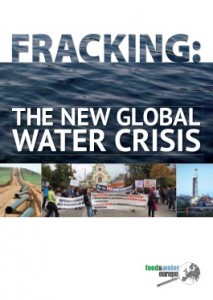
FrackingGlobalWaterCrisisNew drilling and fracking techniques have been a boon for the oil and gas industry in the United States, making it possible for companies to extract large quantities of oil and gas from shales and other “tight” rock formations. However, shale development has been a nightmare for those exposed to the resulting pollution.

DOWNLOAD PDF

New Report: Fracking Could Cause a New Global Water Crisis

Categories

Food

Risky Technology to Extract Shale Gas Should Be Banned, Says Consumer Group

Washington, D.C.—New technology enabling the extraction of large quantities of oil and natural gas from shale and other rock formations could drive the world’s next great global water crisis unless it is banned, according to a new report released today by national consumer group Food & Water Watch. Hydraulic fracturing, or fracking, combined with horizontal drilling, is poised to become a global environmental and public health threat as the oil and gas industry seeks more access to oil and gas trapped in rock formations far beneath the ground.

“Fracking is a dangerous American export that should be viewed critically by countries just starting to engage in the practice,” says Wenonah Hauter, Executive Director of Food & Water Watch. “Modern drilling and fracking have caused widespread environmental and public health problems, as well as posed serious, long-term risks to vital water resources.”

According to the report, Fracking: The New Global Water Crisis, countries around the world are grappling with how to address the push to drill and frack. In Europe, while France and Bulgaria have banned fracking in the face of strong public opposition, Poland has welcomed the industry. In China and Argentina, shale gas extraction is being developed with government support. In South Africa, pending an environmental review, a subsidiary of Royal Dutch Shell may be granted permission to extract shale gas.

The oil and gas industry touts the economic benefits of fracking, but the report counters that any economic benefit to local communities is short lived and can be outweighed by the risks and costs of the industry. Employment, construction, housing demand and royalty payments may increase significantly during an initial boom, but these effects diminish quickly as well productivities decline and operations move elsewhere, leaving behind a costly legacy of environmental pollution and scarred landscapes.

“While the oil and gas industry is profiting off of this technology, it has been a disaster for Americans exposed to its pollution. They have dealt with everything from mysterious ailments likely caused by hazardous air pollution to well water contamination that has left rural communities unable to use their water for washing, brushing their teeth or cooking—much less drinking,” said Hauter. “Does the rest of the world want to live this nightmare?”

The report also notes that while natural gas has been touted as a low-carbon fuel, recent scientific studies have shown that the growing dependence on shale gas is likely to accelerate global climate change in the coming decades.

“Shale gas drilling’s benefits can be summed up quickly: good for the oil and gas industry, and bad for rural communities,” says Hauter. “Legislators around the world need to learn what’s happened to these communities in the U.S. as a cautionary tale and implement fracking bans in their countries before it’s too late.”

Fracking: The New Global Water Crisis is available here.

Contact: Kate Fried, Food and Water Watch, (202) 683-4905, kfried(at)fwwatch(dot)org.

Fracking: The New Global Water Crisis

Categories

Food

Read the full report.Within the past decade, technological advances in horizontal drilling and hydraulic fracturing, or “fracking,” have enabled the oil and gas industry to extract large quantities of oil and natural gas from shale formations in the United States. However, the practice has proven controversial. Pollution from modern drilling and fracking has caused wide­spread environmental and public health problems and created serious, long-term risks to under­ground water resources.

In this report, Food & Water Europe reviews the risks and costs of shale development that have been demonstrated in the United States, including eco­nomic costs that run counter to industry-backed claims about the economic benefits of the practice.

DOWNLOAD PDF VIEW ON SCRIBD

Briefly:Food & Water Europe then summarizes the state of shale development in six selected countries: France, Bulgaria, Poland, South Africa, China and Argentina.

  • Strong public opposition to fracking in France and Bulgaria has led to national bans on the practice.
  • The government of Poland has welcomed oil and gas industry plans to develop shale re­sources in the country, but charges of bribery during the process of awarding leases have tainted these plans.
  • Pending an environmental review by the South African government, Royal Dutch Shell may soon be granted permission to drill and frack in South Africa’s Karoo Basin.
  • The Chinese government is pushing an expan­sion of shale development, and numerous oil and gas companies are partnering with Chinese firms, both in the United States and in China.
  • In Argentina, oil and gas companies have begun developing shale oil and shale gas resources in the Neuquén Basin, with the support of the Argentinean government.

Instead of exposing their citizens to the damages of modern drilling and fracking, countries around the world should enact national bans on the practice and invest aggressively in the deployment of energy efficiency and renewable energy technologies

Poland’s Lack of Transposition of the Water Framework Directive Especially Worrying Given Plans for Shale Gas Expansion

Categories

Food

Statement by Wenonah Hauter, Executive Director Food & Water Europe 

Brussels – “Food & Water Europe is disappointed that Poland has failed for eight years to implement the European Union’s Water Framework Directive. Poland was recently reprimanded by EU Commissioner for the Environment Janez Potocnik on its inability to establish a national monitoring programme on the health of its surface waters and groundwater. This is particularly worrying given Poland’s plans to encourage shale gas extraction on a large scale.”

“As the Polish government embraces widespread drilling and fracking for shale gas, the absence of a meaningful water monitoring programme is highly problematic. Fracking has led to thousands of cases in the United States of water contamination by leaks, spills, blowouts, and improper treatment of wastewater. The absence of a programme to monitor water quality will leave the Polish government without any baseline studies to properly assess the environmental and health impacts of fracking. Poland will essentially be flying blind, unable to assess environmental damage, let alone take remedial action.” 

Contact: Geert De Cock tel. +32 (0) 2 893 10 45, mobile +32 (0)484 629 491, gdecock(at)fweurope.org

Public-Public Partnerships Provide Affordable, Efficient Drinking Water and Sanitation to Cash- and Resource-Strapped Communities 


Categories

Food


New Food & Water Europe Report Shows that Municipalities Can Collaborate, Avoid Privatizing Assets

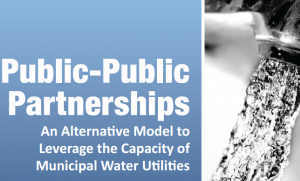
FoodandWaterEuropePublicPublicPartnershipsBrussels – Solving the tragedy of almost 900 million people around the globe lacking access to safe water, and 2.6 billion lacking access to sanitation requires innovative solutions to fixing inadequate and underfunded infrastructure. But a new report released today by the consumer advocacy group Food & Water Europe highlights how public-public partnerships have successfully and inexpensively provided these critical resources to communities around the globe. Public-Public Partnerships: An Alternative Model to Leverage the Capacity of Municipal Water Utilities, shows that municipalities can forge partnerships with one another to efficiently deliver drinking water and wastewater service while ensuring that these resources are kept under public control.

“All too often, communities that cannot afford to maintain their own drinking and wastewater systems are forced to sell or lease them to private entities, which often provide subpar service at higher rates,” said Food & Water Europe Executive Director Wenonah Hauter. “Public-public partnerships allow communities to avoid the woes associated with privatized service and ensure that essential drinking water supplies and sewer systems stay in the public’s hands.”

Under a public-public partnership, two or more water utilities or non-governmental organizations pool resources, buying power and technical expertise. Such partnerships provide the same advantage that a private utility could deliver without the workforce reductions, poor customer service, rate increases and service interruptions that private utilities are notorious for. Because such partnerships do not involve investors who expect a cut of the savings, efficiencies generated are reinvested into the system, not shareholder bank accounts.

Public-public partnerships can be successfully implemented on a variety of scales—within nations, across national boundaries and between industrialized nations and developing ones. Some examples include:

  • The Baltimore Regional Cooperative Purchasing Committee, a group of communities in Maryland saved $1.5 million in 2010 by partnering with one another.
  • In Puerto Cortés, Honduras, a partnership among five civil society groups created a new water utility that was eventually able to provide water to 98 percent of the city’s residents 24 hours a day whereas the city’s old water utility only delivered water to 79 percent of residents, 14 hours a day.

For communities in the developing world, these partnerships can serve as the foundation for sustainable economic development. Partnerships between water systems in industrialized nations and those in developing countries can improve water quality and allow parties to share best practices. Industrialized countries can provide management and technical expertise in these cases while ensuring that costs are kept low for consumers. This model has been particularly successful in Africa, where over half a dozen cross-border utility partnerships have been forged since 1987.

The European Commission recognized the advantage of such cross border partnerships by designating €40 million in 2010 for establishment of non-profit water and sanitation sector PUPs in African, Caribbean and Pacific countries. Importantly, the EU Water Facility guidelines specifically bar profit-making endeavors, thus precluding public-private partnerships from receiving grant funding.

“Tight economic times often mean that communities have a hard time maintaining their drinking water and sanitation systems, and through austerity measures are being forced into leasing or selling these assets to private entities in order to receive bail outs. But privatization has already proven to be a failure. Public-public partnerships are a cheap, efficient method of providing essential drinking water and wastewater services. Governments around the globe should implement policies to facilitate them,” concluded Hauter.

See the report.

For more information, please contact:

Gabriella Zanzanaini, gzanzanaini(at)fweurope(dot)org, +32 488 409 662