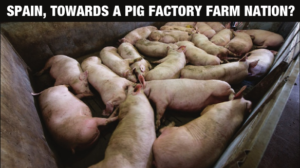
SPAIN, TOWARDS A PIG FACTORY FARM NATION?

Categories

Food

VIEW ON SCRIBD DOWNLOAD PDF

Spain is the third largest exporter of pork after China and the United States and has the largest pig population in the EU, 28,3 million animals.

Production and exports are growing as a result of high industry integration and low production costs. But that means that the industry is getting concentrated in just a few hands, with the number of farms diminishing rapidly and farmers facing growing marginalization. And this industry is not being held accountable for its impacts on the environment, workers and communities.

€200 bn Polluter Bonuses Unleashed by ETS Reform Proposals

February 15, 2017 — Today’s European Parliament vote on the reform of the EU Emissions Trading System (ETS) rubber stamps substantial new handouts to polluting industries and locks in a climate target far short of a fair EU share of cuts in greenhouse gas emissions.

The EU Parliament passed measures that represent around €200 billion in free pollution permits and additional funds for polluting industries, although the eventual value could be higher once the rules on continuing subsidies for the cement and other energy intensive sectors have been clarified.

Corporate Europe Observatory’s Oscar Reyes said:

“It looks like the EU Parliament is quite happy to prolong the welfare scheme for big polluters that has already failed to reduce emissions for too long. EU taxpayers will be the ones forced to pick up the bill for the heavy subsidies forked out to polluting industries.”

The vote also confirms a lack of ambition at the heart of the emissions trading scheme, which is the EU’s flagship climate policy tool.

Frida Kieninger of Food & Water Europe added:

“The 2.2 per cent annual reduction target is a shameful capitulation that is still far off the EU’s fair share of necessary climate action set out in the Paris Agreement.

“It is high time that the EU institutions realise that the ETS is not fit for purpose and scrap it in favour of more effective climate regulations.”

Notes to editors:

  • The EU Parliament voted on the ETS reform proposals and amendments listed here: http://www.europarl.europa.eu/plenary/en/report-details.html?reference=A8-0003-2017
  • The value of free pollution permits and ETS-linked funds will amount to around €198 billion between 2021 and 2030. This figure assumes an average carbon price of €25, and is broken down as follows: Free industry permits worth €135 billion, Innovation Fund €15 billion, Indirect Cost Fund €11 billion, Modernisation Fund €8 billion, Flexible Share €19 billion, New Entrants’ Reserve €10 billion.
  • This media reaction has also been endorsed by attac France.

Contact:

Fracking Legislative Package Enters into Force

Fracking torpedoes implementation of Paris Agreement on Climate Change
(German Version)

Berlin, 10 February 2017 — Today, one day before the German legislative package on fracking enters into force, environmental umbrella organization Deutscher Naturschutzring (DNR) – with its member organizations Bund für Umwelt und Naturschutz Deutschland (BUND), Naturschutzbund Deutschland (NABU) and Robin Wood as well as Deutsche Umwelthilfe (DUH), Umweltinstitut München, PowerShift and Food & Water Europe – fears that now more fracking projects will be realized. They are particularly concerned that fracking in tight sandstone layers, so-called tight gas fracking, is explicitly authorized by the new legislation, and could even be permitted in otherwise protected areas. There are also loopholes allowing fracking for “research projects” in shale, clay, coal bed and marl rock formations.

With this fracking policy, the German government undermines its own goal of being a climate protection leader. At the same time more and more countries in Europe are deciding on fracking bans, the grand coalition in Germany is prolonging the fossil era and hampering the implementation of the Paris Agreement with this fracking legislation, adopted in June 2016. This is a devastating signal to the international community, particularly since Germany will be in the international spotlight, not only hosting this year’s G20 summit but also the United Nations Climate Change Conference.

“We need a clear ban on any kind of oil and gas fracking in order to reach the climate goals as adopted in the Paris Agreement. The German Government has to live up to its international promises and speed up the energy transition [Energiewende] instead of further relying on bygone ages by developing fossil fuels,” says DNR president Prof. Dr. Kai Niebert.

According to the environment protection and nature conservation organizations, it’s now also up to the German federal states to finally ban fracking. The legislative package allows federal state governments to veto research projects for fracking in shale, clay, coal bed and marl rock formations. By consistently identifying protected areas, federal states can moreover rule out tight gas fracking.

Contact:

Andy Gheorghiu, Food & Water Europe, Fracking Policy Advisor, Food & Water Europe, Tel.: 05631/5069507, Mobil: 0160/2030974, E-Mail: [email protected]

Daniel Hiß, DNR-Frackingexperte, Mobil: 0157/89203007, E-Mail: [email protected]

Ann Kathrin Schneider, BUND Leiterin internationale Klimapolitik, Tel.: 030/27586-468, Mobil: 0151/24087297, E-Mail: [email protected]

Sebastian Scholz, NABU Leiter Energiepolitik und Klimaschutz, Tel: 030/2849841617, Mobil: 0172/4179727, Email: [email protected]

Dr. Cornelia Nicklas, DUH, Leiterin Recht, Mobil: 0162/6344657, E-Mail: [email protected]

Dr. Philip Bedall, ROBIN WOOD, Energiereferent, Mobil: 0160/99783336, E-Mail: [email protected]

Franziska Buch, Umweltinstitut München, Referentin für Energie und Klima, Tel: 089/30774917, E-Mail: [email protected],

Laura Weis, PowerShift, Fachpromotorin für Klima- & Ressourcengerechtigkeit, Tel.: 030/42085295, E-Mail: [email protected]
European Public Service Union – Food & Water Europe – European Water Movement


Trade Unions and Civil Society Welcome the Introduction of the Human Right to Water into the Constitution of Slovenia

foodandwatereuropesloveniawaterBrussels, 18 November 2016 – Last night the National Assembly of Slovenia passed an amendment to its Constitution to include a new article that recognizes the Human Right to Water. The amendment affirms water should be treated as a public good managed by the state, not as a commodity, and that drinking water must be supplied by the public sector in a non-for-profit basis. It is a great success for Slovenian activists  and people.
“Citizens from across the EU and Europe have successfully mobilized to have the right to water and sanitation recognized as a human right – as decided by the United Nations – and have this put into EU law. The European Commission continues to ignore nearly two million voices of the first ever successful European Citizens Initiative. Commissioner Vella should listen to citizens and follow the Slovenian example as soon as possible,” said Jan Willem Goudriaan, EPSU General Secretary.

Water is a controversial topic in Slovenia, as foreign companies from the food and beverage industry are buying rights to a large amount of local water resources. The Slovenian government has raised concerns about the impacts of free trade agreements like CETA (between Canada and the European Union) in its capacity to control and regulate these resources (1).

“Trade agreements and investor-state dispute settlement mechanisms can limit the ability of states to take back public control over water resources when foreign investors are involved, as it is the case in Slovenia. To guarantee the right to water and the control over this key resource, the European and the Slovenian Parliaments should reject CETA when it comes to a vote in the coming months,” said David Sánchez, Director of Food & Water Europe.

The amendment is the result of a citizens’ initiative that collected 51.000 signatures to propose a constitutional amendment (2).

‘We welcome the introduction of the human right to water in the Slovenian constitution, as the great result of a citizens’ initiative. Now civil society should be vigilant to guarantee a democratic and transparent management of the integrated water cycle founded in the participation of citizens and workers,” said Jutta Schütz, speakperson at the European Water Movement.

———————————————————————

Notes

  • The Slovenian government raised concerns about the ambiguity of terms like “commercial use of a water source” in CETA, how the agreement applies to existing water rights and the future ability of national governments to put limits on concessions already granted without being subject to claim under ICS, among others.

Contact: 

Jutta Schütz, Speakperson, European Water Movement, +49 (0) 157 390 808 39 (mobile), [email protected]

David Sánchez, Director, Food & Water Europe, +32 (0) 2893 1045 (land), +32 (0) 485 842 604 (mobile), dsanchez(at)fweurope.org

Guillaume Durivaux, Policy officer, EPSU, +32 (0) 22501041, [email protected]


EU-Parliament Welcomes Fracked US LNG and Ridicules Paris Agreement

Brussels, 25 October 2016 – Today, a majority of 415 to 223 MEPs (55 abstentions) approved the report on an “EU strategy on LNG and gas storage”, drafted by EPP MEP András Gyürk.

Only a few days before the global Paris Agreement will enter into force, the European Parliament takes a worrying decision by welcoming the import of fracked US gas and a further lock-in to fossil fuel investments – with European tax money. Given that gas infrastructure is already heavily underused, this will result in numerous cases of stranded assets and even more European LNG overcapacities.

LNG – with its significant share of methane emissions and the disastrous impacts of fracked fossil fuels – is not a climate- or environmentally-friendly solution at all. Our planet reacts much more quickly to reductions of methane emissions, which will be crucial in order to keep global warming under control.

“The EU will not be able to fulfill its obligations under the Paris Agreement by calling for the extraction of more fossil fuels and the expansion of gas infrastructure – while at the same time disregarding energy efficiency and renewables,” said Frida Kieninger, Campaigns Officer at Food & Water Europe.

The report also puts a particular focus on the import of LNG from the United States.”Two thirds of US gas is obtained through fracking. While several EU Member States declared moratoria or bans on fracking, it is cynical to push for the import of fracked gas from abroad at the same time”, said Frida Kieninger, “We need a clear commitment at the EU and Member State level to transition now to a decarbonized future in line with the Paris Agreement.”

Contact:
Frida Kieninger tel. +32 (0)2 893 10 45, mobile +32 (0)4 872 49 905, fkieninger(at)fweurope(dot)org

Facts About LNG: Dismantling Misleading Rhetoric

Categories

Food

In its narrative around the significance of liquified natural gas (LNG) for the European Union, the Commission is repeatedly using a set of controversial arguments. Also many MEPs have adopted the Commission’s wording unquestioned. But what is really behind these concepts?

Learn more in Food & Water Europe’s Factsheet:
Facts About LNG: Dismantling Misleading Rhetoric.

VIEW ON SCRIBD DOWNLOAD PDF