

Genetically Modified Salmon Jeopardize Environment, May Endanger Consumer Health

Categories

Food

Statement from Wenonah Hauter, Executive Director, Food & Water Watch

Washington, D.C. – “As rumors swirl that the Food and Drug Administration (FDA) may allow the sale of genetically modified (GM) salmon to consumers, flaws in the review process surrounding this controversial disruption to the natural food chain are coming into focus. The FDA, which has been tasked with overseeing the public’s health, could approve the divisive science experiment as early as this fall — a decision that consumers strongly oppose. If approved, the salmon would represent the first genetically modified animal sold as food to unsuspecting consumers (currently, there are no labeling requirements in place to assist consumers in identifying and avoiding GM foods).”

“Unfortunately, many in the aquaculture industry seek to genetically engineer fish to speed up production of their product. In this case, the company lobbying the FDA for approval, AquaBounty Technologies, wants to combine salmon genes that control growth hormone with a gene from another fish, the ocean pout. The ocean pout gene would keep the growth hormone in production, effectively creating mutant salmon that grow at twice the normal rate.”

“The FDA’s tests (historically used to determine if a non-GM food was safe) were created before GM products became a reality and are insufficient in determining the long-term, unforeseen consequences of the GM salmon in question. Put simply, these dated tests cannot determine the salmon’s full allergenicity and toxicity.”

“In addition to the FDA’s inability to test for the full range of consumer health threats introduced by GM foods, the agency’s tests do not include a review of the GM animals’ environmental impacts.”

“This is unacceptable, as a recent study commissioned by the European Union revealed that genetically modified fish ‘have a considerably greater effect on the natural environment than hatchery-reared non-transgenic species when they escape.’”

“AquaBounty has claimed that they will raise their fish in land-based facilities where ocean escapes are impossible, but what about the masses of corporations that will no doubt race to produce GM fish in the crowded open ocean facilities they already utilize for fish production? If the FDA approves GM fish, these fish will likely escape from their floating ocean pens (millions of salmon currently escape from them every year). Furthermore, even if a company promises to produce sterile fish incapable of interbreeding with the wild population, fast growing GM fish can easily outcompete wild fish for natural resources.”

“The documented environmental dangers and potential consumer health dangers of GM salmon prove that the public’s distrust of GM products, as reflected in a recent Consumer Reports poll, is not without warrant. The 2008 poll revealed that the majority of Americans are concerned about consuming products from GM animals and 95 percent agree that these products should, at the very least, be labeled.”

“If studies have revealed the dangers of GM foods and the public has verbalized their distaste, why would AquaBounty claim that the FDA is close to approving their product? The reality is that consumers can keep this potentially hazardous food off of their dinner plates by demanding that the FDA perform up-to-date, comprehensive reviews of any new GM product, starting with AquaBounty.”

Contact: Lauren Wright, 202-683-4929; lwright (at) fwwatch.org
European MEPs Back Resolution on Water as a Human Right

Categories

Food

Brussels – Social justice groups delivered a letter today to members of the European Parliament Heide Ruhle, Rosario Crocetta and a representative from MEP Jose Bove’s office, calling on the EU to support a historic resolution currently being considered at the United Nations General Assembly to have water and sanitation declared as human rights. All three MEPs have agreed to lead a campaign within the EU to have Parliament endorse a UN resolution on the rights to water and sanitation.

Others among a growing list of MEPs to endorse the call include Michael Cashman, Joe Higgins, Enrique Guerrero Salom, Linda McAvan, Arlene McCarthy, Keith Taylor and Bart Staes.

“This basic resolution is an important tool for achieving water justice for over a billion people without access to clean safe drinking water and over two billion without access to sanitation,” said Meera Karunananthan, National Water Campaigner at the Council of Canadians.

Advocates fear that the European Union, which will be voting as a block, may end up obstructing the measure.

“If the EU sees itself as a defender of human rights on the global stage, it is important that they support this initiative,” says Gabriella Zanzanaini, Director of European Affairs for Food & Water Europe.

“While stronger measures are needed internationally, this resolution is a necessary first step and a powerful symbol towards democratic and sustainable water management,” says Martin Pigeon, Water Justice Campaigner and Researcher for Corporate Europe Observatory.

The letter was signed by the following organizations:
11.11.11, Belgique, ACME (Association pour un contrat mondial de l’eau), the Blue Planet Project, Corporate Europe Observatory, the Council of Canadians, CEVI Centro di VolontariatoInternazionale, Food & Water Europe, France Libertes and Public Services International

Food & Water Europe Speaks at Green MEP Press Conference on Offshore Drilling Safety in EU

Categories

Food


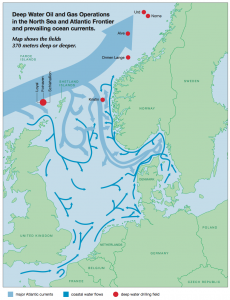
BRUSSELS—Today, Gabriella Zanzanaini, Director of European Affairs for Food & Water Europe, spoke at a press conference held by Green party Members of the European ParFoodandWaterEuropeOilOperationsliament (MEPs) about the safety of the 27 deepwater oil drilling facilities in the North Sea after the Gulf of Mexico disaster.

Download the full map of deepwater oil and gas operations in the North Sea

“Before the BP disaster, both oil companies and the U.S. Minerals Management Service said that there was a zero percent change of this ever happening, which led to complacency in terms of safety checks and development of safety technology,” said Zanzanaini. “The EU must not let this happen.”

According to Zanzanaini, the major oil companies in the U.S.—Exxon Mobil, ConocoPhillips, Shell and Chevron—earned $289 billion dollars in profits over the last three years, and spent $39 billion in the exploration of new wells—but spent only $20 million dollars a year on research and development devoted to safety.

“The EU must make sure that the development of safety technology is given as much priority as the development of drilling technology,” said Zanzanaini.

Over the past decade, the oil and gas industry spent $839 million lobbying U.S. officials—contributing to the cozy relationships between oil and gas industries and regulators there. Zanzanaini urged that the EU system should make sure independent bodies carry out inspections, separate from the body granting licenses. The EU should ensure that Member States implement this separation and raise the bar on the quality of inspections, not only the number. Finally, she urged the EU to refrain from allowing companies to operate on safety based on voluntary schemes—again, using the U.S. Minerals Management Service as a model not to follow.

Other speakers included Michele Rivasi, MEP (France), Bart Staes, MEP (Belgium), Bas Eickhout, MEP (Holland), and Sandy Luk, a lawyer with Client Earth.

Contact: Gabriella Zanzanaini, +32488409662, gzanzanaini (at) fweurope.org

European Parliament to Vote on Controversial Factory Fish Farm Practice

Categories

Food

Advocacy Group Releases Report; Factory Fish Farms Cause Documented Job Loss, Environmental Damage

Brussels, Belgium – On Thursday, a week before the European Parliament is set to debate a new report that will lay the foundation for a European-wide policy for sustainable aquaculture, Food & Water Europe released a report detailing the damage caused by a particularly controversial type of aquaculture supported by the agency. Known as open ocean aquaculture (or factory fish farming), the practice consists of the mass-production of fish using floating cages or net pens in open waters.

The report, Fishy Formula: Why the European Strategy Doesn’t Add up to Sustainable Aquaculture, is a harsh indictment of open ocean aquaculture (OOA); a practice that has caused documented economic damage and job loss in local communities where it has been implemented.

Employment in the farmed salmon sector in Scotland (a hotbed region for open ocean aquaculture) for example, fell 28 percent from 1998 to 2008, despite a 16 percent increase in production. According to the report, an additional five thousand sport angling and tourist related jobs were lost due to the expansion OOA.

“Factory fish farms promise much more than they deliver,” said Gabriella Zanzanaini, Director of European Affairs for Food & Water Europe. “In this economy, the last thing we need is more job loss. The European Parliament must recognize that these massive, industrial operations could devastate Europe’s economic and environmental health for years to come.”

The European aquaculture industry spans a variety of forms, including both OOA and land-based re-circulating operations that recycle the water initially put into the system. Ownership of these systems ranges from small-scale businesses in rural areas to massive publicly traded international corporations.

Nearly three-fourths of the EU’s total aquaculture production – namely farmed salmon, trout, seabass and seabream – originates from the more unsustainable, often corporate-owned OOA systems. According to the report, this figure has quadrupled since 1990 and risen 15-fold since 1985.

The report links the rise in OOA to a rise in local economic damage, citing communities that have experienced the loss of thousands of jobs as OOA operations have polluted coastal waters, undergone numerous corporate mergers, and replaced employees with new technology.

According to the report, OOA operations have polluted waters with disease, filth and (sometimes unapproved) chemicals/antibiotics that can leak from the cages.

A 2000 study revealed that Scotland’s 350 marine salmon farms, for example, produce more sewage waste (in the form of nitrogen and phosphorous) than the country’s entire human population.

Outside the European Union, nearby Norway has suffered similar damage. In 2009, Norway’s Pollution Control Authority called OOA operations “the largest source of anthropogenic emissions of nutrients” in Norway’s coastal areas. According to the agency, a mid-sized farm producing 3,120 metric tons of salmon each year is equivalent to a sewage spill from a city of approximately 50 thousand inhabitants.

“There are different types of aquaculture and factory fish farms are the least sustainable,” said Eve Mitchell, Food Policy Program Manager with Food & Water Europe. “We’re alarmed that the European Parliament is promoting open ocean aquaculture as a viable sustainable enterprise.”

Pollution is not the only threat introduced by OOA. Fish escapes, which can jeopardize wild fish due to competition for resources, introduction of disease, and interbreeding, have been reported in fish farms in Europe and around the world.

Last year in Argyll, Scotland, one hole in a net led to the escape of 60 thousand salmon. In 2008, Scotland’s salmon industry was threatened with outbreaks of infectious salmon anaemia – a deadly virus that can spread to wild populations and has crippled salmon industries elsewhere.

Chile, the world’s second-largest exporter of salmon and trout, saw its salmon exports reach a record high in 2008 before the virus spread quickly through the country’s crowded fish farms. The resulting devastation has led to the loss of at least 20 thousand jobs and a 40 percent drop in Chile’s 2010 salmon exports.

Contact: Gabriella Zanzanaini, Food and Water Europe: +32488409662, gzanzanaini(at)fweurope(dot)org.

Link to reports:

Fishy Formula: Why the European Strategy Doesn’t Add up to Sustainable Aquaculture

No Jobs Here: Why Industrial Fish Farming’s Promise to Boost Local Economies Falls Flat

###

Food & Water Europe is the European program of Food & Water Watch.

Gulf of Mexico Disaster a Cautionary Tale for Europe

Categories

Food

Food & Water Europe Calls on European Authorities to Tighten Inspection of Oil Production Facilities in Aftermath of Horizon Disaster

BRUSSELS—In response to BP’s lax safety record in the United States and cozy relationships between oil companies and regulators there, D.C.-based Food & Water Watch and its European program Food & Water Europe are warning European authorities they must strengthen their oversight and inspections of deepwater oil platforms operating in European waters.

“BP is known for cutting corners where safety is concerned and its deepwater operations in the United States are a cautionary tale for Europe,” said Wenonah Hauter, Executive Director of Food & Water Watch. EU officials should ensure that Member States are regulating deep-water operations adequately, beginning with BP facilities.” Due to the location of the five BP deepwater facilities operating in the North Atlantic and Atlantic currents, any BP disaster there would foul the entire North Sea.
Furthermore, the European Commission coordinated a meeting with the oil companies on 11 May behind closed doors, with insufficient information released publicly about its outcome. During the meeting, a questionnaire was distributed to all the oil companies in attendance, asking them about their capacity to respond to a disaster similar to the BP Horizon explosion in the Gulf of Mexico. It also asked those present to evaluate their safety measures in place.Current efforts by European officials have either been halted or are inadequate, says Food & Water Watch. MEP Boguslaw Sonik, Vice Chairman of the Environment Committee, and two other MEPs drafted a resolution calling for tighter inspection methods, stronger safety rules, and a strengthening of international rules for off-shore exploration and drilling. The motion did not pass.

“We fear this effort only mirrors the cozy and negligent regulation that the oil industry enjoys in the U.S.,” said Hauter. “The European Commission must not enable the industry to evaluate itself when it comes to safety. We also call on them to release the answers from the questionnaires and to reevaluate if the current directives are adequate.”

Food & Water Watch has been working in the U.S. to publicize the failed regulation of BP’s Atlantis production facility in the Gulf of Mexico.

Last month, the organization sued the U.S. Department of the Interior, seeking a temporary injunction to halt operations of BP’s massive Atlantis oil drilling facility until critical safety documents are produced.

“BP Texas City, BP Horizon, and BP Atlantis all have one thing in common: the absence of ‘as built’ drawings that correctly document the facility. This clear pattern of violations makes us question, and should raise alarms about, BP’s safety practices at all of its facilities,” said David Perry, the attorney representing Food & Water Watch in the suit. Perry also represented victims injured in the 2005 Texas City explosion and victims who intervened to oppose the U.S. government’s over-lenient plea bargain with BP over Texas City.

Food & Water Watch, along with former BP document controls contract employee Kenneth Abbott, maintains the Department of the Interior has allowed BP Atlantis to operate without documented, approved final engineering drawings considered critical to safe operation.

In August 2008, Abbott notified his superiors that Atlantis lacked proper and legally-required “as built” final engineering documents for critical subsea components. He later took his concerns to the BP Ombudsman’s office.

An internal BP email written in August 2008 characterized the situation as having the potential for “catastrophic Operator errors.” In February 2010, BP sent a letter to Congress saying that it only learned of the allegations recently and claimed they were unsubstantiated. Recently surfaced BP documents would later reveal, however, that BP had known about these problems for years.

“BP’s safety record speaks to the critical need for independent oversight,” said Hauter. “We hope European authorities are able to learn from the mistakes of the U.S. in regulating the oil industry.”

###

Food & Water Europe is the European program of Food & Water Watch, Inc (a non-profit consumer NGO based in Washington, DC) working to ensure the food, water and fish we consume is safe, accessible and sustainable. So we can all enjoy and trust in what we eat and drink, we help people take charge of where their food comes from, keep clean, affordable, public tap water flowing freely to our homes, protect the environmental quality of oceans, force government to do its job protecting citizens, and educate about the importance of keeping shared resources under public control.

Contacts:

Wenonah Hauter + 1 202 409 6117 [email protected]
Gabriella Zanzanaini +32 488409662 [email protected]
For more information, see our BP safety fact sheet and map of deepwater oil and gas operations in the North Sea and Atlantic Frontier and prevailing ocean currents.

BP Means Risky Business in North Atlantic

Categories

Food

Accident at a BP Platform in UK Waters Would Flood the North Sea

LONDON—In response to BP’s suspect safety record in the United States, Washington, D.C.-based Food & Water Watch and its European program Food & Water Europe is calling on the Department of Energy & Climate Change and the Health and Safety Executive in the United Kingdom to immediately investigate the five deepwater platforms operated by BP in the North Sea and North Atlantic.

“BP is a rogue company that has destroyed the marine environment and communities in the Gulf of Mexico through its disregard for safety,” said Wenonah Hauter, Executive Director of Food & Water Watch. “Anywhere there are BP deepwater facilities, they should be scrutinized. Due to the location of the five BP operations in UK waters and the Atlantic currents, any BP disaster here would foul the entire North Sea.”

Download the full map

Even before Deepwater Horizon exploded in the Gulf of Mexico earlier this year, BP had a troubled safety record in the United States:

  • BP’s Texas City refinery exploded in March 2005, killing 15 workers and injuring more than 170. The U.S. Chemical Safety Board attributed the explosion to BP’s failure to follow safety procedures. Texas City and other U.S.-based BP workplace fatalities accounted for more than one-fourth of U.S. refinery workplace fatalities between 1995 and 2005—10 times higher than fatalities at Exxon facilities;
  • Since 2006, BP has been subject to at least $142.8 million in fines and penalties for workplace safety violations in the U.S. alone—including $87.4 million for allegedly failing to implement workplace safety improvements under a settlement after the Texas City disaster, and $50 million in criminal fines related to that disaster;
  • In March 2006, 267,000 gallons of crude oil leaked from a corroded pipeline at BP’s Prudhoe Bay facility. And in July 2005, Hurricane Dennis struck BP’s Thunder Horse Deep Sea Platform in the Gulf of Mexico. Incorrectly installed ballast piping caused a 30-degree list that dipped the platform into the Gulf.

Last month, Food & Water Watch sued the U.S. Department of the Interior, seeking a temporary injunction to halt operations of BP’s massive Atlantis oil drilling facility until critical safety documents are produced.

“BP Texas City, BP Horizon, and BP Atlantis all have one thing in common: the absence of ‘as built’ drawings that correctly document the facility. This clear pattern of violations makes us question, and should raise alarms about, BP’s safety practices at all of its facilities,” said David Perry, the attorney representing Food & Water Watch in the suit. Perry also represented victims injured in the 2005 Texas City explosion and victims who intervened to oppose the U.S. government’s plea bargain with BP over Texas City as too lenient.

Food & Water Watch, along with former BP document controls contract employee Kenneth Abbott, maintains the Department of the Interior has allowed BP Atlantis to operate without documented, approved final engineering drawings considered critical to safe operation.

In August 2008, Abbott notified his superiors that Atlantis lacked proper and legally-required “as built” final engineering documents for critical subsea components. He later took his concerns to the BP Ombudsman’s office.

An internal BP email written in August 2008, characterized the situation as having the potential for “catastrophic Operator errors.” In February 2010, BP sent a letter to Congress saying that it only learned of the allegations recently and claimed they were unsubstantiated. Recently surfaced BP documents would later reveal, however, that BP had known about these problems for years.

“Are there others like Atlantis operating in the Gulf of Mexico and the North Sea? We won’t know until the U.S. and UK governments take action to assure independent investigations are conducted on each BP deepwater operation within their waters,” said Hauter. “BP’s safety record itself speaks to the critical need for independent oversight.”

Contact: Eve Mitchell, +44 (0)1381 610 740, emitchell (at) fweurope.org

For more information, see our BP safety fact sheet and map of deepwater oil and gas operations in the North Sea and Atlantic Frontier and prevailing ocean currents.