


Latest EU hydrogen push prolongs gas industry hold over Europe’s energy transition – new report

The Projects of Common and Mutual Interest (PCI/PMI) list unveiled by the European Commission last week will do little to advance Europe’s energy transition and much more to perpetuate its fossil fuel import dependence, shows a report published today by CEE Bankwatch Network and Food and Water Action Europe. It will also burn much of the limited public funding that should be spent on electrification, according to the analysis. Check out the full report here.
The PCI/PMI list, some of whose electricity projects are truly high-priority, includes over a hundred hydrogen projects, with twice as many hydrogen pipelines as in the previous list. Alarmingly, 42 out of the 59 pipeline projects will most likely ship fossil gas-based hydrogen, according to the new analysis. 

Any transboundary energy infrastructure granted the lucrative status of ‘Project of Common Interest’ or ‘Project of Mutual Interest’ is eligible for EU subsidies via the Connecting Europe Facility and benefits from faster permitting. 

Yet, while the Commission boasts that PCI/PMI projects will catalyse decarbonisation, today’s report reveals that many of them will make no meaningful contribution to cutting emissions, and their necessity is little more than speculation. 

This is no coincidence. The vast majority of hydrogen projects on the list were originally proposed by the fossil fuel industry, and specifically members of ENTSOG, a gas transmission operators’ lobby group. 

In fact, as the report authors stress, the rules governing the PCI process – namely, the TEN-E Regulation – give ENTSOG a major role in the process from the early stages such as network development planning, to crafting the methodology for cost-benefit analyses and developing demand and supply scenarios. 

EU bodies – including the Agency for Cooperation of Energy Regulators and the European Advisory Board on Climate Change – and civil society have long been warning that the PCI exercise does not serve its purpose. 

Bankwatch and Food & Water Action Europe are therefore calling on Members of the European Parliament and the Council to reject the PCI/PMI list to prevent Europe being chained to fossil gas for decades to come. 

Gligor Radečić, Gas campaign leader at CEE Bankwatch Network: “While it is expected that some projects are promoted by transmission system operators, since they are often the only actors with the necessary know-how and capacity, it makes little sense that the very same companies – represented by ENTSOG – are also the ones responsible for assessing those projects.”  

Eliot Garnier-Karcenti, Senior Energy Advisor at Food & Water Action Europe: “Not voting against the PCI/PMI list would promote a carbon-intensive European Union dependent on fossil-based hydrogen. All European stakeholders are awaiting a review of the hydrogen strategy and the Trans-European Energy Networks (TEN-E) regulation. It makes no sense to support a list that will become obsolete within a few months.” 

The report’s warning is particularly timely given the new Grids Package released today by the Commission. As part of the legislative package, the proposed changes to the TEN-E Regulation could determine the future role of ENTSOG – and later also the European Network of Network Operators for Hydrogen (ENNOH) – in deciding on Europe’s transboundary energy infrastructure.  

However, the TEN-E regulation proposal, which was leaked to several media outlets last week, has so far failed to eliminate this conflict of interest in the PCI/PMI process. Aside from proposing that the Commission now develops the central scenario, all the other roles remain with ENNOH. Decision makers need to ensure that the revision of the TEN-E Regulation not only democratises the PCI/PMI process but also that it prioritises electrification to truly step up the energy transition. 

For additional information, please contact: 

Eliot Garnier-Karcenti
Senior Energy Advisor, Food & Water Action Europe
[email protected]
+33 6 34 31 56 20
LinkedIn: https://linkedin.com/in/eltgk 

Gligor Radečić
Gas Campaign Leader, CEE Bankwatch Network
[email protected] 
European Commission fuels hydrogen fantasies – but MEPs can still halt the next array of fossil fuel follies

Categories

Fossil FuelsClimate

A bill tabled today by the European Commission foresees a massive build-up of hydrogen projects, despite growing expert consensus that hydrogen can only thwart Europe’s decarbonisation efforts. 

The Commission’s Delegated Regulation on Projects of Common Interest (PCIs) and Projects of Mutual Interest (PMIs), unveiled today, includes a list of European transboundary energy infrastructure projects that the Commission and Member States intend to prioritise and subsidise. Over a hundred of these are hydrogen infrastructure projects, the bulk of which are pipelines designed to carry fossil-gas-based hydrogen. 

Members of the European Parliament (MEPs) and the Council of the European Union now have two months to scrutinise the proposed regulation and raise any objections. If none are forthcoming, the regulation will enter into force. Though the PCI/PMI list itself cannot be amended at this stage, MEPs – recognising the urgency of raising the EU’s climate ambition – can and should reject the list for the misguided direction it takes. 

The PCI/PMI process is meant to facilitate the EU’s energy transition by identifying cross-border projects of strategic importance. Projects awarded this preferential status enjoy privileged access to EU public financing and expedited permitting. 

Worryingly, over 80 per cent of the hydrogen projects on the PCI/PMI list have been proposed by the fossil fuel industry, with more than 90 per cent of the hydrogen pipelines tabled by members of the European Network of Transmission System Operators for Gas (ENTSOG) – the lobby group for Europe’s gas transmission operators – according to an analysis by Food & Water Action Europe. 

The result is an important policy instrument that risks perpetuating Europe’s fossil gas habit and birthing an entire cohort of costly stranded assets. 

Civil society has repeatedly urged decision makers to limit hydrogen development to hard-to-abate sectors and to ensure it runs exclusively on renewable sources of energy. Several bogus projects proposed for PCI/PMI status have since been dropped following heavy scrutiny, not least from civilsociety, yet many others remain. 

‘Most of the hydrogen projects on the PCI/PMI list will transport, store or receive large quantities of fossil-based hydrogen. The proposed hydrogen network is disproportionate. The electrolysers included are not linked to any additional dedicated renewable sources of energy, which will vampirise the remaining energy needed for the transition. For these reasons, this list must be rejected,’ says Eliot Garnier-Karcenti, Senior Energy Advisor at Food & Water Action Europe.

‘We join the EU’s own advisory bodies – the European Scientific Advisory Board on Climate Change (ESABCC) and the EU Agency for the Cooperation of Energy Regulators (ACER) – in questioning the credibility of the PCI and PMI selection process and its implications for the EU’s decarbonisation efforts. The process still grants a central role to ENTSOG, an industry body representing the very companies that stand to profit from PCI and PMI status. This inherent conflict of interest undermines trust in the system. The TEN-E Regulation – and the PCI/PMI process it governs – must shift decisively towards rapid electrification and demand-side flexibility, rather than keeping these solutions on an equal footing with fossil fuel interests,’ says Gligor Radečić, Gas Campaign Leader at CEE Bankwatch Network.

For additional information, please contact: 

Eliot Garnier-Karcenti 
Senior Energy Advisor, Food & Water Action Europe
egarnierkarcenti(at)fweurope.org
+33 6 34 31 56 20
LinkedIn: https://linkedin.com/in/eltgk/ 

 Gligor Radečić 
Gas Campaign Leader, CEE Bankwatch Network
gligor.radecic(at)bankwatch.org 

Break free from gas, civil society urges EU energy ministers

Brussels, 12 June 2025 – Civil society organisations gathering outside the EU Council headquarters in Brussels urged European energy ministers to break free from fossil gas completely, and not to simply replace Russian gas with other suppliers, including liquified gas (LNG) from the US. [1]

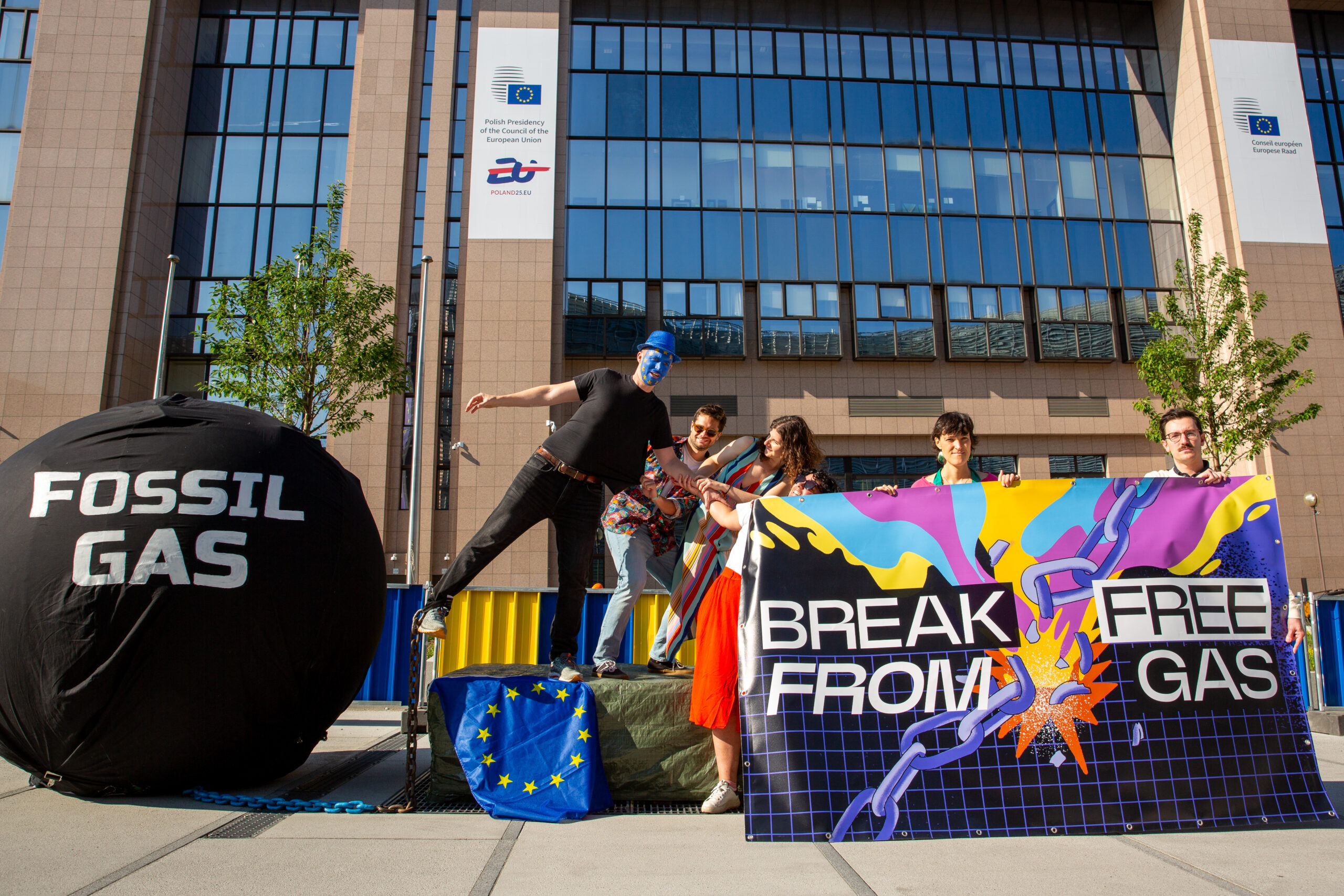
An activist dressed to represent the European Union, face-painted with the EU flag, was attached to a giant 2-metre-across inflatable ball and chain, labelled ‘fossil gas’, while other activists held a banner reading ‘break free from gas’. [2] The protest comes ahead of a meeting of EU energy ministers on 16 June, where they will discuss and vote on a proposal to weaken the EU’s rules on methane pollution, in order to facilitate imports of climate-wrecking gas. The organisations, together with over 70 other Civil Society Organisations and think tanks, also wrote to the energy ministers to warn them of the dangers of this deregulation of methane rules.

In their statement, they said: “Replacing one source of polluting gas with another is a disaster for the climate, and for households’ energy bills, but some energy ministers are determined to strip away rules on methane pollution to do just that. Swapping Putin’s gas for Trump’s gas, or any other gas, does nothing for energy security, it just changes who can extort the EU – and communities near extraction sites will pay with their health, while people in Europe pay with their wallets. The EU and its governments must instead fully commit to energy efficiency, moving to a fully renewable energy system and protecting those suffering from energy poverty.” 

A draft agreement between energy ministers, published by Contexte on 11 June, proposed including the EU’s methane pollution rules in an upcoming effort by the European Commission to deregulate some of the EU’s energy laws. The EU’s methane regulation sets rules for the energy sector to monitor and report on the methane pollution from all fossil fuels, in the EU and along its global supply chains, and to reduce the amount of methane leaking into the atmosphere. Methane is an extremely potent greenhouse gas, with an impact on global heating over 80 times as powerful as carbon dioxide over a 20-year period. [3]

The EU is exploring weakening its methane rules explicitly to facilitate increased imports of liquified fossil gas from the US, according to reporting by Reuters. Civil society organisations are warning that this would have terrible impacts on communities living near drilling and refining installations in the US, and would increase the climate pollution from fossil-fuel-heavy industries in Europe, like petrochemicals.

An analysis by Strategic Perspectives shows the EU can achieve a close-to-full gas phaseout by 2040 and dramatically save on energy import costs. By expanding renewable energy and cutting gas imports, the EU has already saved billions of euros; civil society organisations are urging the EU to continue this trend

Notes to editors:

[1] The organisations, in alphabetical order, are: Center for International Environmental Law (CIEL), Climate Action Network (CAN) Europe, Food & Water Action Europe, Greenpeace, Oil Change International (OCI), Razom We Stand and WeMove Europe.  

[2] High quality photos from the protest, free to use, are available here

[3] Climate Action Network Europe and Food & Water Europe’s briefing on the EU Methane Regulation 

BRIEFING: Europe’s dependence on US fracked gas – environmental & social impacts revealed

Categories

LNGJusticeFossil FuelsClimate

Brussels – 24 April: A recent analysis by Food & Water Action Europe and Gas No Es Solución Network reveals a concerning trend: The overwhelming majority of liquefied ‘natural’ gas (LNG) imported to Europe from the United States in 2023 was sourced from fracking operations. According to the U.S. Department of Energy (DOE), 88% of fossil gas extracted in the U.S. in 2023 came from fracking. Applying this percentage to the total volume of US LNG imports into the EU, American fracked gas met over 17% of the total gas demand in the EU-27 in 2023.

The report titled “LNG – LIQUEFIED FRACKED GAS: Unveiling the Toxic Truth Behind Europe’s LNG Obsession,” brings to light the environmental and social costs associated with this reliance. Fracking and LNG operations not only worsen the climate crisis but also inflict a heavy toll on frontline communities in the U.S. residing near fracking sites and LNG terminals, where environmental injustices are rampant.

From 2021 to 2023, US LNG imports tripled, with last year’s imports into the EU-27 totaling 64 billion cubic meters (bcm), comprising nearly half of the bloc’s total LNG imports. The Netherlands, France, and Spain emerged as the leading importers, collectively receiving over 38 bcm of gas, which represents over 60% of all US LNG imports to the EU. Notably, the majority of fracked gas originated from export terminals in the Gulf Coast region, particularly Texas and Louisiana. 

The EU’s voracious appetite for LNG comes at a grave cost to human rights, perpetuating environmental degradation and exacerbating social inequities. By locking ourselves into long-term LNG contracts and investing in new gas infrastructure, we betray both our climate commitments and the imperative to transition away from fossil fuels,” said Food & Water Action Europe’s Gas Campaigner Enrico Donda.

While the Biden Administration’s decision to put a pause on new LNG projects is a step forward, it won’t halt ongoing construction or reduce current LNG export capacity. Despite this, there are troubling efforts from fossil fuel companies and certain decision-makers on both sides of the Atlantic to paint LNG expansion as crucial for energy security, all while ignoring the disproportionate harm faced by affected communities and brushing aside mounting evidence of future massive LNG overcapacity. It is worth noting that in 2023, EU LNG terminal utilization rates were below 60%.

The report also exposes the paradox of EU countries: While six out of thirteen EU LNG import countries have banned fracking domestically due to environmental and health concerns, they continue to import fracked fossil gas. As the EU rushes to secure gas imports, it turns a blind eye to human rights violations and supports authoritarian regimes through new gas contracts. The solution to high energy prices and the cost of living crisis lies in a rapid just transition to 100% clean energy, not further deepening our reliance on dirty fossil fuels, which only worsen social injustices and climate change while enriching the fossil fuel industry. 

“We need to move away from fossil fuels fast, fair and forever in order to achieve climate and social justice. And especially European countries that ban gas extraction through fracking on their territories – as the Spanish state – must ban imports of this gas from third countries, so as not to externalise its serious impacts.” Marina Gros Breto, activist of the “Gas No es Solución” Spanish network.

***

Contact: Enrico Donda (English/Italian/French/Portuguese) – [email protected], mobile +32 (0) 485 187 523

Greenlighting Greenwashing – Energy Priority List Greenlighted by MEPs today Resembles Fossil Fuel Industry Wishlist

Categories

Fossil FuelsClimate

Brussels 12 March – Today, MEPs greenlighted the 6th PCI list during the Strasbourg plenary votes. The PCI list (Projects of Common Interest List, or Union List) is a collection of large energy infrastructure projects that obtain top EU priority, a streamlined environmental impact assessment, accelerated permitting  and access to EU subsidies.

The adoption of the list flies in the face of a needed phase out of fossil fuels, as a large number of the projects featuring on the PCI list are linked to fossil fuels:

  • 68 large hydrogen projects with a combined cost of €50-100 billion (see Food & Water Action Europe’s analysis here), all of which have been proposed and will be operated by the fossil fuel industry. Many of them are designed to carry fossil-based hydrogen, i.e. hydrogen generated with fossil gas or other fossil fuels.
  • The 14 CO2 transport projects  aim to promote a Carbon Capture and Storage (CCS) market in the EU. But CCS is plagued with a high number of failed and/or abandoned projects, While promoting the dubious hope that removing CO2 from the atmosphere will one day be technically feasible, the technology is mostly embraced by the fossil fuel industry as a means to prolong their climate-wrecking business-model, and is used to dismiss calls for an urgent phase out of all fossil fuels.
  • Two highly controversial fossil gas pipeline projects are featured: the contested EastMed pipeline, planned to connect gas fields in disputed waters offshore Cyprus with Greece, and the Melita TransGas pipeline between Malta and Sicily, which is linked to the murder of journalist Daphne Galizia Caruana.

Over 60 civil society groups from across Europe have called on EU parliamentarians to reject the PCI list: These projects risk becoming stranded assets while helping the fossil fuel industry to stay rich by selling false solutions.” 

These PCI projects do not support a just transition, quite the opposite: They deliver a pretext for the fossil fuel industry to continue polluting while claiming to move to ‘clean’ hydrogen and to projects allegedly capturing CO2. The planet is plagued by increasingly violent impacts of climate change – it is shocking how MEPs fall for false solutions proposed by the fossil fuel industry, which will lock Europe into continued fossil fuel dependence”, says Frida Kieninger, Director of EU Affairs at Food & Water Action Europe.

John Beard from Port Arthur, Texas, community leader who lives at the frontline of climate change and the epicenter of US Liquefied ‘Natural’ Gas (LNG) export, is meeting MEPs in Strasbourg this week to talk about the human face of the LNG boom. The US is the biggest exporter of LNG to the EU, with Port Arthur LNG having supplied 28% of the total volumes of US LNG that reached EU shores in 2023.

It is disheartening to see EU decision makers agreeing once more to a lock-in of the EU into dirty fossil fuels infrastructures. The lives and health of long suffering communities already overburdened by the petrochemical industry, are being sacrificed by the industry.

We are the sacrifice.

This decision will lock in the EU’s fossil fuel dependency and therefore, pushing for continued fossil gas demand. A big part of this gas will be exported from the US, directly from impacted communities like mine in Port Arthur.” says John Beard, Founder of the Port Arthur Community Action Network (PACAN).

“For you LNG might represent a simple energy source, but for us it means more illness and death from high cancer rates, human rights violations, and more racial injustice”.

It is a death sentence, just another nail in the coffin.

The adoption of the PCI list in the form of a delegated act means that the last obstacle to its entering into force has been removed. The projects can now apply for Connecting Europe Facility (CEF) money and benefit from the advantages that come with PCI status.

MEPs rejected the objection to the 6th PCI list with 131 voting for, 431 voting against it and 35 abstaining.


EU Lawmakers Rubber Stamp Top EU Priority List for Energy Infrastructure

Categories

Fossil FuelsClimate

For immediate release: 22 February 2022

Contact: Frida Kieninger (EN, DE, ES, FR), [email protected], mobile: +32 (0) 487 24 99 05

Brussels – MEPs in the EU Parliament’s Energy Committee today voted with a large majority in favor of the Union List of Projects of Common and Mutual Interest (commonly known as the PCI list), a move that could lock in continued fossil fuel dependence. 

The PCI list is a top EU priority list for energy infrastructure, drafted by the EU Commission with considerable influence from the fossil gas transport industry (ENTSO-G). 

This 6th PCI list is the first list under renewed rules since the updated Trans European Networks for Energy (TEN-E) Regulation entered into force, which was allegedly crafted to exclude fossil gas projects from eligibility.

Ahead of the vote, close to 60 civil society groups from across Europe have called on EU parliamentarians to reject the PCI list: “These projects risk becoming stranded assets while helping the fossil fuel industry to stay rich by selling false solutions.” 

Projects on the 6th PCI list voted today include large-scale hydrogen projects that would transport fossil-based hydrogen. The projects were approved for inclusion even though they lack an analysis of life-cycle greenhouse gas emissions as well as an assessment of infrastructure needs for priority uses of hydrogen. All 68 hydrogen projects have been submitted by the fossil fuel industry.

The list also includes more than a dozen CO2 transport projects to boost a European carbon capture and storage (CCS) market. CCS is a technology that has been widely criticized for repeated failures to actually permanently store CO2 or reduce climate pollution. CCS has been strongly supported by fossil fuel companies that  claim industry emissions can eventually be removed in the future.

MEPs backed two particularly problematic fossil gas pipeline plans on the PCI list: the Melita TransGas pipeline between Malta and Sicily, as well as the multi-billion EastMed pipeline from offshore Cyprus to Greece.

“The PCI list is supposed to represent our common interests, but this is a fossil fuel industry wishlist of false solutions and failed technologies like hydrogen and so-called carbon capture,” said Frida Kieninger, Director of EU Affairs at Food & Water Action Europe.   

“PCI projects will benefit not only from eligibility for EU tax money but also from faster permitting procedures and environmental impact assessments. And some of them are explicitly fossil fuel projects; two particularly problematic and contested fossil gas projects in Malta and Cyprus – the EastMed and Melita TransGas pipelines – have  been greenlighted by decision makers.” 

The objection to the 6th PCI list has been dismissed by ITRE MEPs, with 50 MEPs against, 11 MEPs supporting the objection and 2 abstentions. During the March 11-14 session in Strasbourg, a PCI list objection will be voted on by the EU Parliament plenary.