[pdflink file=”rBGH_Health.pdf”]
Although Canada and the European Union have banned the use of bovine recombinant growth hormone in dairy cows due to its health risks for both humans and cows, the Food and Drug Administration has dismissed evidence for these risks in order to approve the use of rBGH. The following is a sampling of research, funded by government agencies and major universities – that raises serious concerns about the safety of rBGH/rBST and challenges FDA approval of the use of this hormone. Please note that in some studies rBGH also is referred to as bovine somatotropin, or rBST.
Human Health
rBGH and Human Health Problems Resulting from Mastitis (I)
Based on the proposed label supplied by Monsanto, the increased risk of mastitis [inflammation of the udder] that may be associated with rBST has human health implications (antibiotic resistance in farm-borne human pathogens)
“BST-induced mastitis is harder to treat than naturally occurring mastitis and duration of treatment is longer due to higher incidence of infection with S. aureus… There is a one third higher incidence of antibiotic resistant bacteria. BST use increases the amounts of drugs in general to treat the various adverse effects it causes in cattle.”
rBST (NUTRILAC) Gaps Analysis Report.” Report of the rBST Internal Review Team, Health Protection Branch, Health Canada.. April 21, 1998.
rBGH and Human Health Problems Resulting from Mastitis (II)
“The public health and food safety aspects of mastitis in dairy cows are exclusively associated with the potential problems of side effects from using antimicrobials in the treatment or prevention of such cases. Treatment of clinical mastitis cases with antimicrobials is not limited to those cases, which may be classified as severe…, also, milk clinical cases are often treated with local application of antimicrobials… Even cases of sub-clinical mastitis are sometimes treated with antimicro-bials…”
“The public health reasons for limiting as far as possible the use of antimicrobials in dairy cows are the risk of: an in-creased incidence of allergic reactions from drugs and their metabolites in consumers of milk and dairy products; an in-creased selection of bacteria resistant to antimicrobials.”
“European Commission. ‚Report on Public Health Aspects of the Use of Bovine Somatotrophin.” 15-16 March 1999. Food Safety – From the Farm to the Fork.
rBGH and IGF-1 (I)
 “Six lactating, non-pregnant Jersey cows were given subcutaneous [below the skin] injections of recombinantly derived bovine growth hormone (rBGH) for seven days Concentrations of [a growth hormone called] insulin-like growth factor (IGF-1) in the milk increased from 0.44 +/- 0.04 (mean +/- s.e.m.) during the seven days preceding treatment to 1.6 +/- 0.2 nmol/l on day seven of treatment. Taking the increase in milk yield into account, the total increase in the secretion of IGF-1 into milk of one udder half was 6-fold.”
Prosser, C. G., Fleet I. R., A. N. Corps. “Increased secretion of insulin-like growth factor 1 into milk of cows treated with recombinantly derived bovine growth hormone.” Journal of Dairy Research 56(1):17-26, 1989.
rBGH and IGF-1 (II)
The increased secretion of IGF-I into milk during rBGH treatment is of further relevance in view of the proposed com-mercial use of this compound in the dairy industry. Bovine IGF-I has an identical amino acid sequence to human IGF-I and would therefore be active in humans.
“Application of rBST increased the amount of excreted IGF-I in milk by 25-70% in individual animals. The Committee noted that bovine milk may contain truncated IGF-I (des(1-3)IGF-1), which was found to be even more potent than IGF-1 in the anabolic response when given subcutaneously to rats.”
European Commission. “Report on Public Health Aspects of the Use of Bovine Somatotrophin.” Food Safety – From the Farm to the Fork. March 15-16, 1999.
IGF-1 and Cancer
“The role of IGFs in cancer is supported by epidemiological studies, which have found that high levels of circulating IGF-I and low levels of IGFBP-3 are associated with increased risk of several common cancers, including those of the prostate, breast, colorectum, and the lung.”
Yu, Herbert and Thomas Rohan. Review. “Role of the Insulin-like Growth Factor Family in Cancer Development and Progression.” Journal of the National Cancer Institute 92:1472-89, 2000.
rBGH, IGF-I, and Gastrointestinal Cancer
“The combination of IGF-1 in BST-milk and IGF-1 normally secreted into the human gastrointestinal lumen would aug-ment intraluminal concentrations of this hormone, increasing the possibility of local mitogenic effects [factors that cause cell division to commence] on gut tissues.”
Challacombe, D. N., and Wheeler, E. E. “Safety of milk from cows treated with bovine somatotropin.” Lancet 344:815-816, 1994.
IGF-I and Breast Cancer in Premenopausal Women
“We evaluated the association of plasma IGF-I and IGF binding protein-3 with risk of breast cancer in a study of 94 cases of premenopausal ductal carcinoma in situ and 76 controls. Compared with women in the lowest tertile [quarter] of IGF-I, women in the upper two tertiles of IGF-I had an elevated risk for ductal carcinoma in situ.”
Bohlke, Kari, Daniel W. Cramer, Dimitrios Trichopoulos, and Christos S. Mantzoros. “Insulin-Like Growth Factor-I in Relation to Premenopausal Ductal Carcinoma in Situ of the Breast.” Epidemiology 9(5):570-573. 1998.
IGF-I and Prostate Cancer
“IGF-I is a mitogen [factor encouraging cell division] for prostate epithelial cells. To investigate associations between plasma IGF levels and prostate cancer risk, a nested case-control study within the Physicians Health Study was conducted on prospectively collected plasma from 152 cases and 152 controls. A strong positive association was observed between IGF-I levels and prostate cancer risk.”
Chan, June M, Meir J Stampfer, Edward Giovannucci, Peter H. Gann, Jing Ma, Peter Wilkinson, Charles H. Henne-kens, and Michael Pollak. “Plasma Insulin-Like Growth Factor-I and Prostate Cancer Risk: A Prospective Study.” Sci-ence 279(5350):563-566. 1998.
IGF-I and Bovine Spongiform Encephalopathy (Mad Cow Disease)
“It is speculated that IGF-I plays a role in the expression of genes that encode for prion [the infectious agent believed to cause BSE] synthesis and that increased IGF-I shortens the incubation period for Bovine Spongiform Encephalopathy (BSE) [commonly referred to as Mad Cow Disease]. Thus, the use of BST might increase the risk of exposure to BSE infection.”
“rBST (NUTRILAC) Gaps Analysis Report.” Report of the rBST Internal Review Team, Health Protection Branch, Health Canada. April 21, 1998.
IGF-I‚ Resistance to Pasteurization
“IGF-I in milk is resistant to pasteurization and even elevated levels of IGF-I have been reported after pasteurization. The latter might be related to the standard analytical procedures, which fail to detect protein-bound (IGFBP-bound) IGF-I. Consequently, consumption of milk from rBST treated dairy cows will increase the daily intake of IGF-I.”
European Commission. “Report on Public Health Aspects of the Use of Bovine Somatotrophin.” Food Safety , From Farm to the Fork. 15-16 March 1999.
IGF‚ Carcinogenic Effects on Rodents (II)
“When exposed to insulin-like growth factor 1 or supraphysiologic [higher than normal] levels of insulin, NIH 3T3 cells that expressed high levels of receptors formed aggregates in tissue culture dishes, colonies in soft agar, and tumors in nude mice… The results demonstrate that when amplified, this ubiquitous growth factor receptor behaves like an oncogenic [cancer causing] protein and is capable of promoting neoplastic [uncontrollable cell] growth in vivo.”
Kaleko, Michael, William J. Rutner, and A. Dusty Miller. “Overexpression of the Human Insulinlike Growth Factor I Receptor Promotes Ligand-Dependent Neoplastic Transformation.” Molecular and Cellular Biology. 10(2):464-473. 1990
rBGH and Unstudied Human Health Problems
The following questions deserve attention:
- Does the IGF-1 molecule remain in the gastrointestinal tract of humans (when products from rBST-treated animals have been consumed)?
- Based on the biological activity of IGF-1 activity as cellular growth factor and assuming that IGF-1 is not immediately destroyed in the gastrointestinal tract, what is the consequence of the direct exposure of the gut mucosa?
- What evidence can be provided that orally ingested IGF-1 enters systemic circulation and what are the possible conse-quences of this systemic bioavailability?
“Several reports express concerns about undesirable allergic reactions which might occur after the consumption of milk obtained from rBST-treated cows… the question of whether or not a change in milk protein composition as a consequence of rBST application to the dairy cows might pose an additional risk factor in the development of food allergies has so far not been addressed adequately.”
European Commission. “Report on Public Health Aspects of the Use of Bovine Somatotrophin.” Food Safety , From Farm to the Fork. 15-16 March 1999.
“Evidence from the subchronic rat study submitted by Monsanto had shown that rBST was absorbed intact from the GI tract following oral administration, albeit at high doses, and elicited a primary antigenic response. The full immunological and potentially toxicological consequences of this observation were not investigated.”
“rBST (NUTRILAC) Gaps Analysis Report.” Report of the rBST Internal Review Team, Health Protection Branch, Health Canada. April 21, 1998.
Animal Welfare
rBGH and Animal Welfare
“Any exogenous treatment that modifies the physiology of an organism with the objective of increasing its productivity is likely to impair welfare if the individual is not able to adapt to the physiological and metabolic changes this treatment in-duces.”
European Commission. “Report on Public Health Aspects of the Use of Bovine Somatotrophin.” Food Safety , From Farm to the Fork. March 15-16, 1999.
rBGH and Animal Welfare: Mastitis
 Milk production, feed efficiency, health, and reproduction were evaluated in 46 Jersey cows that received either 500 mg of sometribove (n-methionyl bST) in a prolonged-release formulation or an equivalent volume of excipient biweekly be-ginning at 60 +/- 3 DIM
“During the pretreatment period, only one quarter in a control cow required antibiotic treatment, whereas 11 quarters in cows later assigned to the treatment group received antibiotic therapy. When the number of new cases of mastitis during the treatment period were examined, the control cows had 4 cases, and the treated cows had 29 cases.”
Pell, A. N., D. S. Tsang, B. A. Howlett, M. T. Huyler, V. K. Meserole, W. A. Samuelss, G. F. Hartnell, and R. L. Hintz. “Effects of Prolonged-Release Formulation of Sometribove (n-Methionyl Bovine Somatotropin) on Jersey Cows.” Jour-nal of Dairy Science. 75:3416-3431, 1992.
rBGH and Animal Welfare: Reproductive Side-effects (I)
“There is evidence that BST treatment can adversely affect reproduction. Pregnancy rate dropped from 82 to 73% in mul-tiparous cows and from 90 to 63% in primiparous cows… The frequency of multiple births, which can cause welfare prob-lems, was substantially increased by BST. Failure to conceive is an indicator of poor welfare and multiple births lead to poor welfare.”
“Report on Animal Welfare Aspects of the Use of Bovine Somatotrophin.” Report of the Scientific Committee on Ani-mal Health and Animal Welfare of the European Commission. March 10, 1999.
rBGH and Animal Welfare: Reproductive Side-effects (II)
“There were a number of effects on reproductive performance that were associated with the use of rBST. These included a substantial increase in the risk of non-pregnancy and a slight increase in days open in cows that do conceive. There was also inconclusive evidence of increased risks of cystic ovaries and twinning.”
“Report of the Canadian Veterinary Medical Association Expert Panel on rBST.” Canadian Veterinary Medical Asso-ciation Expert Panel on rBST Executive Summary.





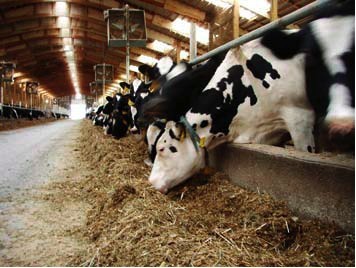 Years ago, when rBGH was being approved for use, Monsanto wanted to make a label claim that it increased both feed efficiency and milk production. This is exactly what proponents of rBGH are saying now, that cows treated with the artificial hormone eat the same amount of feed while producing more milk. But when agency approval came in 1993, the label claim for increased feed efficiency was not allowed because Monsanto could not produce enough data to convince FDA of their claims.
 In California from 1997 to 2007, the number of dairy cows increased by 30 percent, from 1.39 million to 1.81 million. Those 422,000 additional cows consumed 44 million more bushels of corn in 2007 than the state’s dairy herd ate a decade earlier. An additional 293,000 acres of corn were required to feed those new dairy cows in 2007.
 California and Idaho dont produce enough corn to supply the rising demand from factory farms, so much of that extra corn has to be shipped from thousands of miles away, using energy and contributing to climate change.
 The possible health implications of rBGH for humans and cows are significant. The milk from cows injected with rBGH has higher levels of another hormone called insulin growth factor-1 (IGF-1). Elevated levels of IGF-1 in humans have been linked to colon and breast cancer. Some researchers believe there may be an association between the increase in twin births over the past 30 years and elevated levels of IGF-1 in humans.