

Joint Statement by Food & Water Europe and Friends of the Earth Europe on PCI List Vote

March 14th, 2018 – MEPs in Strasbourg today voted on a motion to oppose the EU’s Projects of Common Interest (PCI) list, on the basis that it includes over 100 new fossil gas infrastructure projects. However there was no majority to reject the list, which also includes a number of other energy infrastructure projects.

Reacting to the vote, Antoine Simon, Fossil Free campaigner for Friends of the Earth Europe, said: “A full rejection of this list of priority energy infrastructure (PCI) was always going to be a tall order; but it’s welcome to see 177 MEPs for the first time opposing the EU’s reckless support for new climate-wrecking gas projects. The time is running out to end our dependency on fossil fuels and that means no new gas pipelines.”

Frida Kieninger, Campaign Officer for Food & Water Europe, said: “While it is the first time that the EU-Parliament voices open objection to this priority list for fossil fuels, this is also the first PCI list designed and adopted after the Paris Climate Agreement entered into force. With a far too strong focus on fossil gas projects, today’s adoption of the PCI list marks a setback for the environment, human rights and our global climate.”

***

Notes: 

The PCI list covers priority energy infrastructure projects to be built in Europe, drawn up by the European Commission, Member States and European Network of Transmission System Operators for Gas (ENTSOG). Approved projects become eligible for EU funding (under the Connecting Europe Facility (CEF)).

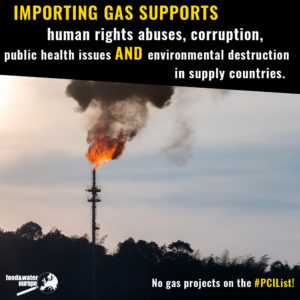
The list contains the controversial Southern Gas Corridor, which has already been associated with serious human rights violations in Azerbajan; the MidCat pipeline between France and Spain facing growing protests on both sides of the Pyrenees; and three LNG terminals in Croatia, Greece and Ireland, for environmentally destructive shale gas imported from the US.

Friends of the Earth Europe has previously revealed that the list is based on flawed data provided by the gas industry, and has not been tested against the Paris Agreement’s climate targets.

***

Contact:
Antoine Simon, Fossil Free campaigner for Friends of the Earth Europe, [email protected], +32 (0) 486 685 664
Frida Kieninger, Campaign Officer for Food & Water Europe, [email protected], +32 (0) 487 249 905
 

Broad Coalition Backs National Trust in Fracking Fight With Ineos

Categories

Food

Brussels and Washington, D.C. — Citing concerns over climate change, protecting sensitive ecological sites, and preserving local control of lands, a diverse coalition of groups and academics from the United Kingdom and the United States released a letter to Prime Minister Theresa May supporting the National Trust’s efforts to prevent the petrochemical company Ineos from making the first steps towards fracking in one of England’s most treasured environmental areas.

The letter is supported by Food & Water Watch, Food & Water Europe, Oil Change International and academics from both countries, including the Marine Conservation Society, Scientists for Global Responsibility, Campaign to Protect Rural England, World Wildlife Foundation, Greenpeace, Frack Free United, Friends of the Earth and UK Youth Climate Coalition. The letter was also signed by individuals and academics including fashion icon Vivienne Westwood and her son Joe Corré, Cornell Professor Robert Howarth, Dr. Sandra Steingraber, Prof. Nick Cowern and Prof. Peter Strachan.

“Ineos’s fracking dreams are a nightmare for communities on both sides of the Atlantic, and that’s why so many anti-fracking campaigners are speaking up to stop them,” said Wenonah Hauter, executive director of Food & Water Watch and Food & Water Watch Europe. “Anyone who cares about the climate crisis, the increasing burden of global plastics pollution, and the air and water pollution associated with petrochemical manufacturing should get active in the fight to stop Ineos from fracking the UK–and anywhere else for that matter.”

Ineos currently is the major shale license holder in the UK, and is attempting to force its way into the National Trust’s Clumber Park, a sensitive and historically significant site that attracts hundreds of thousands of visitors every year. After blocking access to land surveyors, Ineos has responded by taking legal action against the National Trust.

With facilities around the globe, Ineos’s environmental violations and history of air pollution have come under increased scrutiny. The petrochemical giant is pursuing drilling in the United Kingdom in order to supply its facilities with fracked hydrocarbons that can be used to produce plastics. Their corporate vision comes at a time in history when global warming and the plastic pollution of our oceans and shorelines are the most critical issues of our generation, and the ones to come.

The company’s ambitions are relevant to battles over fracking in the United States. Ineos developed a fleet of “dragon ships” to carry gas liquids from Pennsylvania to its facilities in Scotland and Norway. Those shipments are likely to increase if the massive Mariner East 2 pipeline is completed. But that pipeline — a project of Sunoco/Energy Transfer Partners — has been a source of intense controversy, with construction causing drilling spills and water contamination. Most recently, a series of sinkholes caused state regulators to halt operations on the existing Mariner East 1 pipeline.

Ineos’s fracking plans across the United Kingdom have been running into determined local opposition. As the letter to Prime Minister May notes, opinion polls show strong public opposition to fracking, which suggest that the public understands the array of risks associated with the practice. And the Scottish government, in response to overwhelming public opposition, announced its decision to ban fracking last year.

As the letter to Prime Minister May puts it, “Climate change is one of the most urgent and complex threats to the British countryside today. Fracking poses significant risks to the natural environment through loss or fragmentation of habitat, disturbance of wildlife and potential pollution of watercourses that support sensitive ecosystems and biodiversity and as driver of climate change.”

Download the letter here


Over 100 US. & International Groups Tell Wolf: Shut Down Mariner East Pipeline

Sunoco’s Controversial Gas Liquids Pipeline
Poses Threats in US and UK


Philadelphia — Dozens of US and international organizations
released a letter to Governor Tom Wolf encouraging him to bring a halt to Sunoco’s Mariner East 2 pipeline.

The groups point out that the pipeline puts residents on both sides of the Atlantic at risk: Communities in eastern Pennsylvania that will bear the burden associated with fracking, the communities along the pipeline route endangered by spills and explosions, and those living near the petrochemical facilities in Europe that will use the gas liquids carried by the pipeline.

“This effort links the local battles against Sunoco with the vibrant anti-fracking movement in Europe that is focusing on the environmentally disastrous record of Ineos, the petrochemical colossus that is seeking to benefit from fracking in the US and the UK,” said Food & Water Watch Executive Director Wenonah Hauter. “The dangers posed by this project are serious, and require immediate action from Governor Wolf, who is the only the person with the power to protect all of these communities.”

The massive Sunoco project has been plagued by drilling spills and water contamination, which eventually led the state’s Department of Environmental Protection (DEP) to suspend construction permits. But weeks later, the Wolf administration settled with Sunoco, clearing the way for construction to resume.

Governor Wolf has long been an ardent supporter of Sunoco’s project, and pushed to expedite construction permits.

“Since the Wolf administration’s approval the Mariner East 2 pipeline one year ago, the call for him to stop it has grown to include organizations from across the United States, Scotland, England, and Europe,” said Karen Feridun, the founder of Berks Gas Truth. “These groups stand in solidarity with communities whose health, safety, private water supplies, quality of life, and property rights are threatened by bad actors like Sunoco/Energy Transfer Partners on this side of the Atlantic and Ineos in the UK and Europe. Governor Wolf can and must stop this pipeline right now and become the climate leader Pennsylvania needs. His choice will be his legacy.”

The letter, organized by Food & Water Watch, Food & Water Watch Europe and Berks Gas Truth was signed by US groups like Oil Change International, Progressive Democrats of America, Friends of the Earth, the Center for International Environmental Law and the Center for Biological Diversity. They are joined by organizations in Europe like Frack Free United (UK), Friends of the Earth EWNI (England, Wales and Northern Ireland), Talk Fracking (UK), Friends of the Earth Scotland, Frackwatch and Our Forth Against Unconventional Gas (Scotland), Not Here Not Anywhere (Ireland) and Ecologistas en Acción (Spain).

“From both sides of Scotland- East and West – we join our voices to those calling on Governor Wolf to protect his state and people from fracking and pipelines,” read a joint statement from Scottish groups Frackwatch Glasgow and Our Forth Against Unconventional Gas. “We feel fortunate that our government has banned fracking – but we feel sad that our country is destination for most of the gas piped through the dirty and dangerous Mariner East pipeline as it is finally transported via Dragon Class Ships, to travel up and down the Firth of OUR FORTH and pass perilously close to the capital city into the heart of Scotland.  Here, most of the gas will be used to make throwaway plastic to pollute our oceans and add to greenhouse gas emissions. We need some real changes, on both sides of the Atlantic, to move forward in a positive way! The fact is that leaders – real leaders – must now start planning for and working with communities for – a very different economic future.”

The letter closes with this message to Governor Wolf: “It is time to put a stop to this dangerous pipeline, and to move to a full ban on fracking. Your decision to do this will benefit our communities and our health, and it would protect residents of the state of Pennsylvania.”

Contacts:

US
Peter Hart, Food & Water Watch, [email protected], 732-839-0871
Karen Feridun, Berks Gas Truth, [email protected]

EU/UK
Andy Gheorghiu, Food & Water Europe, [email protected]
Penny Cole, Frackwatch Glasgow, [email protected]
Callum McLeod, Our Forth Against Unconventional Gas, [email protected]

Despite Commission promise, new list of energy infrastructure ‘projects of common interest’ prioritises climate-wrecking fossil gas

Categories

Food

350.org, Corporate Europe Observatory, Counter Balance, PowerShift, Gastivists, Justice and Environment, Food & Water Europe

BRUSSELS —Today, the European Commission presented its third “Projects of Common Interest” (PCI) list composed of energy infrastructure projects. It contains around 90 gas infrastructure projects. This is even more than the list of 2015 and directly contradicts Climate and Energy Commissioner Miguel Arias Cañete’s claim that the new PCI list was moving away from gas.[*]

Supporting more climate-killing gas infrastructure is definitely not in the common interest of Europeans, and even less in the interest of communities worldwide that are already heavily impacted by climate change. Providing EU tax-payer money for many of these “priority” projects is a step into the past and a big step away from the Paris Agreement. It also further closes the short gap of time we still have to combat climate change” says Frida Kieninger from Food & Water Europe.

Projects on the PCI list are given the highest national priority and benefit from accelerated permits and streamlined environmental impact assessments. Many of them receive granting from the Connecting Europe Facility (CEF) – EU tax payer’s money.

We can clearly see the gas industry’s fingerprints on the design of this years’ PCI list. Unfortunately, in EU institutions as well as in Member States departments, the gas industry lobby is still setting the agenda. The PCI process itself has been led by the gas industry through the central role of industry lobby group ENTSO-G [the European Transmission System Operators for Gas] in deciding which projects are eligible or needed”, says Pascoe Sabido from Corporate Europe Observatory. “It is obvious that ENTSO-G will never work towards its own abolishment, so involving it so closely in the PCI process undermines much needed climate action.”

The European Parliament now has two months to object to the list, otherwise it will be automatically approved. The Parliament has no ability to vote on single projects or on gas PCIs alone, and must decide on the PCI list as a whole.

Besides a number of electricity and some oil and smart grid projects, the 90 gas projects mean that for the third time in a row, the Commission has not managed to reduce the amount of fossil fuel projects to even close to 50, as stipulated by the TEN-E regulation.[*]

However, the European Commission claims it is supporting fewer gas projects through the PCI list, because it has clustered many together to count them as single projects. “Clustering projects to artificially lower their number is nothing but a cheap accounting trick and changes nothing about the fact that the PCI list still supports far too much gas infrastructure”, says J&E Board Member Birgit Schmidhuber.

The current list not only contains a host of mega-pipelines such as the $45bn Southern Gas Corridor pipeline, the Baltic Pipe and the “Eastring”. Meanwhile, demand has been declining for over a decade. Also on the list is a number of new LNG terminals to import costly, climate damaging liquefied gas from all over the globe. Terminals in Sweden, Ireland, Croatia and Poland get EU support while the EU-wide use of such terminals was at less than one fifth of their capacities in the past.

So far, gas PCIs eligible for funding received twice as much money – over €1bn – as electricity projects, despite the CEF regulation stipulates that electricity PCIs should receive the majority of CEF funding. Over €3bn of the €4.7bn foreseen for gas and electricity PCIs from 2014-2020 still remains unspent. It is still unclear whether the trend of favouring gas project funding will be turned for the benefit of electricity projects in the next three years.


End notes

[*] Cañete told Ends Europe in November 2017 “In the [PCI] list we will publish at the end of November, you will see there is a big shift from gas to electricity” (behind a paywall)
[*] TEN-E regulation

Ineos’ Court Injunction Won’t Stop UK Anti-Fracking Movement

Categories

Food

Washington/Brussels/London—Today, the High Court of the United Kingdom upheld an injunction sought by petrochemical giant Ineos intended to stifle protest against the company’s plans to frack sites in the UK.

In response, Food & Water Watch and Food & Water Europe Executive Director Wenonah Hauter issued the following statement:

“This decision undermines our basic democratic rights to protest and defend our communities.

“Ineos is facing sustained protests for a reason. The company has amassed an atrocious environmental record across Europe, from chemical leaks and substantial pollutant releases to fires and explosions. If this company is being allowed to frack the UK, more pollution and more accidents are likely to follow.”

“The public knows the dangers fracking poses to our clean air and water, and that’s why activists in England are taking bold action to protect their communities against these threats. Ineos would like to stifle this movement, and unfortunately this High Court injunction has given the company a potentially powerful tool to threaten those advocating for a healthy climate and a livable world. If Ineos thinks a court injunction will stop the movement to protect our water, climate and communities from fracking, they are in for a surprise.


The Awful Environmental Record of Ineos Disqualifies Fracking Ambitions

EMBARGOED FOR RELEASE: November 21, 2017 6:01 AM

New Report Takes Hard Look at Chemical Giant’s Trail of Pollution

WASHINGTON, DC/BRUSSELS—Facilities owned by the massive chemical corporation Ineos are responsible for scores of serious health and safety violations across the globe, a troubling record that should move United Kingdom leaders to slam the brakes on the company’s push to begin fracking in the United Kingdom. Ineos has never drilled a commercial gas or oil well, and its indifferent safety record in chemical plants justifies blocking its foray into fracking.

A new issue brief from Food & Water Watch and Food & Water Europe examines Ineos plants in the UK, and across Europe and the United States. The company’s 71 facilities in 18 countries are responsible for a vast array of accidents, chemical leaks, fires and explosions, and substantial air and climate pollution.

“From towering chemical fires in Germany to toxic air pollution in Scotland and plastic pellets littering our oceans, Ineos’s safety record is appalling,” said Wenonah Hauter, executive director of Food & Water Watch. “The company is also a climate disaster waiting to happen—benefiting from fracking in the U.S. while planning to bring the dangerous practice to the United Kingdom. This company’s plans have been met with a passionate, committed grassroots movement, and political leaders are beginning to understand that the right response to fracking is to stop it before it starts.”

The company’s Grangemouth facility in Scotland is the largest industrial site in in the country, and the hub for Ineos’s global fracking ambitions. It can manufacture one million tons of chemicals per year, and has repeatedly received low environmental ratings by Scottish regulators. The plant is Scotland’s single largest emitter of carbon dioxide.

The story is similar at other Ineos facilities, which have amassed a record of fires, explosions, and chemical leaks. The Ineos facility in Cologe, Germany was the site of a massive fire in 2008, and there have been a series of high profile accidents elsewhere—a major oil leak in Norway, a number of chemical leaks in France, long-running controversies over chemical dumping in Italy, and the release of toxic gas that resulted in the hospitalization of workers in Belgium.

Over a quarter of Ineos’s facilities are located in the United States, where the company’s awful record continues. The report shows that between 2014 and 2017, 12 of the company’s 14 plants in one EPA database were failing to comply with a major environmental regulation for at least one three-month period.

Already a chemical industry giant, Ineos has been expanding into fossil fuel infrastructure and drilling, with a plan to bring hydraulic fracturing or fracking to the United Kingdom.

From beginning to end, Ineos’s business model represents grave threats to clean air and water. The company relies on fracked hydrocarbons from Pennsylvania and Ohio, which delivers immediate negative impacts in the communities near drilling sites. These dangerously explosive materials must be transported via major pipelines, like the Mariner East 2 under construction across Pennsylvania, drilling for which has already caused dozens of spills and several cases of water contamination. The materials are shipped across the Atlantic Ocean to the plastics and chemical manufacturing sites, which contribute further environmental threats to the air, water and public health.

“The Ineos vision for the future is a disaster for clean air and water, and a disaster for the climate as well,” said Hauter. “At a time when the entire world must be moving off fossil fuels, Ineos represents a series of dangerous gambles that will take us backwards.”

See the report.

Contact:

Andy Gheorghiu, Policy Advisor, Food & Water Europe, agheorghiu[at]fweurope.org