


Growing Doubts Over Adequacy of €102 Million EU Public Money for Krk LNG Terminal After Lex LNG Adopted in Croatia’s Parliament Today

Brussels – Today, the Croatian Parliament agreed on a law facilitating a planned LNG terminal offshore the island of Krk. Parliamentarians voted in favor of the Law on Liquefied Natural Gas heavily criticized by local groups and NGOs. Environmental organizations warned that the law would speed up the construction of a project implemented against the will of local communities that poses a threat to local tourism and the environment and lacks economic sense.

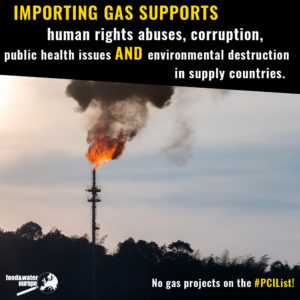
The project is considered highest national priority and was recently re-confirmed as a Project of Common Interest (PCI) for the EU in the PCI list adopted in March. Thanks to its PCI status, the Krk terminal recently received a grant of €102million EU public money through the Connecting Europe Facility [1].

However, growing local opposition and a worrying lack of transparency cast a bad light on the benefits the terminal receives at the EU-level. Arguments opposing the planned terminal are getting louder and include crucial questions about the need for such infrastructure considering current and projected gas demand in Croatia, as well as about the climate implications of a lock-in into fossil gas imports – even more so in connection with possible imports of particularly climate-harmful fracked gas from the United States.

On 26 and 27 March, representatives of the EU Commission’s DG Energy conducted several visits and interviews with stakeholders connected to the Krk LNG terminal in Croatia. To date, no final report about the outcomes has been produced.

A lot of EU-tax payers’ money has been invested in this terminal, and yet we have serious doubts over its economic sense and its democratic legitimacy. Local decision makers oppose this project, communities protest against it, and there is no market for a project of this size, yet still the EU Commission will provide over €100 million for its construction,” says Frida Kieninger, Campaign Officer at Food & Water Europe. “We want to see the conclusions of the EU Commission’s fact-finding mission and highly doubt that the provided CEF money is invested with appropriate diligence.”

Both an offshore terminal, as it is currently discussed, as well as an onshore LNG facility constitute costly fossil fuel infrastructure, threatening to weigh heavy on Croatians’ gas bills. LNG terminals can be operated for decades, locking us into fossil gas far beyond the moment by which we will have to manage a complete fossil fuel phase-out to avert the worst of the climate chaos ahead.

Contact: Frida Kieninger – Tel: +32 (0) 2893 1045, Mobile: +32 (0) 487 24 99 05

_______________________
[1] http://europa.eu/rapid/press-release_IP-17-280_en.htm

‘PLANET INEOS’ : THE QUEST TO FRACK FOR PLASTICS THREATENS AIR, WATER, AND CLIMATE

BREAKING:  Scottish Court Rules Against Ineos in Fracking Case

Food & Water Watch / Food & Water Europe documents delivered to No 10 Downing Street by fashion icon Vivienne Westwood and her son Jon Corré

London/Brussels/ — Dame Vivienne Westwood and her son Joe Corré brought a vision of Armageddon today to No 10 on UN World Environment Day in a protest over pollution from fracking, and the government’s hypocrisy over plastics.

Backed by research materials from Food & Water Watch and Food & Water Europe on the corporate profile and bad environmental record of secretive petrochemical company Ineos, they’ve delivered ‘Planet INEOS”, a representation of the harms caused by plastic pollution and climate change.

Petrochemical giant INEOS is Britain’s biggest private company, owned by UK’s richest man, controversial billionaire and fracking profiteer Jim Ratcliffe. Ineos owns more fracking licenses than any other energy company in the UK and already use fracked gas from the United States to manufacture plastics.

The campaigners say that despite the government’s recently announced War on Plastic, its industrial policy gives plastic production a higher priority than energy.

Corré, who is head of Talk Fracking, says: “It’s impossible to reconcile the Government’s War on Plastic with its policy on fracking when they’re clearly enabling the creation of yet more problem plastic. It’s sheer hypocrisy.

“If INEOS get their way and fulfil their ambition to frack the length and breadth of the UK, they will be making a vast contribution to the already growing pile of cheap plastics in the world today.”

INEOS have a horrendous environmental track record in Europe and have been responsible for toxic chemicals, leaks, fires and explosions that have endangered workers, communities and the environment.

“Now they plan to bring those dangers to hundreds of communities across the UK, just to make more plastics that we don’t want,” Corré added.

Food & Water Watch and Food & Water Watch Europe Executive Director Wenonah Hauter, said: “INEOS’s fracking dreams are a nightmare for communities on both sides of the Atlantic, and that’s why so many people are speaking up to stop them. Anyone who cares about the climate crisis, the increasing burden of global plastics pollution, and the air and water pollution associated with petrochemical manufacturing should get active in the fight to stop INEOS from fracking the UK.”

This action is being supported by the #BreakFreeFromPlastic movement.

European Parliament to Address #ExxonKnew Scandal, Consider Action Against the Fossil Fuel Giant

Categories

Food

Parliament Committee Will Address a Petition Submitted by Food & Water Europe Demanding Accountability for Decades-Long Climate Change Cover-Up

May 15, 2018 – The Petitions Committee of the European Parliament announced that it will consider tomorrow a petition calling on the Parliament to take action to hold ExxonMobil accountable for its decades-long cover-up of internal documents tying its fossil fuel production to globe-threatening climate change. The scandal, known colloquially as #ExxonKnew, arose in 2015 when evidence came to light showing that Exxon scientists confirmed at least as early as 1981 that fossil fuel extraction and burning contributed significantly to dangerous climate change, but hid those conclusions and funded massive efforts to publicly challenge its own internal science.

Parliament’s interest in challenging Exxon comes in stark contrast to the Trump administration’s egregious climate denial and aggressive promotion of the fossil fuel industry. President Trump appointed Rex Tillerson, the CEO of ExxonMobil during much of their science cover-up period, as his first secretary of state. The European Union, signatory of the Paris Climate Agreement and aiming at becoming global leader in renewable energy should take its responsibility to draw boundaries to fossil fuel multinationals like Exxon. With ExxonMobil’s misleading campaign on the European Parliament’s agenda, parliamentarians have now the chance to help protect EU citizens from the corporation’s risky business and to walk the talk of preserving EU climate and energy targets.

“ExxonMobil has misled the public debate on climate change for over 40 years but due to close ties between ExxonMobil and the Trump administration, an initial push to hold the corporation accountable is stalled,” said Member of European Parliament Marina Albiol Guzman, a member of the Petitions Committee. “Tackling ExxonMobil’s climate cover up now in the European Parliament could be an opportunity for parliamentarians to walk the talk and prove their willingness to tackle climate change and honor the Paris Agreement.”

“European Parliament’s interest in holding ExxonMobil accountable for its decades of lies and cover-ups is certainly encouraging,” said Wenonah Hauter, executive director of Food & Water Watch and Food & Water Europe. “The ball is now rolling on a process that may finally force Exxon to reckon with its toxic, deceitful past and answer for its assault on our planet. We urge Parliament to act swiftly and aggressively in this critical matter, and take powerful action against Exxon.”


Contact: Frida Kieninger – Tel: +32 (0) 2893 1045, Mobile: +32 (0) 487 24 99 05

Chemical Companies Go to Court to Challenge Scotland Fracking Ban

Chemical Companies Go to Court to Challenge Scotland Fracking Ban

The international petrochemical giant Ineos, joined by the Scottish company Reach Coal Seams Gas, is in court to challenge the Scottish government’s indefinite moratorium on fracking.

Faced with overwhelming public opposition to drilling, the government announced early this year that it would extend a fracking moratorium indefinitely. The companies are trying their case in the Court of Session this week.

Ineos is the main shale license holder in the UK, and plans to frack parts of Scotland and England in order to use the hydrocarbons as a feedstock for plastic production. The company currently imports fracked hydrocarbons from the United States.

In response to the court challenge, Wenonah Hauter, Executive Director of Food & Water Watch and Food & Water Europe, released the following statement:

“Ineos’s appalling and astonishing record of environmental violations at its facilities across the globe should warrant serious scrutiny. Now it wants to do more harm to clean air, safe water, and a livable climate by trying to force the Scottish government to let it frack their country. Tens of thousands of people across Scotland have spoken out against this dangerous plan, and Scottish officials were right to stop Ineos before it could start drilling. The future belongs to clean energy, not to fossil fuel corporate behemoths like Ineos, which will use every tool at its disposal to force fracking on Scotland. Ineos has lost in the court of public opinion, and they will lose this court challenge as well.”

EU/UK Andy Gheorghiu, Food & Water Europe, [email protected]

US Peter Hart, Food & Water Watch, [email protected], 732-839-0871

Joint Statement by Food & Water Europe and Friends of the Earth Europe on PCI List Vote

March 14th, 2018 – MEPs in Strasbourg today voted on a motion to oppose the EU’s Projects of Common Interest (PCI) list, on the basis that it includes over 100 new fossil gas infrastructure projects. However there was no majority to reject the list, which also includes a number of other energy infrastructure projects.

Reacting to the vote, Antoine Simon, Fossil Free campaigner for Friends of the Earth Europe, said: “A full rejection of this list of priority energy infrastructure (PCI) was always going to be a tall order; but it’s welcome to see 177 MEPs for the first time opposing the EU’s reckless support for new climate-wrecking gas projects. The time is running out to end our dependency on fossil fuels and that means no new gas pipelines.”

Frida Kieninger, Campaign Officer for Food & Water Europe, said: “While it is the first time that the EU-Parliament voices open objection to this priority list for fossil fuels, this is also the first PCI list designed and adopted after the Paris Climate Agreement entered into force. With a far too strong focus on fossil gas projects, today’s adoption of the PCI list marks a setback for the environment, human rights and our global climate.”

***

Notes: 

The PCI list covers priority energy infrastructure projects to be built in Europe, drawn up by the European Commission, Member States and European Network of Transmission System Operators for Gas (ENTSOG). Approved projects become eligible for EU funding (under the Connecting Europe Facility (CEF)).

The list contains the controversial Southern Gas Corridor, which has already been associated with serious human rights violations in Azerbajan; the MidCat pipeline between France and Spain facing growing protests on both sides of the Pyrenees; and three LNG terminals in Croatia, Greece and Ireland, for environmentally destructive shale gas imported from the US.

Friends of the Earth Europe has previously revealed that the list is based on flawed data provided by the gas industry, and has not been tested against the Paris Agreement’s climate targets.

***

Contact:
Antoine Simon, Fossil Free campaigner for Friends of the Earth Europe, [email protected], +32 (0) 486 685 664
Frida Kieninger, Campaign Officer for Food & Water Europe, [email protected], +32 (0) 487 249 905


Over 100 US. & International Groups Tell Wolf: Shut Down Mariner East Pipeline

Sunoco’s Controversial Gas Liquids Pipeline
Poses Threats in US and UK


Philadelphia — Dozens of US and international organizations
released a letter to Governor Tom Wolf encouraging him to bring a halt to Sunoco’s Mariner East 2 pipeline.

The groups point out that the pipeline puts residents on both sides of the Atlantic at risk: Communities in eastern Pennsylvania that will bear the burden associated with fracking, the communities along the pipeline route endangered by spills and explosions, and those living near the petrochemical facilities in Europe that will use the gas liquids carried by the pipeline.

“This effort links the local battles against Sunoco with the vibrant anti-fracking movement in Europe that is focusing on the environmentally disastrous record of Ineos, the petrochemical colossus that is seeking to benefit from fracking in the US and the UK,” said Food & Water Watch Executive Director Wenonah Hauter. “The dangers posed by this project are serious, and require immediate action from Governor Wolf, who is the only the person with the power to protect all of these communities.”

The massive Sunoco project has been plagued by drilling spills and water contamination, which eventually led the state’s Department of Environmental Protection (DEP) to suspend construction permits. But weeks later, the Wolf administration settled with Sunoco, clearing the way for construction to resume.

Governor Wolf has long been an ardent supporter of Sunoco’s project, and pushed to expedite construction permits.

“Since the Wolf administration’s approval the Mariner East 2 pipeline one year ago, the call for him to stop it has grown to include organizations from across the United States, Scotland, England, and Europe,” said Karen Feridun, the founder of Berks Gas Truth. “These groups stand in solidarity with communities whose health, safety, private water supplies, quality of life, and property rights are threatened by bad actors like Sunoco/Energy Transfer Partners on this side of the Atlantic and Ineos in the UK and Europe. Governor Wolf can and must stop this pipeline right now and become the climate leader Pennsylvania needs. His choice will be his legacy.”

The letter, organized by Food & Water Watch, Food & Water Watch Europe and Berks Gas Truth was signed by US groups like Oil Change International, Progressive Democrats of America, Friends of the Earth, the Center for International Environmental Law and the Center for Biological Diversity. They are joined by organizations in Europe like Frack Free United (UK), Friends of the Earth EWNI (England, Wales and Northern Ireland), Talk Fracking (UK), Friends of the Earth Scotland, Frackwatch and Our Forth Against Unconventional Gas (Scotland), Not Here Not Anywhere (Ireland) and Ecologistas en Acción (Spain).

“From both sides of Scotland- East and West – we join our voices to those calling on Governor Wolf to protect his state and people from fracking and pipelines,” read a joint statement from Scottish groups Frackwatch Glasgow and Our Forth Against Unconventional Gas. “We feel fortunate that our government has banned fracking – but we feel sad that our country is destination for most of the gas piped through the dirty and dangerous Mariner East pipeline as it is finally transported via Dragon Class Ships, to travel up and down the Firth of OUR FORTH and pass perilously close to the capital city into the heart of Scotland.  Here, most of the gas will be used to make throwaway plastic to pollute our oceans and add to greenhouse gas emissions. We need some real changes, on both sides of the Atlantic, to move forward in a positive way! The fact is that leaders – real leaders – must now start planning for and working with communities for – a very different economic future.”

The letter closes with this message to Governor Wolf: “It is time to put a stop to this dangerous pipeline, and to move to a full ban on fracking. Your decision to do this will benefit our communities and our health, and it would protect residents of the state of Pennsylvania.”

Contacts:

US
Peter Hart, Food & Water Watch, [email protected], 732-839-0871
Karen Feridun, Berks Gas Truth, [email protected]

EU/UK
Andy Gheorghiu, Food & Water Europe, [email protected]
Penny Cole, Frackwatch Glasgow, [email protected]
Callum McLeod, Our Forth Against Unconventional Gas, [email protected]