

The European Commission Approves First Genetically Modified (GM) Potato in the Name of “Responsible Innovation”

Categories

Food

Statement from Wenonah Hauter, Executive Director, Food & Water Europe

“In his new role as EU Health and Consumer Policy Commissioner, John Dalli has chosen to ignore public and scientific opinion and approve the first genetically-modified potato to be cultivated in the European Union.

“It has been 12 years since the European Commission has approved any cultivation of genetically modified (GM) products on EU soil, yet it has taken John Dalli only a few weeks to declare that ‘no new scientific issues merited further assessment.’”

“The Amflora potato is created by the German chemical company BASF. Amflora has a high content in starch and was developed for use in industrial processes, animal feed and fertilizers. However, conventional potatoes with almost identical high starch content but without antibiotic resistance genes are also available on the market. Furthermore, products from the animals fed the GM potato pulp will not require labelling under EU traceability and labelling laws.

“The European Commission decision is a contradiction in itself, as it was based on a favorable opinion from the European Food Safety Agency (EFSA) regarding the use of antibiotic resistant marker (ARM) genes. This technology has been challenged by the European Medicines Agency (EMA), who, together with the World Health Organization, have warned about the “critical importance” of the antibiotics affected by the Amflora potato. Releasing BASF’s GM potato into the environment could raise bacterial resistance to life-saving medicines, including drugs used for the treatment of illnesses as devastating and potentially widespread as tuberculosis.  An EU law was adopted in 2001 requiring that antibiotic resistance genes that could pose a threat to human health and the environment be phased out by the end of 2004. BASF applied for authorization for the use of this GM crop as food and feed in 2005.

“It is also of interest that Sweden was the country that undertook the safety assessment of the GM potato, since Sweden is one of the four countries (alongside Germany, the Czech Republic and the Netherlands) where BASF plans on cultivating 250 hectares of Amflora by the end of the year.

“This is a shocking move by the new commissioner, who has decided to please the world’s biggest chemical company BASF – a company that collaborates with U.S. based Monsanto on GMOs. The commission is blatantly ignoring what 70 percent of EU citizens want, as well as scientific opinion and EU policy. This move is a slap in the face to those organizations that supported the recent transfer of “pharmaceuticals, medicines and biotechnology” from the dossier of Industry and Enterprise to that of Health and Consumer Policy.

“Pro-GM European Commission President Barroso knew exactly what he was doing when he appointed the ex-industry accountant and private financier John Dalli to the job. While Barroso was being applauded for finally moving the EU’s pharmaceutical package (previously under DG Industry) into DG SANCO’s authority, he also moved biotechnology (previously under DG Environment) under the same authority, thereby making Commissioner John Dalli the main and only obstacle for pro-GM lobbyists in the EU.

“Since the two opposing safety assessment bodies on genetically modified organisms (GMOs) – EFSA and EMA – are now placed under the same Commissioner, does the impact of their opinion hold the same validity?

“In the Barroso Commission’s proposal – a 2020 economic roadmap for Europe, it was clear that consumer opinion will take a backseat to anything labeled “innovation” or “technology.” The new decision on GM potatos makes it likely that conventional potatoes with the same high starch content as the Amflora (but without antibiotic resistant genes), will be looked down upon as “backward”. Biotech companies insist that these new innovations have much to offer Europeans, yet they have been unable to show what exactly these heralded benefits are. GM products are unnecessary when there are conventional, non-GM alternatives. It is time to realize that unnecessary risks are being taken at the expense of consumers so that BASF can make 20-30 million euros per annum on license fees for Amflora.

Food & Water Europe is the program of Food & Water Watch, (a non-profit consumer NGO based in Washington, DC), working to ensure clean water and safe food in Europe and around the world.  We challenge the corporate control and abuse of our food and water resources by empowering people to take action and transforming the public consciousness about what we eat and drink.

Contact:

Gabriella Zanzanaini, Food & Water Europe, Brussels

+32488409662

Paris Reclaims Public Water

Categories

WaterCommon Resources

Paris Reclaims Water

In June 2009, the Paris City Council announced that the city’s water system would revert to public control at the end of 2009, after a century of private control. Paris is one of more than 40 French municipalities and urban communities that reclaimed public control of their water systems over the last decade to reduce prices and improve services.

DOWNLOAD PDF   VIEW ON SCRIBD


Food & Water Europe Welcomes U.S. Court Ruling for Compensation by GM Contaminators

Categories

Food

Statement of Food & Water Europe Executive Director Wenonah Hauter

Brussels – “We welcome the ruling from a federal court in Arkansas requiring Bayer Crop Science to pay $1.5 million to two U.S. rice farmers as compensation for contamination. We are pleased to see the federal court step in to protect farmers and consumers when regulatory bodies fail.

“We hope this proves once and for all that genetically modified crops cannot ‘coexist’ with conventional crops. Bayer Crop Science has already been ordered to pay $2 million to two other farmers and three more test cases will be heard soon, including one from a rice exporter.

“This recent ruling is set against the backdrop of other U.S. court cases halting the cultivation of GM alfalfa and sugar beets because the regulators failed to adequately assess the impacts of the crops and because of potential irreversible environmental damage. The U.S. Supreme Court will soon hear a case about the safety of GM seed and the U.S. Department of Justice is pursuing an anti-trust investigation of Monsanto.”

“Furthermore, U.S. rice exports to the EU are continuing to be affected by a contamination incident some three and a half years later, showing just how damaging GM crops can be. This is just more evidence that this technology is not economically or environmentally viable.”

Food and Water Europe is the program of Food and Water Watch, Inc (a non-profit consumer NGO based in Washington, DC), working to ensure clean water and safe food in Europe and around the world.  We challenge the corporate control and abuse of our food and water resources by empowering people to take action and transforming the public consciousness about what we eat and drink.

For more information, visit http://www.foodandwaterwatch.org/world/europe

Contact:

Eve Mitchell, Food and Water Europe, The Black Isle, Scotland

[email protected] +44 (0)1381 610 740

Gabriella Zanzanaini, Food and Water Europe, Brussels

[email protected], +32488409662

Food and Water Europe welcomes UK Supermarket Ombudsman

Categories

Food

Statement of Food & Water Europe Executive Director Wenonah Hauter

The Black Isle, Scotland – Yesterday‚ announcement that the UK will at last have a supermarket Ombudsman to curb the economic power of retail grocery stores and to enforce the Groceries Supply Code of Practice is welcome news for suppliers and consumers. We are pleased that the Ombudsman will be given the power to respond to anonymous complaints and we look forward to a tough response to the widespread non-competitive practices that have been used by supermarket chains.

“These large chains have continued to use their unfair market power in negotiations with suppliers and small producers. Resistance from both supermarkets and the British Retail Consortium to an Ombudsman demonstrates the continued desire to put their economic interests above the best interests of customers and the economy. It is time for the retail grocery companies to drop their opposition and work with the Ombudsman for everyone‚ benefit.

“We hope the Ombudsman vigorously takes up both the arbitration of disputes between supermarkets and their suppliers and proactively investigates complaints. We are especially hopeful that the “Big Four”, who grip a disproportionate share of the market and wield considerable power over family farmers, will be investigated and their practices curbed.

“Respect for the people who produce our food is long overdue, and we hope the new Ombudsman redresses the imbalances in the marketplace created by supermarket chains that punish small suppliers and farmers.  This, in turn, should help end the race to the bottom caused when these small businesses are unable to thrive because every penny of their profit is squeezed out by the large retail grocery stores.

“Consumers should also celebrate having a champion to enforce the Code of Practice, hear complaints, and prevent the unethical practices that impact consumers. In the long term, this will result in higher quality food produced in a more sustainable way. Additionally, ethical retailers will be able to be profitable and not have to fear being driven out of business by unprincipled competitors.

For more information, visit http://www.foodandwaterwatch.org/world/europe.

Contact:

Eve Mitchell, Food and Water Europe, The Black Isle, Scotland, UK
[email protected]

Gabriella Zanzanaini, Food and Water Europe, Brussels
[email protected], +32488409662

Groups Applaud American Public Health Association for Opposition to Hormone Use in Beef and Dairy Production

Categories

Food

For Immediate Release
Contacts: David Wallinga, MD, Institute for Agriculture and Trade Policy, 612-423-9666
Rich Bindell, Food & Water Watch, 202-683-2457
Rick North, Oregon Physicians for Social Responsibility, 503-968-1520
Martin Donohoe, MD, Oregon Physicians for Social Responsibility, martindonohoe(at)phsj(dot)org

Groups Applaud American Public Health Association for Opposition to Hormone Use in Beef and Dairy Production

Washington, D.C.–Public health and consumer groups today applauded the decision of the American Public Health Association (APHA) to oppose the use of growth hormones in beef and dairy production by calling for a ban on the use of recombinant bovine growth hormone (rBGH) in dairy cows and a slate of growth hormones in beef cattle.

APHA is the oldest and largest association of public health professionals in the world, representing 50,000 professionals nationwide. APHA‚ resolution follows an official position statement released last year by the American Nurses Association opposing rBGH. The past president of the American Medical Association (AMA) last year asked all AMA members to serve only rBGH-free milk in hospitals.

The U.S. Department of Agriculture has estimated that over 42 percent of large dairy operations in the United States inject their cows with rBGH, a synthetic hormone that induces cows to produce more milk. Six steroid hormones are in widespread use in U.S. and Canadian beef cattle to speed weight gain.

“Americans are now awash in environmental hormones, while the science reveals that hormone-related diseases are on the rise,” said David Wallinga, M.D., physician/director of Food and Health at the Institute for Agriculture and Trade Policy. “The most prudent step — and the one called for by APHA — is to reduce the needless and risky addition of hormones to the food chain wherever possible.”

APHA‚ resolution asks the Food and Drug Administration to ban the use of rBGH and growth-promoting beef hormones, and recommends that hospitals, schools and other institutions — especially those serving children — serve food produced without these hormones. The resolution also supports product labeling for consumers to make informed purchasing decisions.

“For too long, regulators have looked the other way while industrial beef and dairy operations use hormones recklessly,” said Food & Water Watch Executive Director Wenonah Hauter. “APHA’s resolution against this practice sends a clear signal that public health, not industry convenience, should guide U.S. food policy.”

The use of rBGH has well-known negative impacts on the health of dairy cows.  Human consumption of dairy products produced using the hormone also may increase the risk of certain types of cancer. Canada, Australia, New Zealand, Japan and all 27 members of the European Union have disallowed the use of rBGH. Codex Alimentarius, the United Nations main food safety body, twice determined that there was no consensus on the safety of rBGH for human health.

It is widely acknowledged that the use of hormones in beef production leaves hormone residues in meat, putting consumers at risk for prolonged exposure. While European Union authorities have never approved the use of hormones in beef production, the U.S. government has relied on very limited and now out-of-date research to back its claim that it is safe for producers to use growth hormones on their animals.

“In the marketplace, consumers are demanding meat and dairy produced without these hormones,” said Martin Donohoe, MD of Oregon Physicians for Social Responsibility. “But access to safe food should not depend on the whims of the market. It is the government’s responsibility to ensure that all consumers are protected.”

The APHA resolution can be viewed at: www.apha.org/advocacy/policy/policysearch/default.htm?id=1379

Guided by the values and expertise of medicine and public health, Physicians for Social Responsibility works to protect human life from the gravest threats to health and survival. PSR is the medical and public health voice working to prevent the use or spread of nuclear weapons and to slow, stop and reverse global warming and toxic degradation of the environment. www.psr.org/chapters/oregon

IATP works locally and globally at the intersection of policy and practice to ensure fair and sustainable food, farm and trade systems. Please visit www.iatp.org.

###

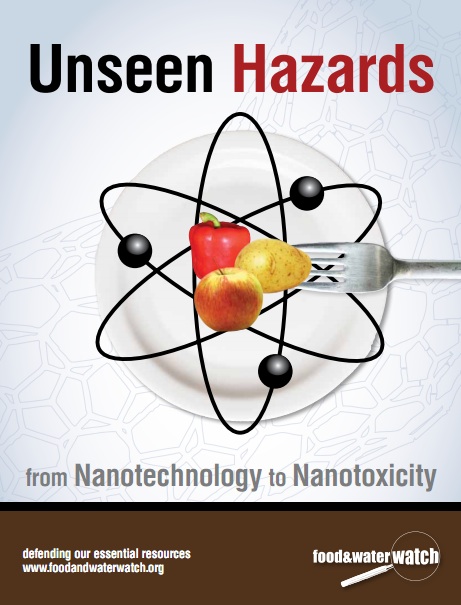
Unseen Hazards: from Nanotechnology to Nanotoxicity

Categories

Food

nanotech-reportUnfortunately, the enormous potential of nanotechnology to quell the world’s problems may be offset by its potential to cause harm. There is legitimate concern that the nano-sized particles employed in this new technology will have seriously damaging effects on the health of humans and the environment. Dozens of studies from the emerging field of nanotoxicity have already demonstrated hazards associated with nanoparticles.

DOWNLOAD PDF  

VIEW ON SCRIBD