

Opposition Rises to Planned Agriculture Mega-mergers: Major Threat to Our Food and Farms, Says Civil Society

Brussels, March 27, 2017 – More than 200 organisations –including Food & Water Europe – have today raised their objections to the planned mergers of six giant agriculture corporations.

The farmer, farmworker, beekeeper, religious, international development, and environmental groups claim that the three resulting companies will concentrate market power and “exacerbate the problems caused by industrial farming – with negative consequences for the public, farmers and farm workers, consumers, the environment, and food security” in an open letter to the European Commission and Competition Commissioner Margrethe Vestager [1]

The European and national organisations – together representing millions of members – state that the proposed mergers of Dow Chemical with DuPont, Monsanto with Bayer AG, and Syngenta with ChemChina will lead to an unacceptable monopoly, with three companies controlling around 70% of the world’s agro-chemicals and more than 60% of commercial seeds.

Ramona Duminicioiu, peasant seed producer of the farmer organization European Coordination Via Campesina said: “Approving these mergers works completely against the rights of peasants, with far reaching effects in our society. When the Commission says that small family farms are the back bone of European agriculture does it honestly believe that or is it just lip service? The already fragile rights of peasants regarding seeds, land and markets risks of being obliterated by these mega-corporations and our Food Sovereignty abducted. The Commission should say no to these mergers!

Adrian Bebb of Friends of the Earth Europe said: “Europe’s food and farming system is broken and if giant firms, like Monsanto and Bayer, are allowed to merge they will have an even tighter toxic grip on our food. The mergers are a marriage made in hell and should be blocked by regulators. We need to build a fairer and greener food system out of corporate control.”

Arnd Spahn from the European trade unions of agricultural workers EFFAT said:  “Workers, as well as the environment and all society, are victims of the use of pesticides. We are fighting for health and safety on work places and we need partners for our ideas. Today the producers of pesticides are big, but after such a merger they will be too big for anybody to bring them on a path to worker and environmental protection. How shall we stop Glyphosate if we have such strong opponents?”

Isabelle Brachet of CONCORD Europe said: “Ending hunger implies addressing power imbalances in our food systems. A small number of multinational corporations dominate internationally traded food systems and get most of the knowledge, benefits and access to decision makers. Corporate power in our food must be restrained – not further extended by mega-mergers. The main investors in agriculture in developing countries are farmers themselves and it is they who must be at the centre of agriculture development policies.”[3]

The organisations have called on the European Commission to reject the mergers, prevent the damage caused by these corporations, and urgently take steps to support just and sustainable food systems less dependent on agri-business.

[1] See the letter.

No EU Money for the Trans Adriatic Pipeline

Statement by Food & Water Europe

 “We express our solidarity with the people from Melendugno and Salento regions of Italy as well as the No TAP committee who oppose the construction of the Trans Adriatic Pipeline. The destruction of farmland, sensitive environmental sites and areas of importance for tourism makes the TAP a threat for communities not only in Italy but also in Greece and Albania.

“This project should not be considered a Project of Common Interest (PCI) and should not continue getting financial support with EU taxpayers’ money, nor should it enjoy further advantages of being a PCI.

“The EU cannot consider the TAP as a priority for energy security while EU gas demand is declining and the European gas infrastructure is already largely resistant to extreme disruption scenarios.

“European greenhouse gas emissions will need to be reduced by 80-95% by 2050 so carrying out this costly project that will remain there for decades is nonsense. It is not in the interest of Europeans to investing billions in a pipeline that clearly risks becoming a stranded asset.

“We need investments in energy efficiency and renewable energy projects in line with European climate targets. Finally, limited public funds should not go into a pipeline that is supposed to bring gas from Azerbaijan, an authoritarian regime struck by corruption, to Europe, that urgently needs to phase out the use of fossil fuels.”

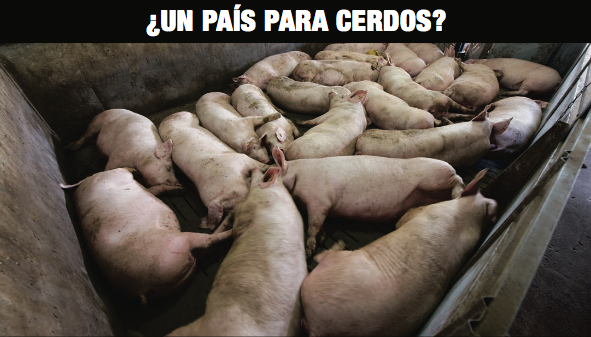
¿UN PAÍS PARA CERDOS?

Categories

Food

VER EN SCRIBD DESCARGAR PDF

La industria española del porcino supone el 37 por ciento del total de la producción ganadera, y el 14 por ciento de la producción agraria total, generando alrededor de 6 millones de euros en 2014.

España es el tercer mayor exportador mundial de porcino, detrás de China y Estados Unidos, tras convertirse en 2015 en el principal exportador de la Unión Europea (UE), por delante de Alemania y Dinamarca. En ese mismo año, España
alcanzó también el mayor censo de la UE, con 28.3 millones de cerdos. Mientras que otros productores europeos reducen su producción, España la incrementa, así como sus exportaciones, como resultado de una industria con un alto nivel de integración y con los costes de producción más reducidos entre los principales países productores de la UE.

SPAIN, TOWARDS A PIG FACTORY FARM NATION?

Categories

Food

VIEW ON SCRIBD DOWNLOAD PDF

Spain is the third largest exporter of pork after China and the United States and has the largest pig population in the EU, 28,3 million animals.

Production and exports are growing as a result of high industry integration and low production costs. But that means that the industry is getting concentrated in just a few hands, with the number of farms diminishing rapidly and farmers facing growing marginalization. And this industry is not being held accountable for its impacts on the environment, workers and communities.

€200 bn Polluter Bonuses Unleashed by ETS Reform Proposals

February 15, 2017 — Today’s European Parliament vote on the reform of the EU Emissions Trading System (ETS) rubber stamps substantial new handouts to polluting industries and locks in a climate target far short of a fair EU share of cuts in greenhouse gas emissions.

The EU Parliament passed measures that represent around €200 billion in free pollution permits and additional funds for polluting industries, although the eventual value could be higher once the rules on continuing subsidies for the cement and other energy intensive sectors have been clarified.

Corporate Europe Observatory’s Oscar Reyes said:

“It looks like the EU Parliament is quite happy to prolong the welfare scheme for big polluters that has already failed to reduce emissions for too long. EU taxpayers will be the ones forced to pick up the bill for the heavy subsidies forked out to polluting industries.”

The vote also confirms a lack of ambition at the heart of the emissions trading scheme, which is the EU’s flagship climate policy tool.

Frida Kieninger of Food & Water Europe added:

“The 2.2 per cent annual reduction target is a shameful capitulation that is still far off the EU’s fair share of necessary climate action set out in the Paris Agreement.

“It is high time that the EU institutions realise that the ETS is not fit for purpose and scrap it in favour of more effective climate regulations.”

Notes to editors:

  • The EU Parliament voted on the ETS reform proposals and amendments listed here: http://www.europarl.europa.eu/plenary/en/report-details.html?reference=A8-0003-2017
  • The value of free pollution permits and ETS-linked funds will amount to around €198 billion between 2021 and 2030. This figure assumes an average carbon price of €25, and is broken down as follows: Free industry permits worth €135 billion, Innovation Fund €15 billion, Indirect Cost Fund €11 billion, Modernisation Fund €8 billion, Flexible Share €19 billion, New Entrants’ Reserve €10 billion.
  • This media reaction has also been endorsed by attac France.

Contact:

Fracking Legislative Package Enters into Force

Fracking torpedoes implementation of Paris Agreement on Climate Change
(German Version)

Berlin, 10 February 2017 — Today, one day before the German legislative package on fracking enters into force, environmental umbrella organization Deutscher Naturschutzring (DNR) – with its member organizations Bund für Umwelt und Naturschutz Deutschland (BUND), Naturschutzbund Deutschland (NABU) and Robin Wood as well as Deutsche Umwelthilfe (DUH), Umweltinstitut München, PowerShift and Food & Water Europe – fears that now more fracking projects will be realized. They are particularly concerned that fracking in tight sandstone layers, so-called tight gas fracking, is explicitly authorized by the new legislation, and could even be permitted in otherwise protected areas. There are also loopholes allowing fracking for “research projects” in shale, clay, coal bed and marl rock formations.

With this fracking policy, the German government undermines its own goal of being a climate protection leader. At the same time more and more countries in Europe are deciding on fracking bans, the grand coalition in Germany is prolonging the fossil era and hampering the implementation of the Paris Agreement with this fracking legislation, adopted in June 2016. This is a devastating signal to the international community, particularly since Germany will be in the international spotlight, not only hosting this year’s G20 summit but also the United Nations Climate Change Conference.

“We need a clear ban on any kind of oil and gas fracking in order to reach the climate goals as adopted in the Paris Agreement. The German Government has to live up to its international promises and speed up the energy transition [Energiewende] instead of further relying on bygone ages by developing fossil fuels,” says DNR president Prof. Dr. Kai Niebert.

According to the environment protection and nature conservation organizations, it’s now also up to the German federal states to finally ban fracking. The legislative package allows federal state governments to veto research projects for fracking in shale, clay, coal bed and marl rock formations. By consistently identifying protected areas, federal states can moreover rule out tight gas fracking.

Contact:

Andy Gheorghiu, Food & Water Europe, Fracking Policy Advisor, Food & Water Europe, Tel.: 05631/5069507, Mobil: 0160/2030974, E-Mail: [email protected]

Daniel Hiß, DNR-Frackingexperte, Mobil: 0157/89203007, E-Mail: [email protected]

Ann Kathrin Schneider, BUND Leiterin internationale Klimapolitik, Tel.: 030/27586-468, Mobil: 0151/24087297, E-Mail: [email protected]

Sebastian Scholz, NABU Leiter Energiepolitik und Klimaschutz, Tel: 030/2849841617, Mobil: 0172/4179727, Email: [email protected]

Dr. Cornelia Nicklas, DUH, Leiterin Recht, Mobil: 0162/6344657, E-Mail: [email protected]

Dr. Philip Bedall, ROBIN WOOD, Energiereferent, Mobil: 0160/99783336, E-Mail: [email protected]

Franziska Buch, Umweltinstitut München, Referentin für Energie und Klima, Tel: 089/30774917, E-Mail: [email protected],

Laura Weis, PowerShift, Fachpromotorin für Klima- & Ressourcengerechtigkeit, Tel.: 030/42085295, E-Mail: [email protected]