

Joint Statement by Food & Water Europe and Friends of the Earth Europe on PCI List Vote

March 14th, 2018 – MEPs in Strasbourg today voted on a motion to oppose the EU’s Projects of Common Interest (PCI) list, on the basis that it includes over 100 new fossil gas infrastructure projects. However there was no majority to reject the list, which also includes a number of other energy infrastructure projects.

Reacting to the vote, Antoine Simon, Fossil Free campaigner for Friends of the Earth Europe, said: “A full rejection of this list of priority energy infrastructure (PCI) was always going to be a tall order; but it’s welcome to see 177 MEPs for the first time opposing the EU’s reckless support for new climate-wrecking gas projects. The time is running out to end our dependency on fossil fuels and that means no new gas pipelines.”

Frida Kieninger, Campaign Officer for Food & Water Europe, said: “While it is the first time that the EU-Parliament voices open objection to this priority list for fossil fuels, this is also the first PCI list designed and adopted after the Paris Climate Agreement entered into force. With a far too strong focus on fossil gas projects, today’s adoption of the PCI list marks a setback for the environment, human rights and our global climate.”

***

Notes: 

The PCI list covers priority energy infrastructure projects to be built in Europe, drawn up by the European Commission, Member States and European Network of Transmission System Operators for Gas (ENTSOG). Approved projects become eligible for EU funding (under the Connecting Europe Facility (CEF)).

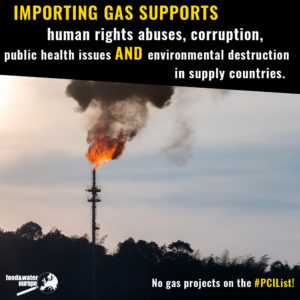
The list contains the controversial Southern Gas Corridor, which has already been associated with serious human rights violations in Azerbajan; the MidCat pipeline between France and Spain facing growing protests on both sides of the Pyrenees; and three LNG terminals in Croatia, Greece and Ireland, for environmentally destructive shale gas imported from the US.

Friends of the Earth Europe has previously revealed that the list is based on flawed data provided by the gas industry, and has not been tested against the Paris Agreement’s climate targets.

***

Contact:
Antoine Simon, Fossil Free campaigner for Friends of the Earth Europe, [email protected], +32 (0) 486 685 664
Frida Kieninger, Campaign Officer for Food & Water Europe, [email protected], +32 (0) 487 249 905
 

Over 100 US. & International Groups Tell Wolf: Shut Down Mariner East Pipeline

Sunoco’s Controversial Gas Liquids Pipeline
Poses Threats in US and UK


Philadelphia — Dozens of US and international organizations
released a letter to Governor Tom Wolf encouraging him to bring a halt to Sunoco’s Mariner East 2 pipeline.

The groups point out that the pipeline puts residents on both sides of the Atlantic at risk: Communities in eastern Pennsylvania that will bear the burden associated with fracking, the communities along the pipeline route endangered by spills and explosions, and those living near the petrochemical facilities in Europe that will use the gas liquids carried by the pipeline.

“This effort links the local battles against Sunoco with the vibrant anti-fracking movement in Europe that is focusing on the environmentally disastrous record of Ineos, the petrochemical colossus that is seeking to benefit from fracking in the US and the UK,” said Food & Water Watch Executive Director Wenonah Hauter. “The dangers posed by this project are serious, and require immediate action from Governor Wolf, who is the only the person with the power to protect all of these communities.”

The massive Sunoco project has been plagued by drilling spills and water contamination, which eventually led the state’s Department of Environmental Protection (DEP) to suspend construction permits. But weeks later, the Wolf administration settled with Sunoco, clearing the way for construction to resume.

Governor Wolf has long been an ardent supporter of Sunoco’s project, and pushed to expedite construction permits.

“Since the Wolf administration’s approval the Mariner East 2 pipeline one year ago, the call for him to stop it has grown to include organizations from across the United States, Scotland, England, and Europe,” said Karen Feridun, the founder of Berks Gas Truth. “These groups stand in solidarity with communities whose health, safety, private water supplies, quality of life, and property rights are threatened by bad actors like Sunoco/Energy Transfer Partners on this side of the Atlantic and Ineos in the UK and Europe. Governor Wolf can and must stop this pipeline right now and become the climate leader Pennsylvania needs. His choice will be his legacy.”

The letter, organized by Food & Water Watch, Food & Water Watch Europe and Berks Gas Truth was signed by US groups like Oil Change International, Progressive Democrats of America, Friends of the Earth, the Center for International Environmental Law and the Center for Biological Diversity. They are joined by organizations in Europe like Frack Free United (UK), Friends of the Earth EWNI (England, Wales and Northern Ireland), Talk Fracking (UK), Friends of the Earth Scotland, Frackwatch and Our Forth Against Unconventional Gas (Scotland), Not Here Not Anywhere (Ireland) and Ecologistas en Acción (Spain).

“From both sides of Scotland- East and West – we join our voices to those calling on Governor Wolf to protect his state and people from fracking and pipelines,” read a joint statement from Scottish groups Frackwatch Glasgow and Our Forth Against Unconventional Gas. “We feel fortunate that our government has banned fracking – but we feel sad that our country is destination for most of the gas piped through the dirty and dangerous Mariner East pipeline as it is finally transported via Dragon Class Ships, to travel up and down the Firth of OUR FORTH and pass perilously close to the capital city into the heart of Scotland.  Here, most of the gas will be used to make throwaway plastic to pollute our oceans and add to greenhouse gas emissions. We need some real changes, on both sides of the Atlantic, to move forward in a positive way! The fact is that leaders – real leaders – must now start planning for and working with communities for – a very different economic future.”

The letter closes with this message to Governor Wolf: “It is time to put a stop to this dangerous pipeline, and to move to a full ban on fracking. Your decision to do this will benefit our communities and our health, and it would protect residents of the state of Pennsylvania.”

Contacts:

US
Peter Hart, Food & Water Watch, [email protected], 732-839-0871
Karen Feridun, Berks Gas Truth, [email protected]

EU/UK
Andy Gheorghiu, Food & Water Europe, [email protected]
Penny Cole, Frackwatch Glasgow, [email protected]
Callum McLeod, Our Forth Against Unconventional Gas, [email protected]

Energy Committee Dismisses Effort of 18 MEPs to Stop Fossil-Fuel-Favoring Infrastructure Priority List

BRUSSELS — Today, the Energy Committee of the European Parliament rejected a motion for an objection to the third list of energy “projects of common interest” (PCIs) which was proposed to parliamentarians by the European Commission in November 2017. The PCI list is a priority list for infrastructure projects which benefit from advantages for permit granting and environmental impact assessments and which are eligible for CEF funding.

The objection, submitted by an initial number of 18 MEPs from 5 political groups (ALDE, EFDD, GUE, Greens and S&D), highlights the high proportion of fossil fuel infrastructure, notably gas projects, on this priority list. In today’s Committee votes, only 15 Members voted in favour of an objection, while 44 opposed it, with 2 abstentions.

“This list is the first PCI list that was drafted after the Paris Agreement came into force. Instead of aligning the list with international climate commitments, the European Commission proposed an amount of gas projects that remains as high as in the last years with. At the same time, the amount of electricity projects in the list is stagnating. This is unacceptable and incompatible with aiming at keeping global warming below 1.5 or even 2 degrees, says Frida Kieninger from Food & Water Europe.

In the objection, MEPs pointed out to the risks of investing into stranded assets since gas infrastructure constructed now is designed to last until 2060 or beyond. By then, commitments to phase out greenhouse gas emissions will have made most pipelines, compressor stations and LNG terminals irrelevant and unneeded. The PCI list, so the objection, will lock Europe into a new fossil fuel dependence if adopted in its current form and therefore it needs to be reviewed.

An objection is the only possible action for MEPs to show they are dissatisfied with the current form of the PCI list. The European Parliament and the Council can only reject the entire list, including gas and electricity projects, otherwise the list automatically enters into force since the Council already confirmed its support.

“Main aim of the objection is to align the PCI list with climate and energy targets and the Paris Agreement. It asks the Commission to draft a new list in favor of more electricity projects which are crucial to integrate renewable energy as well as other projects supporting a phase out of fossil fuels”, says Frida Kieninger. This list can’t remain serving corporate interests instead of public interest.”

This is the first time since the European Parliament is using its right of scrutiny on the PCI List. The European Commission will have to take it into account that the public will watch its every step when the next PCI List is drafted.

After today’s rejection of motion for an objection, there is still a possibility to submit the objection to the plenary. If at least 38 of the 751 Members of the European Parliament support the objection, it will likely be voted in mid-March.


Contact: Frida Kieninger, Food & Water Europe, Campaign Officer, Rue d’Edimbourg 26, Brussels 1050, Belgium, +32 487 24 99 05, fkieninger(at)fweurope.org

===

Notes to the editor:

Motion for an Objection:

http://www.michele-rivasi.eu/assets/uploads/2018/01/PCI-Objection-20180131.pdf

Proposal for a 3rd PCI list:

https://ec.europa.eu/energy/sites/ener/files/documents/annex_to_pci_list_final_2017_en.pdf

European Water Movement – Food & Water Europe – Wasser in Bürgerhand 

The European Commission once again disappoints citizens that supported the Initiative for the Right to Water

Brussels, 31st January 2018. Today European water advocates said the leaked proposal for a new Drinking Water Directive is disappointing and doesn’t meet the expectations of the citizens and organisations that supported the first successful European Citizen’s Initiative (ECI) on the right to water. The review of this directive was framed by the Commission as their only answer to the ECI. Five years later, this draft doesn’t meet any of the demands supported by nearly two million people.

Elisabetta Cangelosi, member of the European Water Movement said, “Five years waiting for an answer and the result couldn’t be more disappointing. Although we welcome the timid attempt of the Commission to include provisions about universal access to water and the emphasis on minorities and vulnerable groups, this text has nothing to do with the human right to water recognized by the United Nations and demanded by citizens”.

The Human Right to Water as defined by the United Nations implies that water and sanitation must be physically accessible, safe, acceptable, sufficient and affordable. The draft Drinking Water Directive addressed just the first three aspects.

David Sánchez, director at Food & Water Europe added, “The proposal from the Commission simply ignores the main challenge for the Human Right to Water in the European context, affordability. With thousands of families having their water cut-off in Europe in recent years for not being able to pay the bills, guaranteeing access is not enough. We need political courage from the Commission to challenge private companies that make profit out of water management to really implement this human right in Europe”.

The proposal also includes provisions to promote free access to water in public spaces, including public buildings, but it falls short as this provision is not specific about it being tap water.

Jutta Schütz, member of Wasser in Bürgerhand added, “The Commission vague wording allows the interpretation that installing vending machines with bottled water would be enough. We need to close this gap so the Drinking Water Directive is coherent with the efforts to get rid of plastics at the European level such as the Plastics Strategy or the Circular Economy Package, and to challenge this unacceptable, environmentally-damaging industry”.

Contacts

Elisabetta Cangelosi, European Water Movement, +32 488 08 00 21 (mobile), [email protected]

David Sánchez, Food & Water Europe, +32 (0) 485 842 604 (mobile), dsanchez(at)fweurope.org

Jutta Schütz, Wasser in Bürgerhand, +49 (0) 157 390 808 39 (mobile), [email protected]

The European Water Movement is an open, inclusive and pluralistic network whose goal is to reinforce the recognition of water as a commons and as a fundamental universal right. http://europeanwater.org/


Vast Polluter Subsidies in EU Emissions Trading Deal Irresponsible and Counterproductive, Say NGOs

NGOs Include Attac France, Corporate Europe Observatory, Ecologistas en Acción, Food & Water Europe, Friends of the Earth Europe, Global Justice Now, re:Common, the Transnational Institute

Brussels—The ‘trilogue’ negotiations concluded between the EU Commission, Parliament and Council in the early hours of the night has prolonged the future of the EU Emissions Trading System as a source of billions of euros in polluter subsidies, according to Attac France, Corporate Europe Observatory, Ecologistas en Acción, Food & Water Europe, Friends of the Earth Europe, Global Justice Now, re:Common and the Transnational Institute.

EU member states will potentially be able to use a sizable chunk of these funds to continue burning fossil fuels, with Poland, for instance, looking to prolong the lifespan of its aging coal infrastructure.

Commenting on the ‘trilogue’ deal, Corporate Europe Observatory’s climate campaigner Belén Balanyá said:

“Using emissions trading revenues to subsidy fossil fuels is extremely irresponsible and works directly against efforts to halt catastrophic climate change. Once again, it is obvious that the emissions trading system benefits big polluters far more than it does the climate. “

Maxime Combes of Attac France added:

“While an increasing number of member states are phasing out coal power, it is absurd that emissions trading revenues may end up supporting this type of fossil-energy generation in other parts of the EU.”

But coal financing is just the tip of the iceberg. Polluter subsidies linked to emissions trading revenues could reach close to €200 billion between 2021 and 2030. The largest share of this money is earmarked for free pollution permits to be handed to steel and cement producers, in order to help them delay the transition away from fossil fuels.

Food & Water Europe campaigner Frida Kieninger commented:

“While the EU touts its ‘climate leadership’ at the UN talks in Bonn, the emissions trading policy agreed in Brussels means the EU will continue to shirk its fair share of global climate action. Emissions trading is clearly a part of the problem rather than a climate solution.”

Notes to editors:

  • The ‘trilogue’ negotiations establish the rules for a new, fourth phase of the EU Emissions Trading System, which will run from 2021-2030. The ETS has consistently been used to undermine other climate policies, including energy efficiency and renewable energy. The example of coal-fired power generation shows how this could continue in the fourth phase. As well as offering direct subsidies to “modernise” coal generation, the extension of the ETS assumes that significant power generation from coal will continue until 2030. Yet an increasing number of EU countries are announcing plans to phase out coal-power generation in the next decade. Tougher standards on air pollutants, passed this summer as part of the implementation of the Industrial Emissions Directive, have put pressure on other countries to do the same.
  • Corporate Europe Observatory has highlighted the industry lobbying which skewed the EU Emissions Trading System (ETS) in favour of polluting corporations, analysing how big polluters influenced the ETS reform to ensure it would serve their interests.


Advocacy Groups Release Legal Resource for Fighting Fossil Fuel Projects

New toolkit helps clarify EU legislation to challenge exploration and extraction of hydrocarbons
BrusselsFood & Water Europe – with the pro bono support of The Good Lobby – has released today the 1st guide through the jungle of European environmental legislation for activists and non-governmental organisations that oppose fossil fuel projects.

The Hydrocarbons Toolkit provides legal arguments for activists in the European Union (EU) against the exploration and extraction of hydrocarbons in general (and shale gas/oil, tight gas/oil and coal-bed methane in particular) by referring to relevant articles of existing and binding EU law. It explains in accessible language the most relevant directives and regulations that are applicable to the exploration and extraction of hydrocarbons.

More precisely, the toolkit discusses the individual pieces of legislation along the hydraulic fracturing process, starting from prior assessments to liability. For each Directive/Regulation it discusses the goal and scope, the most relevant provisions, limitations, and the general line of argument that activists and non-governmental organisations (NGOs) can use to challenge the exploration and extraction of hydrocarbons. Case law is discussed where relevant. Lastly, the toolkit establishes the procedural steps that citizens and/or organisations can take to contest a certain project on the EU level.

“Despite the abundant scientific evidence that methane emissions from oil and gas extraction in general and from shale oil and gas in particular are a significant driver of climate change, the EU Commission and Member States are nonetheless pushing for more unneeded gas projects in Europe,” says Andy Gheorghiu, Policy Advisor for Food & Water Europe. “Since we all know that we need to act quick to prevent the worst outcomes of global warming, we want to give activists free legal advice on how they could possibly fight these fossil fuel projects.”

“Alberto Alemanno, director of The Good Lobby”, says “this project epitomizes the importance of intensified collaboration between academics, professionals and EU civil society organisations. This tool-kit will guide future infirmed and evidence-based advocacy in the field so as to gain policymakers’ respect and trust. As such, it is a model for future co-operation”.

In one glance, NGOs or activists can see which regulations may provide legal arguments to fight oil and gas exploration/extraction projects in their countries. For more extensive information on the exact obligations and possible limitations of these regulations, download the toolkit here.

Contact: Andy Gheorghiu, Food & Water Europe, agheorghiu(at)fweurope.org, Giacomo Delinavelli, The Good Lobby, Giacomo(at)thegoodlobby.eu

###

The Good Lobby is a skill-based volunteering network that makes European academics, legal professionals and students available on a pro bono basis to support non-governmental organisations working on key social and political issues at the European level. The Good Lobby does not engage in any actual lobby. It supports legal and policy advocacy carried out by NGOs across Europe, it fosters pro bono collaborations, it carries out advocacy training, and we connect communities of public interest actors.