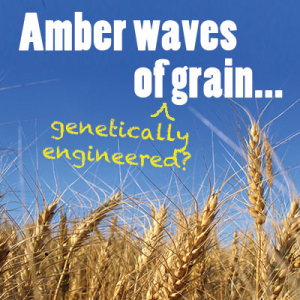


Last week, the USDA announced that an Oregon farmer was unknowingly growing glyphosate-resistant wheat in his non-GE wheat field. This was quite shocking considering Monsanto ended its GE wheat research program in 2004 and its field trials in 16 states in 2005. If this happened in one farm in Oregon, who’s to say that there are aren’t similar incidents in Arizona, California, Colorado, Florida, Hawaii, Idaho, Illinois, Kansas, Minnesota, Montana, Nebraska, North Dakota, South Dakota, Washington or Wyoming? Not only could there be incidents from years ago, but according to USDA data, Monsanto is currently field testing new varieties of GE wheat in North Dakota and Hawaii. These experimental GE crops could be contaminating neighboring wheat fields this very moment.
Monsanto claims that its process for ending its Roundup Ready wheat program was “rigorous, well-documented and audited” and the USDA claims that all field trials are inspected once a year. Yet, at a December 2011 USDA stakeholder meeting I attended, a USDA representative from the Biotechnology Regulatory Services branch announced that only 800 inspections were performed that year even though there were 2,500 new permits in addition to older permits that still needed to be inspected. That means that not even a third of permitted GE field trials are inspected by the USDA every year.
The jig is up—USDA and biotech companies were unable to reign in the GE technology a decade ago, and they still can’t control it today. This isn’t the first time an unapproved GE trait has made it past the field trial stage into the food system, with serious economic ramifications.
The Government Accountability Office (GAO) identified six known unauthorized releases of GE crops between 2000 and 2008. In 2000, Japan discovered GE StarLink corn, which was not approved for human food, in 70 percent of tested samples, even though StarLink represented under 1 percent of total U.S. corn cultivation. After the StarLink discovery, Europe banned all U.S. corn imports, costing U.S. farmers $300 million. In August 2006, unapproved GE Liberty Link rice was found to have contaminated conventional rice stocks. Japan halted all U.S. rice imports and Europe imposed heavy restrictions, costing the U.S. rice industry $1.2 billion. In 2007, Ireland impounded imported U.S. livestock feed that tested positive for GE, unapproved in the country.
Half of U.S. wheat is exported to countries with strict labeling restrictions, and since 90 percent of Oregon’s wheat is exported, it is likely that some of the unapproved GE wheat made it overseas. This could mean millions of dollars of costs for farmers and the U.S. government if that is indeed the case. To avoid any more of these GE contamination fiascos, tell Agriculture Secretary Vilsack to place a moratorium on field trials of GE crops.
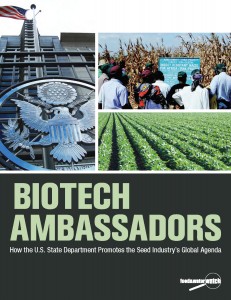
If you have a feeling that genetically modified (GM) foods are being forced upon the population by a handful of business interests and vociferously defended by the scientists that work in the ag industry or at the research institutions it funds, you might be onto something. The zeal with which GMO proponents evangelize transgenic seeds (and now, transgenic food animals) is so extreme that they are even pouring vast sums of money to defeat popular efforts to simply label GE foods—like the nearly $50 million spent to defeat the popular ballot measure to label GE foods in California, Prop 37. What’s more, it’s not just happening in the United States. A new report by Food & Water Watch shows the extent to which the U.S. State Department is working on behalf of the GM seed industry to make sure that biotech crops are served up abroad—whether the world wants them or not.
The report analyzes over 900 State Department diplomatic cables from 2005 to 2009 and reveals how far the U.S. government will go to help serve the seed industry’s agenda abroad, knowing that resistance to GMOs worldwide is high. It lobbies a vociferously pro-biotech agenda, operates a rigorous public relations campaign to improve the image of biotechnology and challenges commonsense safeguards and rules — including opposing popular GM food labeling laws.
Here are some of the tidbits gleaned from our comprehensive look at the cables:
Between 2007 and 2009, annual cables were distributed to “encourage the use of agricultural biotechnology,” directing U.S. embassies to ”pursue an active biotech agenda”.
There was a comprehensive communications campaign aimed to “promote understanding and acceptance of the technology” and “develop support for U.S. government trade and development policy positions on biotech” in light of the worldwide backlash against GM crops.
Where backlash was high, some embassies downplayed efforts. In Uruguay, the embassy has been “extremely cautious to keep [its] fingerprints off conferences” promoting biotechnology. In Peru and Romania, the U.S. government helped create new pro-biotech nongovernmental organizations.
The State Department urged embassies to generate positive media coverage about GE crops. Diplomatic posts also bypassed the media and took the message directly to the public; for example, the Hong Kong consulate sent DVDs of a pro-biotech presentation to every high school.
The State Department worked to diminish trade barriers to the benefit of seed companies, and encouraged the embassies to “publicize the benefits of agbiotech as a development tool.”
Click here to read the report, “Biotech Ambassadors: How the U.S. State Department Promotes the Seed Industry’s Global Agenda”.
Monsanto was a great beneficiary of the State Department’s taxpayer-funded diplomacy, helping pave the way for the cultivation of its seeds abroad: the company appeared in 6.1 percent of the biotech cables analyzed between 2005 and 2009 from 21 countries. The embassy in South Africa even informed Monsanto and Pioneer about two recently vacated positions in the agency that provided biotech oversight, suggesting that the companies advance “qualified applicants” to fill the position. Some embassies even attempted to facilitate favorable outcomes for intellectual property law and patent issues on behalf of the company.
The cables also show extensive lobbying against in-country efforts to require labeling of GM foods. In 2008, the Hong Kong consulate “played a key role” in convincing regulators to abandon a proposed mandatory labeling requirement. One in eight cables from 42 nations between 2005 and 2009 addressed biotech-labeling requirements.
What’s more, the U.S. government is now secretly negotiating major trade deals with Europe and the countries of the Pacific Rim that would force skeptical and unwilling countries to accept biotech imports, commercialize biotech crops and prevent the labeling of GM foods.
The vast influence that Monsanto and the biotech seed industry have on our foreign affairs is just one tentacle of a beast comprised by a handful of huge corporations who wield enormous power over most food policy in the United States. My new book, Foodopoly: The Battle Over the Future of Food and Farming in America (which is being launched in Europe this week) deals extensively with this corporate influence over our food system.
It’s no accident that we’re here: a farm policy of “get big or get out” that has been going on for decades has only benefited big companies that are becoming more and more consolidated. They wield unprecedented power over the market, putting small and midsized farmers out of business and favoring factory farms and the cultivation of GM commodities that fuel them—GM corn and soy, which are also the cornerstone of junk foods produced and sold worldwide (fueling an obesity epidemic in America and beyond.)
Thanks, Monsanto. And thanks, State Department. Not only are you selling seeds—you’re selling out democracy.
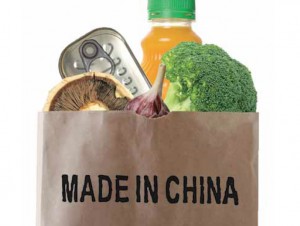
Thanks to Michael Pollan’s new book, there’s a lot of buzz right now about Americans’ meals being outsourced, but a connected and equally troubling trend – with even riskier food safety implications – is that Americans’ food is increasingly being imported from countries with abominable track records for food safety. And the country on the top of the list is China.
This week, Food & Water Watch Assistant Director Patty Lovera testified before the House Committee on Foreign Affairs Subcommittee on Europe, Eurasia and Emerging Threats to discuss China as the leading producer of many foods Americans eat: apples, tomatoes, peaches, potatoes, garlic, seafood, processed food and food ingredients like xylitol and vitamin C.
Headlines about risky food from China have become all too common – melamine in milk, a chicken for beef swap, toxic juice, exploding watermelons (really, you can’t make this stuff up). Even our pets are threatened. Since 2007, chicken jerky treats imported from China are suspected to have caused more than 600 cases of canine illness and deaths to date.me
In her testimony, Patty explains how combining trade policy with a food safety regulatory system that’s not up to the job of dealing with the rising tide of imports is a recipe for disaster. She warns about the risks involved when cash-strapped agencies turn to third party certifiers (doubly outsourced), and how consumers’ only tool to be able to make informed decisions about where their food comes from – Country of Origin Labeling (COOL) – needs to be improved and expanded.
Early this week, USDA announced the availability of a petition for a new GE alfalfa, marking the 20th GE crop currently awaiting USDA’s approval and eventual commercialization. Since the introduction of GE crops, the USDA has never denied a single petition for commercialization.
Touted as “low-lignin” to make it easier for livestock to digest, Monsanto and Forage Genetics’ new alfalfa variety will likely be stacked with Monsanto’s Roundup Ready trait (already approved for alfalfa in 2011). Throughout the petition, the companies cite the fact that “extensive review” has already been performed on GE alfalfa with the 2010 Environmental Impact Statement for Roundup Ready alfalfa.
Back then, the Environmental Impact Statement pointed to some negative economic impacts for organic and conventional alfalfa farmers, including increased costs needed to prevent contamination, reduced demand and lost markets due to contamination—which didn’t stop USDA from approving the crop. Those contamination costs are even more pronounced now. Alfalfa is an open-pollinated crop, meaning it is much more likely than corn or soybeans to contaminate nearby non-GE fields with the help of wind or insects. This crop poses special risks for organic alfalfa and for organic dairy farms whose crops may be contaminated.
Additionally, the review was performed three years ago and a lot has changed since then.
Since 2010, the number of Roundup-resistant weeds has grown from 11 to 14 and the amount of land infested with these weeds has grown from a reported 2 million acres in 2010 to industry estimates of more than 60 million acres in 2012. These numbers should raise a red flag, but Monsanto continues to petition for the introduction of more and more glyphosate-tolerant crops.
Herbicide use has escalated since the introduction of GE crops, and will only continue to grow as more of these GE crops are introduced. As the “superweed” problem worsens, the USDA must seriously consider the environmental, health and economic ramifications of this new GE alfalfa, and the agency’s overall system of blanket approvals on herbicide-tolerant GE-crops.
To weigh in on the rocket docket containing seven petitions for approval of new, herbicide-tolerant crops, sign this petition.
Watching UK’s National Farmers Union (NFU) President Peter Kendall testify to the UK Parliamentary Committee on Environment, Food and Rural Affairs’ inquiry into horse meat contamination of the EU beef supply on March 5, I was struck again by the inconsistencies in the NFU approach when it comes to GM animal feed.
I have three questions for the NFU:
1) In his testimony, Mr. Kendall repeated the position that short supply chains are the answer to predictable control of our meat supply and regaining consumer confidence. How does this tally with the repeated insistence that UK livestock farmers need industrial GM feed from the Americas traded through complex international commodity markets?
Much is made about the allegedly dwindling availability of non-GM soy (known in the UK as soya), but the non-GM soya industry itself paints a rather different picture. On February 26, Augusto Freire, Managing Director of Cert-ID (a company certifying non-GM soya supplies), said, “20-25% of Brazilian soybean production is free from genetic modification for the 2012/13 crop. China’s and India’s soy production is 100% Non-GMO….Estimates for 2013 are strongly up compared to earlier years due to adoption of the CERT ID and ProTerra [non-GM certification] programs by new operators in Brazil, as well as increased demand in Europe.”
In the current climate, before supply and demand reduce the cost of non-GM feed, it may well be a bit more expensive per tonne, but according to our calculations if non-GM feed costs an extra £14/tonne (about $21.00), this works out to be a mere 3p/dozen eggs (about 5 cents). Mr. Kendall asks, “Are we going to produce chickens in this country that are non-GM, but buy them in from Asia because they are 20% cheaper and they are fed on GM [feed]?” Is he perhaps confusing feed costs with the poor animal husbandry that keeps meat from many non-European factory farms cheap?
We also need to be careful in working out how much animal feed is actually GM – any amount of GM feed comingled with an otherwise non-GM shipment means the entire quantity, and all subsequent feed bags, are labelled GM. This does not mean that feed is anything like 100% GM, and in fact the bulk of any animal feed is probably non-GM.
2) If, as Mr. Kendall says, UK farmers need “confidence” in the market to invest and improve UK beef production levels, why does this logic not apply to the farmers in Brazil already growing non-GM soya but unable to risk the costs of certification without confirmed advance orders from the EU to ensure they gets a return?
Augusto Freire notes, “An additional volume of Brazilian soy meal representing 1.5 million metric tonnes of soybeans could have been certified [as non-GM] if EU buyers had expressed their demand early in the year.” The non-GM soya is there, and more can be grown, we just need to say we want it. It’s not hard.
Consumer demand should boost confidence enough to take this step. A 2010 GfK/NOP poll showed fewer than 40% of supermarket shoppers were aware that imported GM animal feed fuels British factory farming, and 89% wanted these products to be clearly labelled. In January of this year the UK Food Standards Agency published research showing again that two-thirds of respondents want all use of GM feed to be labelled. Even among those undecided about GM food and crops respondents felt “some form of labelling should be in place to help them determine GM content and avoid choosing foods containing GM if they so wish”. Overall there is a clear indication this need to identify GM use applies to animal products in particular. People don’t want GM feed in the food chain, and they want clear labels to help them see where it is – or isn’t.
3) I completely agree that there is, as Mr. Kendall told the Committee, “too much focus on price” in the food industry. If this is the case, why are industrial crops feeding industrial megafarm production to produce cheap meat worthy of such vocal support?
True, there are vested interests on both sides of the discussion, and there are rumours that Indian soya is less desirable than Brazilian. Overall we’d be far better off moving away from the industrial meat model. Yet this does not explain why supermarkets can’t do their part in delivering what the market demands now by placing clear orders for non-GM soya (or non-GM fed products) to give Brazilian farmers the confidence they need to grow and certify non-GM crops. The NFU position invokes the market, but goes directly against the basics of supply and demand. The more non-GM feed is demanded, the more will be supplied, and the costs will come down—unless vested interests interfere with the market. Large supermarkets and dairies in other parts of Europe seem to be able to manage it, so it is very difficult to see why the UK is different.
Mr. Kendall told the NFU 2013 conference, “Today I want to talk about a pact with the great British consumer to get things changed…We now need supermarkets to stop scouring the world for the cheapest products they can find and start sourcing high quality, traceable, product from farmers here at home…That may mean more dedicated supply groups. It will certainly mean longer-term thinking and a shorter supply chain.” We agree, and we’re here to help.
Mr. Kendall, if you truly “Do not want food safety and standards to be politicised,” as you told the Committee, why do you say GM skepticism is “directly comparable to Nazi book-burning in the 1930’s”? Why do you not support your members in providing what the market clearly wants?
The situation with regard to GM animal feed looks increasingly like lucrative supply lines controlled by shippers and importers, not farmers, attempting to force an end to non-GM supplies on an unwilling market. The NFU position, which wedges farmers uncomfortably between their market and these vested interests, remains very difficult to understand. The sooner the NFU applies the logic it uses in the meat chain to the feed chain, the sooner consumers will begin to regain confidence in our food.
Mr. Kendall also told your 2013 conference consumers should demand answers from the people they buy from. We agree European consumers can and should get what they want.
The 2013 World Social Forum will be held this March 26-30 in Tunisia, where only two years ago, a revolution began and resulted into a historic change that created a ripple effect across the region. Now, Tunisia is an inspiration to movements both old and new, across the globe.
Food & Water Watch and Food & Water Europe are busy getting ready to participate in the World Social Forum on water, fracking and food sovereignty issues. As a coordinator of the European Water Movement, our main aim is to build up links with local and regional groups and set up a Euro-Mediterranean Alliance for Water to facilitate the exchange of experience and information. Many North African countries are currently facing the same problems we have in Europe namely with the threat of privatization of water services and unconventional energy sourcing projects such as hydraulic fracturation. The same private water companies and energy companies are trying to push through projects in the North African region which have been met with resistance by civil society in Europe.
This website uses cookies to improve your experience while you navigate through the website. Out of these, the cookies that are categorized as necessary are stored on your browser as they are essential for the working of basic functionalities of the website. We also use third-party cookies that help us analyze and understand how you use this website. These cookies will be stored in your browser only with your consent. You also have the option to opt-out of these cookies. But opting out of some of these cookies may affect your browsing experience.
Necessary cookies are absolutely essential for the website to function properly. These cookies ensure basic functionalities and security features of the website, anonymously.
Cookie
Duration
Description
cookielawinfo-checkbox-analytics
11 months
This cookie is set by GDPR Cookie Consent plugin. The cookie is used to store the user consent for the cookies in the category "Analytics".
cookielawinfo-checkbox-functional
11 months
The cookie is set by GDPR cookie consent to record the user consent for the cookies in the category "Functional".
cookielawinfo-checkbox-necessary
11 months
This cookie is set by GDPR Cookie Consent plugin. The cookies is used to store the user consent for the cookies in the category "Necessary".
cookielawinfo-checkbox-others
11 months
This cookie is set by GDPR Cookie Consent plugin. The cookie is used to store the user consent for the cookies in the category "Other.
cookielawinfo-checkbox-performance
11 months
This cookie is set by GDPR Cookie Consent plugin. The cookie is used to store the user consent for the cookies in the category "Performance".
viewed_cookie_policy
11 months
The cookie is set by the GDPR Cookie Consent plugin and is used to store whether or not user has consented to the use of cookies. It does not store any personal data.
Functional cookies help to perform certain functionalities like sharing the content of the website on social media platforms, collect feedbacks, and other third-party features.
Performance cookies are used to understand and analyze the key performance indexes of the website which helps in delivering a better user experience for the visitors.
Analytical cookies are used to understand how visitors interact with the website. These cookies help provide information on metrics the number of visitors, bounce rate, traffic source, etc.
Advertisement cookies are used to provide visitors with relevant ads and marketing campaigns. These cookies track visitors across websites and collect information to provide customized ads.