


Place Your Bets Now: GM vs Democracy in the EU

Categories

Food

By Eve Mitchell

“What a hot potato.”

unlabeled GE sweet corn coming to a store near you?EU Health and Consumer Commissioner Borg’s understatement opened his presentation of the cultivation application for GM Pioneer1507 maize to the European Council on Tuesday. Having been thumped to and fro like a flat football since before Christmas, we were expecting a vote on the application to answer the question once and for all. We didn’t get it.

Instead we got another round of “indicative votes” from EU Member States, and the outcome was grim. The Greeks currently hold the rotating Presidency of the Council, and being firmly anti-GM they are presumably keen not to be painted into any procedural corners that would see a new GM crop authorised on their watch. So Member States were asked to say what they would do if there was a vote. Only 5 out of 28 countries said they would vote in favour of the crop. Given the clear vote in the European Parliament on 16 January instructing the Council to reject the application, one would have thought that was that. It isn’t. Not by a long shot.

The Council operates under a qualified majority system, with each country casting a weighted number of votes – UK and France have 29 votes, Sweden 10, Malta 3, and so on. Since the UK voted in favour of the GM crop (much to the dismay of British people and against the clear opposition to GM in the Scottish and Welsh Governments), and since big-hitter Germany abstained, the indicative votes did not demonstrate a sufficient qualified majority either way. The law says that if an actual vote was cast and produced that result, the Commission would be bound to take a decision on the file. (The Commission’s last foray into this territory was with the highly controversial Amflora potato; its authorisation was recently annulled by the second highest court in the EU for failing to abide by the law. One suspects the Commission is on tenterhooks here, but it also seems prepared to press the GM point.)

Thankfully the Greeks seem reluctant to ask for such a vote.

Still with me?

A complex legal discussion in the Council chamber tried to find a way through the marsh. Many member states had urged the Commission to withdraw the application altogether to avoid undermining the credibility of the European project in the run-up to the May elections, saying they did not see how approval by politically-appointed Commissioners could be explained to the electorate after rejection by the Parliament and the clear majority of EU countries. The Greens say they will call for the resignation of the Commission with a formal motion of censure if it approves the file. A number of member states told the Council it would help an awful lot if countries would stand up for their convictions and vote “no” rather than abstaining, but clearly four couldn’t manage it. So here we are, in the marsh, waiting to see who blinks first.

Governing is a complex business, especially among 28 countries, and democracy is a hard-won and precious thing. Often the test of governing structures is how well they cope with contentious issues. Many commentators are calling this situation an example of the “absurd” nature of EU GM regulation. We need to be a bit careful here: everyone signed up to the rules of the game a long time ago, so we can’t say we didn’t know what would happen in such circumstances. It could also be a lot worse – this process means we still only grow one GM crop here. Even so this mess sure does make a citizen scratch her head in wonderment.

One way to sort this out is what I call “proper identification of the bad guy”. We need to remember that the real problem here is corporate-driven GM food, not democratic bureaucracy. When it comes to GM pollen contamination in honey, the EU (lead by a UK MEP) performs all sorts of contortions to hide it from consumers rather than ban the crop causing the problem. When it comes to deciding on new GM crops, following the law means ignoring the wishes of both the Parliament and the majority of EU member countries – so why not just ban GM crops if they really threaten the fabric of European togetherness as claimed?

Are crops no one wants to eat really worth it, particularly when the annual industry mouthpiece “assessment” of global GM uptake demonstrates a “plateau” in GM cultivation in major GM markets? It’s not even clear if Pioneer Hi-Bred will ever sell 1507 in the EU – while suing the Commission for delay in processing the 1507 maize application Pioneer Hi-Bred said, “Once cultivation approval is granted, DuPont Pioneer will evaluate the situation and the available options, and will take a strategic decision on the marketing of the product based on these considerations.” Honestly.

Many pro-GM politicians say we need to keep politics out of the GM discussion and “stick to the science” – a laughable position if you read any of the above. An adamant proponent of this position is UK Secretary of State for Environment, Food and Rural Affairs Owen Paterson. 

So where is the Right Honourable Secretary of State while this is breaking loose?  Consulting with the Scottish and Welsh Governments to agree a democratic position for the UK on GM cultivation? Helping badgers in the flooded West Country learn to swim? No. In the run-up to the vote Paterson gave a pro-GM speech at a conference hosted by Big Biotech industry lobby group EuropaBio. (True story: the Countess of Mar felt compelled to ask a formal Parliamentary Question to clarify if Paterson was to “represent the policy of the Scottish Government and the Welsh Government, the policy of the United Kingdom Government, or his personal views” during the EuropaBio event – answer: UK. In that speech Patterson said of Pioneer1507 maize, “The UK has no current interest in planting this particular crop.” Yet the UK still voted in favour of it, mind you.). Soon the Secretary of State is off to Addis Ababa* to help the EU’s colourful Chief Scientist Anne Glover, another Brit, sell GM crops to Africans. No politics there.

GM vs Democracy? The wheel is spinning. I know where my money is.

* Update, February 17, 2014 : The trip was cancelled amid growing publicity after this piece was published.
Food & Water Europe: A New Year

Categories

Food

We’re hitting the ground running in 2014 and need you to be part of this year’s successes in our work to protect Europe’s food and water.
Sign up today.

By Eve Mitchell

It’s February? Already? Let’s get this going!

After a very busy 2013, 2014 sure started with a roar for Food & Water Europe!

While we are full on for the new year, we want to say “Thank you!” for your part in our successes food, water and fracking successes in 2013, including:

Happy Birthday, Horsemeat Scandal

Categories

Food

By Eve Mitchell

It’s been a year since we were first told the beef we buy may actually be horsemeat, but we still don’t really know what happened, how far it spread, who is responsible, or how they will be called to account for themselves.

We’ve seen a smattering of arrests, notably the September 2013 arrests of eight managers of the French company Spanghero on charges of aggravated fraud and mislabelling of food products. French authorities say they “knowingly sold” 750 tonnes of horsemeat mislabelled as beef. Around two-thirds of this went to French firm Comigel’s Luxembourg subsidiary Tavola and found its way into some 4.5 million products that were then sold again to 28 companies operating in 13 European countries. This may be the source of the tainted Findus “beef” lasagne (100% horsemeat) found on UK supermarket shelves.

Sound complicated? It is, but if you’re going to buy heavily processed foods you need to know this stuff – unless you’re happy to just pinch your nose and swallow.

Justice is elusive. Accused of netting some €500,000 over six months of fraud (£425,000 or US$681,000), Spanghero had been stripped of its operating license in February 2013. It then closed in June, changed managers, sacked nearly 60% of its workforce, renamed itself La Lauragaise, refinanced and was trading again by the end of July – protesting its “innocence” all the way. Then came the arrests in September. The company’s new tagline “Saveurs des terroirs” (“The flavours of the land”, with heavy overtones of traditional cultural quality) feels like a bad joke.

Flagship arrests, while welcome, are not enough. Supermarkets sold us this stuff but are not feeling the heat. The UK Parliamentary inquiry into the affair quizzed supermarket bosses, pointing out to Tesco that it is “notorious” for rejecting misshapen apples but somehow managed to miss the fact that products labelled beef were actually up to 29% horse. The Tesco representative attempted to blame consumers, saying the company does what they want, but this didn’t wash with the committee, which retorted, “You obviously don’t [do what your customers want] on horse.”

The inquiry pressed that if beef is trading at a premium to horse, and with “unscrupulous people out there, as obviously there are,” surely supermarkets should watch cheaper products more closely. Tesco said each of its suppliers is scrutinised with the same ”rigour” (Tesco does one DNA test per year at each meat production site). Horsemeat was still being found in Tesco products as late as June, but as the Food Standards Agency only reports results over 1%, for all we know horsemeat is still masquerading as beef all over the place. At this stage it isn’t in anybody’s interest to say differently, and consumers have to take what they can get.

Supermarkets sell UK shoppers 80% of our food, so when they fail us, it is a big deal. Tesco pleads innocence, saying its supplier used unapproved suppliers further down the chain. The Committee’s July 2013 report concluding its inquiry said while some retailers may have been misled, the big ones “need to ‘up their game’”, and the costs should rest on companies, not consumers. The inquiry concluded, “Retailers and meat processors should have been more vigilant against the risk of deliberate adulteration,” instead of taking everything “on trust”. The Committee continued, “We are dismayed at the slow pace of investigations and would like assurance that prosecutions will be mounted where there is evidence of fraud or other illegal activity.” That was in July 2013. 

So what has the UK Government done? Testifying before the inquiry in January 2013 Minister for Agriculture and Food David Heath MP announced a wide-ranging review of the crisis, but the report was kicked into the long grass and is not due before an unnamed point in 2014, with actual action who knows when after that. Meanwhile the inquiry heard the Government is proposing to decriminalise food labelling violations amid a declining number of public analysts and labs able to carry out food testing and budget cuts to the local authorities responsible for food testing.

UK Secretary of State for Food and Farming Owen Paterson said of the horsemeat scandal: “I think we came out of it very strongly.” On addressing the scandal he said, “Firstly we are bound by the rules of the European market,” although this is a notable departure from his feelings in other areas (Paterson calls Europe’s rules on GM food “medieval” and compares them to “witchcraft”). The annual review of his department showed that fewer than a third of his staff have confidence in managerial decision making and fewer than a quarter think their management have a clear vision of the future. They are not alone.

Some say all this is proof that “Big Retail has government in an armlock”. It sure feels like they have shoppers under the other arm.

On 14 January 2014 the European Parliament passed a motion on food fraud that “deplores” that it has never been an EU enforcement priority and reiterates that “the retail sector has a special responsibility to guarantee the integrity of food products”. With supermarkets claiming innocence and the UK Government playing “hurry up and wait,” maybe the EU can force some action on our behalf.

Syngenta Correctly Predicts Superweeds Infestation: Jolly Well Done!

Categories

Food

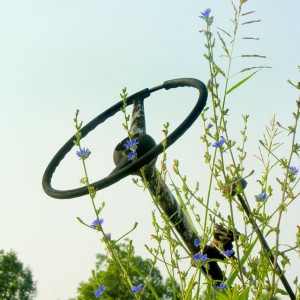
weeds and tractor steering wheel

By Eve Mitchell

In 2009 Swiss biotech giant Syngenta made a bold prediction that by 2013 a quarter of U.S. cropland would be infested with glyphosate-resistant superweeds. I heartily congratulate Syngenta for its foresight, if not the response to it. By January 2013, 61.2 million acres of U.S. farmland suffered from an increasingly stubborn case of superweeds. So Syngenta was being uncharacteristically modest – around one third of the 185 million acres of U.S. land planted with corn, cotton and soy has weeds that can’t be killed by normal means, adding significantly to the cost and effort of farming.

As 2013 drew to a close, a new Union of Concerned Scientists (UCS) policy brief reported that, in fact, “Almost 50 percent of surveyed farms are infested with glyphosate-resistant weeds, and the rate of these weeds’ spread has been increasing.” UCS added:

“Herbicide-resistant weeds are also symptomatic of a bigger problem: an out-dated system of farming that relies on planting huge acreages of the same crop year after year. This system, called monoculture, has provided especially good habitat for weeds and pests and accelerated the development of resistance. In response, Monsanto and its competitors are now proposing to throw more herbicides at resistant weeds, an approach that ignores the underlying biology of agricultural systems and will inevitably lead to more resistance and a further spiraling up of herbicide use.”

The rapid spike in the use of Monsanto’s best-selling weed killer glyphosate in the U.S. is closely linked to the uptake of genetically modified (GM) crops designed to be used with the brand name version of the chemical (Roundup). As widely predicted by both industry and GM skeptics, problematic weeds like Palmer amaranth quickly developed resistance to Roundup and are spreading fast as farmers struggle to kill them with combinations of chemicals in heavier concentrations, or simply resorting to hand weeding hundreds of acres of fields. The problem is so serious in the Southern U.S. that UCS reports, “92 percent of cotton and soybean fields are infested as a result of Roundup Ready crops.” Superweeds are also causing escalating problems in other countries with heavy GM crop use, including in the soy fields of Argentina and Brazil upon which the EU is so reliant to fuel its factory farms.

Clones, the Commission and Ethical Contortionism

Categories

Food

By Eve Mitchell

The European Commission’s proposed Directives on clones in the food chain fall woefully short of what citizens want and the Parliament demands.

The draft laws are not all they appear to be at first glance. One draft Directive “provisionally prohibits” cloning farm animals and the sale of farm clones or clone embryos. The other “provisionally prohibits” the sale and import of food from clones. Once enshrined in law the Directives would be reviewed to enable any “improvements” in cloning techniques that reduce animal suffering to be taken into account in future regulation.

Any prohibition of cloning is welcome, based as it is on the acknowledgement that cloning for food is unwanted and unconscionably cruel, but it‘s not enough.

The draft laws do not prohibit the sale of food from the offspring of clones, which renders them next to useless in the real world. The Commission emphasises, “[C]loning is so expensive that its use for food production is not lucrative.” This is a tacit admission that the proposed measures don’t actually tackle the real problem – food from cloned offspring.

It was a Bad Idea in 1489…

Categories

Food

By Eve Mitchell

Some things get better with age — fine wine, farmhouse cheese. Some just don’t.

It’s all the fashion these days to talk about a “new” way to ensure that companies involved in food production are held accountable for the environmental damage they do. Often called natural capital accounting or offsetting, the theory is that if we attach a notional price to, say, healthy soil and clean water, then companies can use that information to account for any damage they do, or be somehow rewarded for avoiding this damage.

Among the several difficulties with this approach are that (a) it isn’t new and (b) it doesn’t work.

To the folks promoting this stuff: please convince me that this isn’t an extension of the Enclosures and Clearances on a global scale, because it sure feels like it.