

Hallucinating hydrogen: Why the PCI/PMI process must be overhauled

Categories

Fossil FuelsDemocracyClimate

In December 2025, the European Commission published the second Projects of Common and Mutual Interest (PCI/PMI) aiming to grant priority status to a record number of cross-border hydrogen infrastructure projects. It includes 108 hydrogen related projects: 59 transmission pipelines, 21 electrolysers, 19 storage facilities and 9 reception terminals. Food & Water Action Europe and Bankwatch CEE analysed all hydrogen projects on the PCI/ list and compiled the alarming findings in this new report: “Hallucinating hydrogen: Why the PCI/PMI process must be overhauled”.

More than two-thirds of the hydrogen pipelines on the list – 42 out of 59 – are likely to transport fossil-fuel-based hydrogen for decades. And seven of them are rebranded gas projects. Few, if any, electrolyser projects are set to include additional renewable electricity capacity; most will rely on grid power, which risks cannibalising existing power generation. Although far from economically viable, hydrogen import terminals aim to receive mostly fossil-fuel-based ammonia. The use of hydrogen derived from fossil fuels will undermine the EU’s current plans to limit dependence on fossil fuel imports.

The scale of the planned hydrogen infrastructure far exceeds the current level of hydrogen economy development in the EU, and is out of touch with realistic forecasts for renewable hydrogen production and demand. This creates a serious risk of stranded assets if these projects are ever built. Even in the best case scenario, it would still mean wasting public funds on expensive feasibility studies and permitting procedures, which could amount to tens of millions of euros, based on recent Connecting Europe Facility (CEF) calls. 

Governance flaws in the TEN-E framework are one of the reasons for this outcome. ENTSOG retains control over infrastructure planning, scenario development and cost–benefit analyses, despite its clear conflicts of interest, which have been repeatedly flagged by the EU Agency for the Cooperation of Energy Regulators (ACER), the European Scientific Advisory Board on Climate Change (ESABCC) and civil society. The result is a self-reinforcing cycle in which gas incumbents define ‘system needs’, shape the methodology used to assess candidate projects, and then evaluate projects proposed by their own members. 

The Council and Parliament must reject the current Delegated Act on PCIs and PMIs, as it would support an oversized network running on fossil-based hydrogen. Alternatively, it risks creating costly stranded assets. 

Upcoming reforms to the TEN-E Regulation must curb the influence of the fossil-fuel industry, ensure democratic oversight, and end public funding for fossil-based hydrogen and related infrastructure. The EU’s hydrogen plans must focus on local and fully renewable production used only in sectors that cannot be directly electrified. Overall, the EU’s energy planning and financing must prioritise electrification and proven renewable technologies, such as interconnections, smart grids, and renewable integration, as the most efficient path to decarbonisation.

Check out the full report for more details!
DOWNLOAD PDF


European Commission fuels hydrogen fantasies – but MEPs can still halt the next array of fossil fuel follies

Categories

Fossil FuelsClimate

A bill tabled today by the European Commission foresees a massive build-up of hydrogen projects, despite growing expert consensus that hydrogen can only thwart Europe’s decarbonisation efforts. 

The Commission’s Delegated Regulation on Projects of Common Interest (PCIs) and Projects of Mutual Interest (PMIs), unveiled today, includes a list of European transboundary energy infrastructure projects that the Commission and Member States intend to prioritise and subsidise. Over a hundred of these are hydrogen infrastructure projects, the bulk of which are pipelines designed to carry fossil-gas-based hydrogen. 

Members of the European Parliament (MEPs) and the Council of the European Union now have two months to scrutinise the proposed regulation and raise any objections. If none are forthcoming, the regulation will enter into force. Though the PCI/PMI list itself cannot be amended at this stage, MEPs – recognising the urgency of raising the EU’s climate ambition – can and should reject the list for the misguided direction it takes. 

The PCI/PMI process is meant to facilitate the EU’s energy transition by identifying cross-border projects of strategic importance. Projects awarded this preferential status enjoy privileged access to EU public financing and expedited permitting. 

Worryingly, over 80 per cent of the hydrogen projects on the PCI/PMI list have been proposed by the fossil fuel industry, with more than 90 per cent of the hydrogen pipelines tabled by members of the European Network of Transmission System Operators for Gas (ENTSOG) – the lobby group for Europe’s gas transmission operators – according to an analysis by Food & Water Action Europe. 

The result is an important policy instrument that risks perpetuating Europe’s fossil gas habit and birthing an entire cohort of costly stranded assets. 

Civil society has repeatedly urged decision makers to limit hydrogen development to hard-to-abate sectors and to ensure it runs exclusively on renewable sources of energy. Several bogus projects proposed for PCI/PMI status have since been dropped following heavy scrutiny, not least from civilsociety, yet many others remain. 

‘Most of the hydrogen projects on the PCI/PMI list will transport, store or receive large quantities of fossil-based hydrogen. The proposed hydrogen network is disproportionate. The electrolysers included are not linked to any additional dedicated renewable sources of energy, which will vampirise the remaining energy needed for the transition. For these reasons, this list must be rejected,’ says Eliot Garnier-Karcenti, Senior Energy Advisor at Food & Water Action Europe.

‘We join the EU’s own advisory bodies – the European Scientific Advisory Board on Climate Change (ESABCC) and the EU Agency for the Cooperation of Energy Regulators (ACER) – in questioning the credibility of the PCI and PMI selection process and its implications for the EU’s decarbonisation efforts. The process still grants a central role to ENTSOG, an industry body representing the very companies that stand to profit from PCI and PMI status. This inherent conflict of interest undermines trust in the system. The TEN-E Regulation – and the PCI/PMI process it governs – must shift decisively towards rapid electrification and demand-side flexibility, rather than keeping these solutions on an equal footing with fossil fuel interests,’ says Gligor Radečić, Gas Campaign Leader at CEE Bankwatch Network.

For additional information, please contact: 

Eliot Garnier-Karcenti 
Senior Energy Advisor, Food & Water Action Europe
egarnierkarcenti(at)fweurope.org
+33 6 34 31 56 20
LinkedIn: https://linkedin.com/in/eltgk/ 

 Gligor Radečić 
Gas Campaign Leader, CEE Bankwatch Network
gligor.radecic(at)bankwatch.org 

Fossil fuel lobbyists undermining energy crisis measures across Europe

Categories

Fossil FuelsClimate

Brussels, 25 October 2023 – Lobbyists for the fossil fuel industry have successfully pressed governments and the EU to undermine measures meant to reduce household bills, protect people from energy poverty and tax windfall profits during the energy crisis, new research from the Fossil Free Politics campaign and national partners shows. 

Case studies from Italy, Spain, the Czech Republic, the UK and at the EU level in Brussels has revealed that the oil and gas companies profiting from the energy crisis have lobbied to weaken and delay windfall taxes, scupper protections for households struggling to pay, and even get clearance for new drilling.

Chloé Mikolajczak, Fossil Free Politics coalition co-ordinator said: “Europe’s addiction to fossil fuels has created this energy crisis, and the companies most responsible are lobbying to claw even more profit from it at the expense of households struggling to pay the skyrocketing bills. Asking oil companies to advise on this crisis is like asking a fox to consult on henhouse design. Politicians have a responsibility to protect people – from climate breakdown, and from corporate greed – so they have to put a firewall between their decisions and the companies behind this destruction.”

The research comes as the calls for a firewall between the fossil fuel industry and climate and energy policymaking become louder. Members of the European Parliament, from four political groups, today launched a new pledge for fossil free politics in Europe, with the aim of gathering more signatures towards the elections, and over 100 civil society organisations and trades unions published a declaration calling for the same. This comes after 100,000 signed a petition to kick the fossil fuel industry out of politics.

Key findings of the research

In Italy, where the government has appointed a fossil fuel lobbyist as an advisor, oil and gas giant ENI has used the crisis to secure more drilling and new liquified gas terminals. 

In the Czech Republic, energy giant EPH used public threats, a powerful media empire and ties to the ruling political party to delay and weaken the windfall tax on excess profits. 

In the UK, fossil fuel lobby group Offshore Energies UK used privileged access, parliamentary receptions and special advisory groups to ensure the windfall tax is weakened and full of loopholes. 

In Spain, energy companies Endesa, Naturgy and Iberdrola have used a complex web of political, legal and PR manoeuvres, including a series of employees moving to or coming from Spain’s top legal civil servants, to fight measures that curb their profits and to make vulnerable families bear the financial burden instead of them. 

At EU-level, oil and gas lobby group International Association of Oil & Gas Producers has lobbied – and been invited to advise – the European Commission, pushing for more fossil gas and other technologies to extend gas’s lifetime like unproven carbon capture or hydrogen infrastructure, advice that will keep bills high and Europe hooked on fossil fuels.

Follow Fossil Free Politics at: www.twitter.com/FossilFreeEU 

Fossil Free Politics is a European-wide coalition which campaigns for a firewall between the fossil fuel industry and climate policy. It is coordinated by Corporate Europe Observatory, Food and Water Action Europe, Friends of the Earth Europe, Global Witness and Greenpeace EU.

EU Transparency Register: 461250348032-23

Fracking – Coming To Your Doorstep

Categories

LNGFossil FuelsClimate

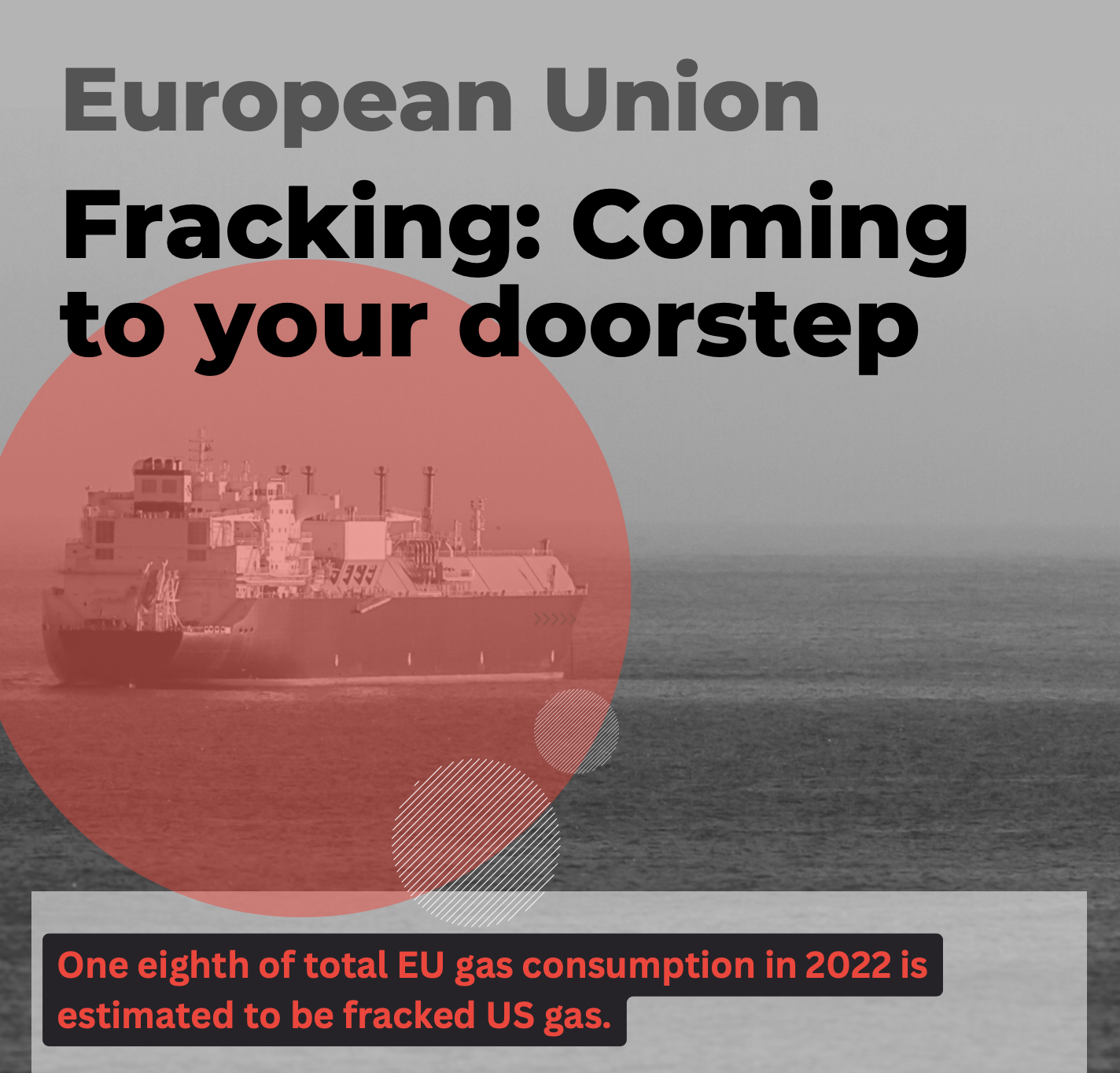
One eighth of total EU gas consumption in 2022 is estimated to be fracked U.S. gas.

Imports of US gas into the EU represent 23% of the fossil gas consumption in the 11 EU LNG importer countries, and 14% of total EU27 gas consumption – and almost all of it is fracked. Fracking is a disaster for our climate and for communities affected by the brutal drilling method. Europe must swiftly move off all fossil gas for a safe liveable future.

  • 12% of the gas running in pipelines in the EU could be fracked US gas
  • Shipments of US gas to the EU have increased by 150% between 2021 & 2022
  • The biggest fracked US gas importer in 2022 was France, followed by Spain and The Netherlands
  • Europe’s gigantic LNG infrastructure build out plans do not match supply and will not provide real energy security

Read the full briefing here.

LNG – Der Flüssige Weg ins Klimachaos

Categories

Fossil Fuels


Hier geht’s zum LNG-Papier (Deutsch).

‘Liquefied Natural Gas’ (LNG) – Flüssigerdgas steht im Rampenlicht. Die Kosten für fossiles Gas steigen seit 2021 und die furchtbare Invasion der Ukraine durch russische Streitkräfte zwingt Regierungen sich mit der Frage zu befassen, wie die Abhängigkeit Europas von fossilen Energieträgern aus Russland beendet werden kann. Zusammen mit der Notwendigkeit so schnell wie möglich von fossilen Brennstoffen wegzukommen, um die Auswirkungen des Klimawandels zu begrenzen und die globale Erwärmung unter 1,5°C zu halten, haben diese Realitäten Aufregung um LNG erzeugt. Was jedoch ist LNG und warum ist es wichtig? Das vorliegende Papier ist als Warnung davor zu verstehen, was die Ausbreitung von LNG als vermeintliche Lösung für Fragen der Energiesicherheit in Europa anrichten könnte. Es wird zehn Hauptargumente anführen, die die zahlreichen Probleme aufzeigen, die LNG mit sich bringt.

Lesen Sie hier das LNG-Papier auf Deutsch

New survey of fossil gas companies shows gas industry climate strategies are business as usual

Categories

Fossil Fuels

Brussels, 18 May 2022 – There is no doubt that meeting global climate goals will require a rapid transition away from fossil fuels. This task – already a monumental challenge – is complicated by the fact that the fossil gas industry is advancing  false solutions that seem primarily designed to preserve their  business models.

A new market survey from two German NGOs, Deutsche Umwelthilfe (DUH) and urgewald, reveals a shocking lack of knowledge among fossil gas companies about their own methane emissions, and massive inconsistencies in industry climate strategies that rely on pseudo-solutions such as fossil hydrogen to extend fossil gas use.

While all 12 responding companies proclaim a desire to become climate neutral by 2050 at the latest, there is little to no awareness that fossil gas consumption needs to be radically reduced in the short-term, and that the power and heating sectors must shift to clean alternatives. Instead of credible plans to move out of fossil gas, company climate strategies present measures such as carbon capture and storage (CCS) and gradual replacement with green and low-carbon gases as ways to make gas “clean” in the long term. Many are even planning to shift from coal to fossil gas as part of their climate strategies.

The industry is pinning particularly high hopes  on hydrogen, which is a risky bet. Available hydrogen quantities will be too limited for a large-scale use, and using hydrogen for heat and power generation is among the most inefficient uses of the fuel.

Four companies are also actively pursuing fossil hydrogen, such as ‘blue’ or ‘turquoise’ hydrogen, which is linked to the extraction and processing of fossil gas. 1.7 GW of total blue hydrogen capacity is already in the pipeline among surveyed companies. Fossil hydrogen plans are industry’s smokescreen for more fossil fuel use, to the detriment of the planet, climate and people. While turquoise hydrogen is still in the experimental stages and highly expensive, studies show that blue hydrogen produced from fossil fuels may be more climate-damaging than burning coal or fossil gas. The CCS technology associated with blue hydrogen production, which promises to capture fugitive CO2 emissions, is not only expensive and inefficient, but it is also unable to effectively stop methane leaks and requires huge amounts of electricity.

The survey indicates that nine companies have plans to expand their electrolysis capacity, up to 10GW by 2030, but only two companies will focus on 100% renewable-based hydrogen projects. Only green hydrogen produced by the electrolysis of water and using electricity from renewable sources has a real climate benefit. However, its application needs to be limited to priority uses, and not the “blending” projects where small amounts of green hydrogen are injected into existing fossil gas pipelines. Such plans would only maintain operational the fossil gas network.

That very fossil gas network represents a key climate problem. Methane is the main component of fossil gas and a super-potent greenhouse gas (GHG). Methane leakages occur along the entire fossil gas value chain, including during fossil hydrogen production, and the survey shows that companies do not control these emissions effectively. Only four of the surveyed companies were able to provide details on detected methane leaks from their own infrastructure, while leak detection and repair campaigns are conducted at most annually, if at all.

Although climate science is clear about the need to transition away from fossil fuels altogether, only two companies have set a clear timeline for phasing out fossil gas by 2040. Additionally, none of the fossil fuel producing companies surveyed envisages targets to halt extraction activities. This is in clear disagreement with the latest IPCC report on mitigation of climate change, which reminds us that greenhouse gas emissions need to peak before 2025 to limit global warming below 1.5°C.

As the EU is under pressure to cut Russian energy imports, the fossil industry is desperate to keep fossil gas in the future energy mix. Fossil companies distract people by investing in pseudo-solutions, while they leave the door open to fossil gas after 2030 and 2035. This is further encouraged by some Member States, such as Germany, which are ready to implement new projects to transport blue hydrogen and are pursuing massive LNG expansion plans.

It is clearly not enough to rely on voluntary industry commitments to achieve the kinds of pollution reductions that are necessary. Strong government regulations are needed to prevent the global phase-out of coal from leading to the increased use of fossil gas and to ensure that energy companies comply with the Paris climate target rather than undermining it by betting on fig-leaf solutions.


Contact:

Enrico Donda, [email protected]
Julian Schwartzkopff, [email protected]