

Hallucinating hydrogen: Why the PCI/PMI process must be overhauled

Categories

Fossil FuelsDemocracyClimate

In December 2025, the European Commission published the second Projects of Common and Mutual Interest (PCI/PMI) aiming to grant priority status to a record number of cross-border hydrogen infrastructure projects. It includes 108 hydrogen related projects: 59 transmission pipelines, 21 electrolysers, 19 storage facilities and 9 reception terminals. Food & Water Action Europe and Bankwatch CEE analysed all hydrogen projects on the PCI/ list and compiled the alarming findings in this new report: “Hallucinating hydrogen: Why the PCI/PMI process must be overhauled”.

More than two-thirds of the hydrogen pipelines on the list – 42 out of 59 – are likely to transport fossil-fuel-based hydrogen for decades. And seven of them are rebranded gas projects. Few, if any, electrolyser projects are set to include additional renewable electricity capacity; most will rely on grid power, which risks cannibalising existing power generation. Although far from economically viable, hydrogen import terminals aim to receive mostly fossil-fuel-based ammonia. The use of hydrogen derived from fossil fuels will undermine the EU’s current plans to limit dependence on fossil fuel imports.

The scale of the planned hydrogen infrastructure far exceeds the current level of hydrogen economy development in the EU, and is out of touch with realistic forecasts for renewable hydrogen production and demand. This creates a serious risk of stranded assets if these projects are ever built. Even in the best case scenario, it would still mean wasting public funds on expensive feasibility studies and permitting procedures, which could amount to tens of millions of euros, based on recent Connecting Europe Facility (CEF) calls. 

Governance flaws in the TEN-E framework are one of the reasons for this outcome. ENTSOG retains control over infrastructure planning, scenario development and cost–benefit analyses, despite its clear conflicts of interest, which have been repeatedly flagged by the EU Agency for the Cooperation of Energy Regulators (ACER), the European Scientific Advisory Board on Climate Change (ESABCC) and civil society. The result is a self-reinforcing cycle in which gas incumbents define ‘system needs’, shape the methodology used to assess candidate projects, and then evaluate projects proposed by their own members. 

The Council and Parliament must reject the current Delegated Act on PCIs and PMIs, as it would support an oversized network running on fossil-based hydrogen. Alternatively, it risks creating costly stranded assets. 

Upcoming reforms to the TEN-E Regulation must curb the influence of the fossil-fuel industry, ensure democratic oversight, and end public funding for fossil-based hydrogen and related infrastructure. The EU’s hydrogen plans must focus on local and fully renewable production used only in sectors that cannot be directly electrified. Overall, the EU’s energy planning and financing must prioritise electrification and proven renewable technologies, such as interconnections, smart grids, and renewable integration, as the most efficient path to decarbonisation.

Check out the full report for more details!
DOWNLOAD PDF


Fossil fuel lobbyists undermining energy crisis measures across Europe

Categories

Fossil FuelsClimate

Brussels, 25 October 2023 – Lobbyists for the fossil fuel industry have successfully pressed governments and the EU to undermine measures meant to reduce household bills, protect people from energy poverty and tax windfall profits during the energy crisis, new research from the Fossil Free Politics campaign and national partners shows. 

Case studies from Italy, Spain, the Czech Republic, the UK and at the EU level in Brussels has revealed that the oil and gas companies profiting from the energy crisis have lobbied to weaken and delay windfall taxes, scupper protections for households struggling to pay, and even get clearance for new drilling.

Chloé Mikolajczak, Fossil Free Politics coalition co-ordinator said: “Europe’s addiction to fossil fuels has created this energy crisis, and the companies most responsible are lobbying to claw even more profit from it at the expense of households struggling to pay the skyrocketing bills. Asking oil companies to advise on this crisis is like asking a fox to consult on henhouse design. Politicians have a responsibility to protect people – from climate breakdown, and from corporate greed – so they have to put a firewall between their decisions and the companies behind this destruction.”

The research comes as the calls for a firewall between the fossil fuel industry and climate and energy policymaking become louder. Members of the European Parliament, from four political groups, today launched a new pledge for fossil free politics in Europe, with the aim of gathering more signatures towards the elections, and over 100 civil society organisations and trades unions published a declaration calling for the same. This comes after 100,000 signed a petition to kick the fossil fuel industry out of politics.

Key findings of the research

In Italy, where the government has appointed a fossil fuel lobbyist as an advisor, oil and gas giant ENI has used the crisis to secure more drilling and new liquified gas terminals. 

In the Czech Republic, energy giant EPH used public threats, a powerful media empire and ties to the ruling political party to delay and weaken the windfall tax on excess profits. 

In the UK, fossil fuel lobby group Offshore Energies UK used privileged access, parliamentary receptions and special advisory groups to ensure the windfall tax is weakened and full of loopholes. 

In Spain, energy companies Endesa, Naturgy and Iberdrola have used a complex web of political, legal and PR manoeuvres, including a series of employees moving to or coming from Spain’s top legal civil servants, to fight measures that curb their profits and to make vulnerable families bear the financial burden instead of them. 

At EU-level, oil and gas lobby group International Association of Oil & Gas Producers has lobbied – and been invited to advise – the European Commission, pushing for more fossil gas and other technologies to extend gas’s lifetime like unproven carbon capture or hydrogen infrastructure, advice that will keep bills high and Europe hooked on fossil fuels.

Follow Fossil Free Politics at: www.twitter.com/FossilFreeEU 

Fossil Free Politics is a European-wide coalition which campaigns for a firewall between the fossil fuel industry and climate policy. It is coordinated by Corporate Europe Observatory, Food and Water Action Europe, Friends of the Earth Europe, Global Witness and Greenpeace EU.

EU Transparency Register: 461250348032-23

Fracking – Coming To Your Doorstep

Categories

LNGFossil FuelsClimate

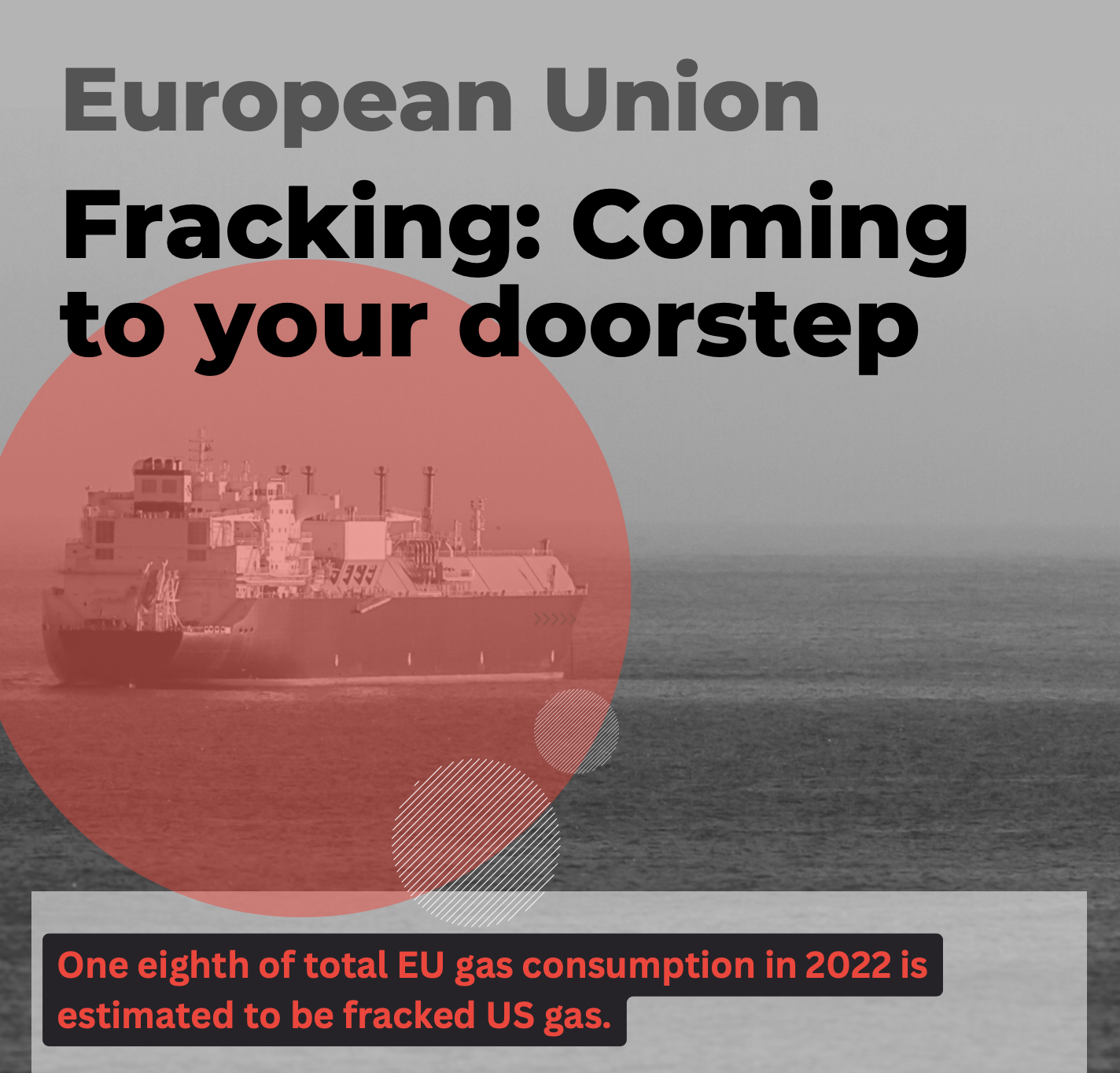
One eighth of total EU gas consumption in 2022 is estimated to be fracked U.S. gas.

Imports of US gas into the EU represent 23% of the fossil gas consumption in the 11 EU LNG importer countries, and 14% of total EU27 gas consumption – and almost all of it is fracked. Fracking is a disaster for our climate and for communities affected by the brutal drilling method. Europe must swiftly move off all fossil gas for a safe liveable future.

  • 12% of the gas running in pipelines in the EU could be fracked US gas
  • Shipments of US gas to the EU have increased by 150% between 2021 & 2022
  • The biggest fracked US gas importer in 2022 was France, followed by Spain and The Netherlands
  • Europe’s gigantic LNG infrastructure build out plans do not match supply and will not provide real energy security

Read the full briefing here.

LNG – Der Flüssige Weg ins Klimachaos

Categories

Fossil Fuels


Hier geht’s zum LNG-Papier (Deutsch).

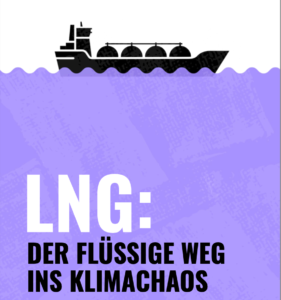
‘Liquefied Natural Gas’ (LNG) – Flüssigerdgas steht im Rampenlicht. Die Kosten für fossiles Gas steigen seit 2021 und die furchtbare Invasion der Ukraine durch russische Streitkräfte zwingt Regierungen sich mit der Frage zu befassen, wie die Abhängigkeit Europas von fossilen Energieträgern aus Russland beendet werden kann. Zusammen mit der Notwendigkeit so schnell wie möglich von fossilen Brennstoffen wegzukommen, um die Auswirkungen des Klimawandels zu begrenzen und die globale Erwärmung unter 1,5°C zu halten, haben diese Realitäten Aufregung um LNG erzeugt. Was jedoch ist LNG und warum ist es wichtig? Das vorliegende Papier ist als Warnung davor zu verstehen, was die Ausbreitung von LNG als vermeintliche Lösung für Fragen der Energiesicherheit in Europa anrichten könnte. Es wird zehn Hauptargumente anführen, die die zahlreichen Probleme aufzeigen, die LNG mit sich bringt.

Lesen Sie hier das LNG-Papier auf Deutsch

MEPs fail to end Europe’s fossil fuel dependency, locking Europe into further gas volatility

Categories

Fossil Fuels

BRUSSELS, 9TH MARCH 2022 – Today, Members of the European Parliament voted to approve a list of priority energy projects, including 30 cross-border gas mega projects

Most MEPs voted in favour of the so-called fifth Projects of Common Interest (PCI) list, giving the 30 cross-border gas infrastructure projects faster permitting procedures and the opportunity to access EU public funds [1].  

Eilidh Robb, Fossil Fuel Campaigner at Friends of the Earth Europe commented: 

“Today MEPs have voted to pour yet more public money into fossil fuel infrastructure that will lock households into a dirty energy system that people and planet simply cannot afford.  Parliamentarians have failed to break the cycle of destruction and to speed-up the transition we desperately need away from fossil fuels and to warm homes and clean, secure, renewable energy.”

Frida Kieninger, Director of EU Affairs at Food & Water Action Europe states: 

“The dark times we live in show clearer than ever that Europe’s fossil fuel dependence brings harm, energy poverty and insecurity. The answer to this must not be creating more fossil gas dependence through 30 massive fossil gas pipelines and LNG projects worth €13 billion. The answer must be putting all possible support behind 100% renewable energy and energy efficiency.

***

Notes to Editor: 

Please note that MEPs were asked whether or not they wanted to vote in support of the motion of rejection, or against the motion of rejection.This means that a + vote is a vote to reject the 5th PCI list and a – is a vote to accept the 5th PCI list as it stands.


[1] 5th PCI List Plenary Vote Resolution B9-0137/2022: 696 total votes, 497 against the motion for rejection, 177 in support of the motion for rejection, 22 abstained. 

4th PCI List Plenary Vote Resolution B9-0091/2020: 648 total votes, 443 against the motion for rejection, 169 in support of the motion for rejection, 36 abstained. 


Relevant Links: 

Motion for Rejection of 5th PCI List 

5th Projects of Common Interest List 

FAQ on Rejecting the 5th PCI List


Contact:
Eilidh Robb (EN) +32 (0) 493 93 50 79, [email protected]

Frida Kieninger (EN, DE, ES, FR) +32 (0) 487 24 99 05, [email protected] 

EU Methane Regulation – the lack of ambition will fail climate goals

Categories

Fossil Fuels

BRUSSELS: Methane emissions resulting from the petrochemical industry’s extraction and production of coal, gas and oil are responsible for 25 per cent of overall global warming – but a new Methane Regulation unveiled today by the European Commission is a half-hearted step back from EU climate goals.

Campaigners from the London-based Environmental Investigation Agency (EIA), Brussels- based Food & Water Action Europe (FWAE) and Berlin-based Deutsche Umwelthilfe (DUH) warned the Regulation is letting fossil fuel imports off the hook.

Methane emissions are 86 times more potent than carbon dioxide and tackling the energy sector has been identified as the most cost effective way of reducing them.

The Commission’s Regulation puts in place a framework with obligations on measurement, reporting and verification (MRV), leak detection and repair (LDAR) and a ban on routine venting and flaring (BRVF) of gases, which are the three main pillars of effective methane emissions mitigation.

Despite numerous calls from European policymakers and recommendations from leading NGOs, the Regulation lacks a key element – extending the framework to all oil, gas and coal consumed in the EU, imports included, and to the petrochemical sector.

The EU imports more than 80 per cent of the fossil gas, 90 per cent of the crude oil and 40 per cent of the coal it consumes, long after methane has been emitted outside EU borders.

EIA Climate Campaigner Kim O’Dowd said: “The Commission is hiding behind excuses. With this regulation, the EU will continue to drive global methane emissions in other countries, turning a blind eye to its role.

“In the context of the Global Methane Pledge to take action on these emissions –launched and adopted by the US, EU and others at the UN CoP26 climate change summit in November – the EU should be irreproachable, but this proposal sends completely the wrong message, effectively saying it’s okay for the EU and other countries to pledge and pontificate at the podium and then dally and dither at home.”

Any methane reduction initiative not linked to a phase-out of fossil fuels falls dangerously short of the necessary climate action. In October, MEPs asked, in a resolution on the EU strategy to reduce methane emissions, to phase-out all fossil fuels as soon as possible, but today’s proposal ignores the Parliament’s position.

As a major importer of fossil gas and oil, the EU must work on cutting methane emissions along the whole supply chain and, in the meantime, implement phase-out plans to get rid of oil, fossil gas and coal.

There is no way the EU can cut methane emissions fast enough and promote a sustainable energy transition while still investing in climate-harming fossil fuels.

Fossil gas consists almost entirely of methane, pollutes air and water with numerous hazardous substances and contributes to environmental destruction on top of inherently leading to methane emissions. While cutting methane emissions is important to reduce the climate impact of fossil fuels, it risks being used to support false sustainability claims by the oil and gas companies.

Food & Water Action Europe Campaigner Enrico Donda said: “Fossil gas, even with reduced methane emissions, is neither clean nor a ‘bridge fuel’ and the Commission proposal fails to make this clear. All gas infrastructure is prone to leaks and a serious methane law should stop the development of new fossil gas infrastructure such as pipelines and LNG (Liquified Natural Gas) terminals, used to reception and unload gas from the cargo shipped mainly from the US, Qatar and Russia”.

The European Parliament must now protect the ambition it showed in its own initiative report on the Methane Strategy, which called for extending the framework across the supply chain and to the petrochemical sector.

Members of the European Parliament and the Council of the European Union now have the opportunity to improve the proposal.

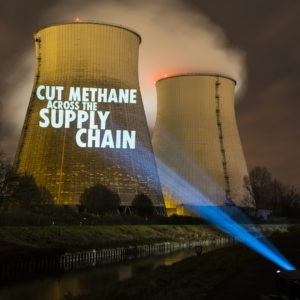
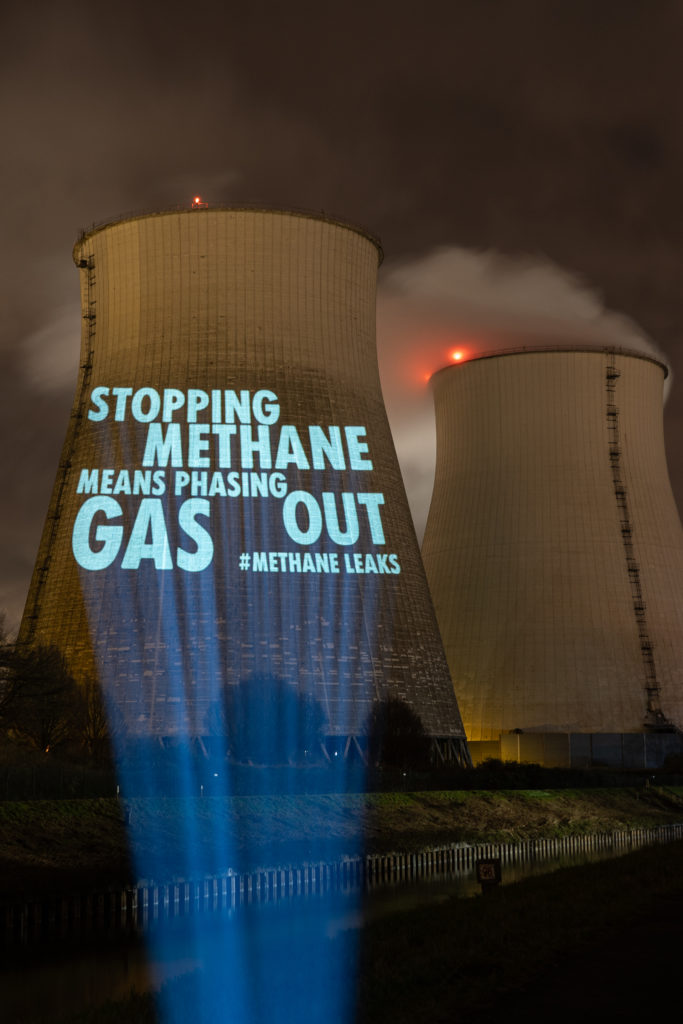
Pictures. Monday 13 Dec, local anti-gas activists TegenGas and the Gastivists Collective projected slogans and infrared images of methane leakage from around Europe to criticize the lack of ambition in EU methane Regulation. More high-quality images here: https://www.flickr.com/photos/192587475@N02/albums/72157720207985773

CONTACTS FOR MEDIA

  • Tim Grabiel, EIA Senior Lawyer, timgrabiel[at]eia-international.org
  • Enrico Donda, FWAE Gas Campaigner, edonda[at]fweurope.org
  • Paul Newman, EIA Senior Press & Communications Officer, press[at]eia-international.org
  • Neal Huddon-Cossar, [email protected], +39 345 44 70 749


EDITORS’ NOTES

  1. The Environmental Investigation Agency (EIA) investigates and campaigns against environmental crime and abuses. Our undercover investigations expose transnational wildlife crime, with a focus on elephants, pangolins and tigers, and forest crimes such as illegal logging and deforestation for cash crops such as palm oil; we work to safeguard global marine ecosystems by tackling plastic pollution, exposing illegal fishing and seeking an end to all whaling; and we address the threat of global warming by campaigning to curtail powerful refrigerant greenhouse gases and exposing related criminal trade.
  2. Food & Water Action Europe (FWAE) is the European programme of Food & Water Watch, a non-profit organisation based in the US. FWAE works to create a healthy future for generations to come – a world where all people have the resources they need, including wholesome food, clean water and sustainable energy. We campaign for a 100 per cent sustainable energy transition, this implies ending EU and national fossil fuels subsidies and drastically cutting GHG emissions. This requires organising people from all over the world to engaging in a large movement with the political power to make our democratic process work for us all.
  3. Environmental Action Germany (Deutsche Umwelthilfe e.V.- DUH) was founded in 1975. The organisation is politically independent, recognised as a non-profit organisation, entitled to bring legal action and it campaigns mainly on a national and European level. Environmental Action Germany supports all sustainable ways of life and economic systems that respect ecological boundaries. At the same time, the organisation fights for the preservation of biological diversity and the protection of natural assets as well as for climate protection. DUH is convinced that only energy supplies based on efficiency and regenerative energies, sustainable mobility, the respectful handling of our natural resources and the avoidance of waste will secure life on our planet.